


 Preview
 Send
Send Share
Share
 Details
 Guide
Guide

 Download
 Similars
 X-Ray
X-Ray Diaporama
 Stats
Statsuntitled (7630)

 Read More
Giclée / Art Print
Museum-quality giclée or canvas print with fast production and flexible finish options. ( Buy Hand Made Painting Switch to Digital Image)




P118B $10

P118H $10

P118W $10

P438Z $10

P508JH $12

P508YH $12

P805H $10

P805Z $10

P919BZ $10

P919G $10

P919XJ $10

P959ZH $10

P968JZ $12

W106C $8

W218G $10

W218JH $8

W218Y $10

W307PJ $10

W316G $10

W316PJ $8

W316Y $10

W398PJ $8

W4111J $10

W500HY $15

W500JH $15

W692G $12

W849H $8

W940BG $15

W953PJ $8




Pick from our preset sizes that match the artwork's original proportions.

Type the width and the height you need, to fit your frame or your wall. A print can only be cut, never made bigger than the picture, so a size with a different shape loses a part of the image. We send you a digital mockup to approve before we print anything. The picture shown on this page does not show the real cut — only the mockup does.
Worldwide Delivery () in 2 weeks instead of standard 4/5 weeks. (27 October)

Free Worldwide Express Shipping

High-Quality Linen Canvas

Full Shipping Insurance

Customs Tax Refund Guarantee

True Color Matching Guarantee

100-Day Return Policy (Defects Only)

100% Money-Back Guarantee

Bulk Discount Offer
 Glass option is only available in size under 110 CM

untitled (7630)
Giclée / Art Print
Reproduction Size
-


Total Price
$ 65
A Stark Portrait of Isolation: Unveiling Egon Schiele's "Untitled (7630)"
Egon Schiele’s “Untitled (7630),” a deceptively simple black and white composition, is far more than a depiction of a modest house with a steeple. It’s a concentrated distillation of anxiety, mortality, and the profound loneliness that permeated the artist's life and work. Created around 1912-1914, during a period of intense personal turmoil and artistic experimentation, this painting offers a haunting glimpse into Schiele’s psychological landscape – a world where architectural solidity clashes with an underlying sense of unease. The photograph itself presents a stark, almost photographic quality, emphasizing the textures of the building materials and the subtle shifts in light and shadow, lending it a timelessness that belies its intensely personal origins.
Architectural Echoes and Symbolism’s Weight
The scene is dominated by a modest dwelling, its yellow roof a small beacon of warmth against the muted tones. The presence of multiple chimneys speaks to both domesticity and perhaps a hint of confinement – a suggestion that this space, while providing shelter, also holds within it a sense of restriction. A clock hangs prominently on the wall, an insistent reminder of time’s relentless march, further amplifying the painting's themes of mortality and the fleeting nature of existence. The steeple in the background, a traditional symbol of faith and stability, seems oddly isolated, almost dwarfed by the surrounding structures, mirroring the protagonist’s own feeling of being adrift. Schiele frequently employed architectural elements to explore themes of confinement and isolation, using them as visual metaphors for the psychological states he sought to capture.
- The House: Represents stability, but also potential entrapment.
- The Steeple: Symbolizes faith and tradition, juxtaposed with the painting’s overall sense of unease.
- The Clock: A potent symbol of time's passage and the inevitability of death.
Schiele’s Expressionist Vision – Line and Emotion
Executed in a monochrome palette, “Untitled (7630)” exemplifies Schiele’s signature style: bold, expressive lines that convey raw emotion rather than precise representation. The artist's use of line is particularly striking—thick, gestural strokes define the contours of the buildings and create a sense of dynamism within the static composition. This technique, deeply rooted in Expressionism, allows him to imbue the scene with an almost palpable feeling of tension and vulnerability. Schiele’s meticulous attention to detail, particularly in rendering the textures of the walls and roof tiles, adds another layer of complexity to the work, highlighting the contrast between the rough materiality of the buildings and the underlying emotional turmoil.
A Window into a Troubled Soul
Born in Vienna in 1890, Egon Schiele’s life was tragically short, cut short by illness and war. His early exposure to loss—the deaths of his father and sister—deeply impacted his artistic vision, fueling an obsession with mortality and the fragility of human existence. “Untitled (7630)” can be interpreted as a reflection of this personal experience, capturing a sense of isolation and vulnerability that resonates powerfully across time. The painting’s quiet intensity invites viewers to contemplate the darker aspects of the human condition—the anxieties, fears, and uncertainties that lie beneath the surface of everyday life. Reproductions of this work offer a unique opportunity to engage with Schiele's intensely personal vision, allowing us to connect with his emotional world on a profound level.
To explore more about Egon Schiele’s life and art, we encourage you to visit the artwork database or discover the Egon Schiele Art Centrum in Český Krumlov.
Questions & Answers
What is "untitled (7630)" about, and what atmosphere does it have?
"untitled (7630)" by Egon Schiele combines house, steeple, blackwhite, clock, architecture, rural, mortality with a dramatic atmosphere.
How harmonious are the colors of "untitled (7630)" by Egon Schiele?
The colors of "untitled (7630)" by Egon Schiele show a unified palette harmony. Harmony describes how the colors relate to each other.
Can the image of "untitled (7630)" by Egon Schiele be freely reproduced?
"untitled (7630)" by Egon Schiele is in the public domain - its copyright has expired. This status governs how the image of the work may be reproduced.
Related Artworks


Artist Biography
A Life Forged in Expression
Born in 1890 in the Austrian town of Tulln an der Donau, Egon Schiele’s life was a tempestuous journey marked by both extraordinary artistic vision and profound personal hardship. His early years were shadowed by illness and loss; his father succumbed to syphilis when Egon was just fourteen, a tragedy that would deeply resonate within his work, fueling an obsession with mortality and the fragility of existence. Raised initially by his mother and then under the somewhat controlling guardianship of his uncle Leopold Czihaczek, Schiele’s childhood lacked conventional stability but fostered a fiercely independent spirit. Even as a boy, he displayed an intense fascination with trains—a motif that subtly reappeared in later paintings—and a burgeoning talent for drawing, though this was initially met with disapproval from his father who saw it as a distraction from more practical pursuits. The early death of his sister Elvira also cast a long shadow over the young artist’s psyche. These formative experiences instilled within him a sensitivity and an emotional rawness that would become hallmarks of his artistic expression, a constant grappling with themes of life, death, and the human condition.
The Crucible of Vienna: Artistic Development
Schiele's formal artistic training began at the Kunstgewerbeschule (School of Arts and Crafts) in Vienna, but he quickly found himself stifled by its conservative approach. He transferred to the Akademie der bildenden Künste (Academy of Fine Arts), only to become further disillusioned with its rigid academic traditions. This dissatisfaction led him to abandon formal training altogether, choosing instead to forge his own path, a testament to his unwavering artistic conviction. The influence of Gustav Klimt was pivotal during these early years; Schiele admired Klimt’s decorative style and exploration of symbolism, even receiving mentorship from the established artist. However, Schiele soon diverged from Klimt's aesthetic, developing a distinctly individual voice characterized by its stark honesty and psychological intensity. He co-founded the Neues Wiener Kunstgruppe (New Viennese Art Group) in 1909, aligning himself with other progressive artists who challenged the prevailing artistic norms. His early works, often unsettling portraits and self-portraits, began to emerge as powerful statements of emotional turmoil, featuring distorted figures and a palpable sense of vulnerability. These paintings were not merely representations of physical form but explorations of the inner landscape—the anxieties, desires, and fears that haunted the human psyche. He sought to depict not what he *saw*, but what he *felt*.
Raw Emotion and Unflinching Truth
Egon Schiele’s art is immediately recognizable for its raw honesty and psychological depth. He fearlessly confronted themes often considered taboo – sexuality, death, anxiety, isolation – with an unflinching gaze. His distinctive style features elongated figures, contorted poses, and expressive lines that convey a sense of unease and emotional intensity. The human form, particularly the nude, became his primary subject, not as an object of idealized beauty but as a vessel for exploring the complexities of human experience. Self-portraits constitute a significant portion of his oeuvre, offering intimate glimpses into his inner world—a world often marked by loneliness and self-doubt. He didn’t shy away from depicting himself in unflattering or vulnerable poses, revealing a profound level of self-awareness and introspection. Beyond self-portraiture, Schiele created numerous portraits of others, capturing their likenesses with an unsettling realism that seemed to penetrate beneath the surface. His landscapes, while less central to his work than his figurative paintings, demonstrate his mastery of form and color, often reflecting the same emotional intensity as his portraits. The use of line is particularly striking in Schiele’s work; it's not merely a tool for defining shape but an expressive force that conveys emotion and psychological tension. Recurring motifs like the *Physalis* plant – symbolizing death and transience with its delicate, papery husk – further underscore this preoccupation with mortality.
A Legacy Cut Short: Achievements & Significance
Despite facing censorship and legal challenges – including a brief imprisonment for allegedly corrupting minors with his art – Schiele gained recognition within Vienna’s avant-garde circles. His work challenged the conventions of the time, provoking both admiration and outrage. By the time of his untimely death during the Spanish flu pandemic in 1918 at the age of twenty-eight, he had established himself as a leading figure in Austrian Expressionism. Significant works such as Self-Portrait with Physalis, Couple Embracing, and Field Landscape (Kreuzberg near Krumau) stand as testaments to his artistic genius. His influence on subsequent generations of artists is undeniable, particularly those interested in exploring psychological themes and challenging conventional artistic norms. Schiele’s bold approach to form and subject matter continues to resonate with audiences today, making him one of the most important and influential figures in early 20th-century art. His paintings are now held in major museum collections worldwide, including the Leopold Museum in Vienna and the Egon Schiele Art Centrum in Český Krumlov, ensuring his artistic legacy endures. He left behind a body of work that is not merely aesthetically compelling but profoundly human—a testament to the power of art to confront the complexities of existence with honesty, courage, and unwavering vision.
- Key Themes: Mortality, sexuality, isolation, psychological turmoil.
- Influences: Gustav Klimt, Viennese Secession, personal trauma.
- Style Characteristics: Elongated figures, contorted poses, expressive lines, raw emotion.
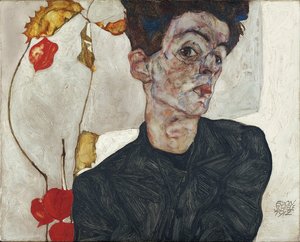
Egon Schiele
1890 - 1918 , Croatia
Quick Facts
- Artistic Movement Or Style: Expressionism
- Artists Or Movements Influenced By This Artist: ['Austrian Expressionism']
- Artists Who Influenced This Artist: ['Gustav Klimt']
- Full Name: Egon Leo Adolf Ludwig Schiele
- Nationality: Austrian
- Notable Artworks:
- Self-Portrait with Physalis
- Couple Embracing
- Field Landscape (Kreuzberg near Krumau)
- Death and the Maiden
- Place Of Birth: Vienna, Croatia
- Date Of Birth: 1890
- Date Of Death: 1918
Related Articles
Monochrome Visions: Exploring the Aesthetic & Historical Significance of Black & White Photography
Explore the rich history & artistic power of black and white photography. From early techniques to iconic masters like Ansel Adams, discover why monochrome continues to captivate art lovers today. Expert insights for collectors.

Dark Masterpieces: 10 Iconic Paintings Dominated by Black Tones |
Explore 10 iconic paintings dominated by black tones, from Rembrandt’s chiaroscuro to Goya's dark expressions. Discover the stories behind these masterpieces & find museum-quality art reproductions for your home at .

Egon Schiele: Expressionism, Anxiety & the Modern Condition – A Comprehensive Exploration
Explore the emotionally charged world of Egon Schiele (1890-1918). Discover his Expressionist masterpieces, psychological themes, and lasting impact on modern art. A comprehensive guide for collectors & enthusiasts.
Egon Schiele's Masterpieces: 25 Paintings That Define Expressionism | AllPaintingsStore
Delve into the haunting world of Egon Schiele with our curated selection of his 25 most iconic Expressionist paintings. Explore the artist's life, technique & emotional depth. Find museum-quality Schiele reproductions and elevate your home decor on AllPaintingsStore.com.

White on Canvas: 10 Masterpieces & Timeless Elegance for Your Home Decor
Explore 10 iconic white paintings by Monet, Whistler & Rothko! Discover the stories behind these serene masterpieces and their impact on art history. Find museum-quality reproductions for your home decor at .


