- Home

- Oil Painting Reproduction
- Eugène Delacroix
- Summer - Diana and Actaeon

 Buy print
 Send
Send Share
Share
 Details

 Download
 Similars
 X-Ray
X-Ray Diaporama
Summer - Diana and Actaeon


 Read More
Hand Made Oil Reproduction
Hand-painted oil on canvas in your size and frame, made to order by our artists.




P118B $10

P118H $10

P118W $10

P438Z $10

P508JH $12

P508YH $12

P805H $10

P805Z $10

P919BZ $10

P919G $10

P919XJ $10

P959ZH $10

P968JZ $12

W106C $8

W218G $10

W218JH $8

W218Y $10

W307PJ $10

W316G $10

W316PJ $8

W316Y $10

W398PJ $8

W4111J $10

W500HY $15

W500JH $15

W692G $12

W849H $8

W940BG $15

W953PJ $8




Pick from our preset sizes that match the artwork's original proportions.

You may enter your own dimensions to fit a specific frame or space. If your selected size does not match the original image's proportions, we will either crop the artwork or extend the painting with additional hand-painted elements. A digital mockup will be sent for your approval before production begins.
Please note that the on-screen preview does not reflect the actual cropping or extension. Only the mockup will accurately show the final composition.
While custom sizes are available, we recommend selecting a dimension from the predefined list to preserve the original proportions.
After order, AllPaintingsStore.com team will email client for instructions and provide a mockup preview
Worldwide Delivery () in 3/4 weeks instead of standard 5 weeks. (16 July). No compromise on quality.

Free Worldwide Express Shipping

High-Quality Linen Canvas

Full Shipping Insurance

Customs Tax Refund Guarantee

True Color Matching Guarantee

60-Day Return Policy (Defects Only)

100% Money-Back Guarantee

Bulk Discount Offer
 Glass option is only available in size under 110 CM

Summer - Diana and Actaeon
Reproduction Medium
Reproduction Size
-


Total Price
-
Artwork Description
The Echoes of Myth and Passion: Delacroix’s ‘Summer – Diana and Actaeon’
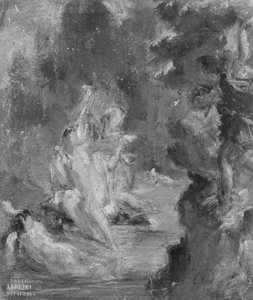
Eugène Delacroix's “Summer – Diana and Actaeon,” housed within the Museo de Arte de Sao Paulo, isn’t merely a painting; it’s a visceral plunge into the heart of Greek mythology, rendered with an intensity that still resonates today. Completed between 1856 and 1863, this monumental work captures a pivotal moment from Ovid's *Metamorphoses* – the horrifying transformation of the hunter Actaeon after he unwittingly stumbles upon Diana bathing in a secluded forest pool. More than just a retelling of a myth, Delacroix’s masterpiece is a profound exploration of shame, vulnerability, and the devastating consequences of transgression, all conveyed through his signature Romantic style. The painting immediately commands attention with its dramatic lighting, rich color palette, and dynamic composition, drawing the viewer into a scene brimming with both beauty and terror.A Mythical Genesis: Context and Narrative
The story at the heart of “Diana and Actaeon” is a classic tale of divine retribution. Actaeon, a skilled hunter in pursuit of a deer, violates Diana’s privacy by spying on her bathing. Enraged by this intrusion, she transforms him into a stag, condemning him to be hunted and ultimately torn apart by his own hounds – a brutal punishment for his hubris. Delacroix masterfully captures the immediate aftermath of this transformation: Actaeon, now in stag form, stares with horrified recognition at his reflection in the pool’s surface, realizing the horror of his situation. The presence of two dogs, one poised to attack and another already engaged in the gruesome pursuit, amplifies the scene's tension and underscores the inevitability of his fate. This isn’t a detached recounting of events; it’s an intensely emotional portrayal of a man confronting his own monstrous transformation.Delacroix’s Romantic Vision: Technique and Style
Delacroix was a leading figure in the Romantic movement, rejecting the rigid formality of Neoclassicism in favor of expressive brushwork, vibrant color, and an emphasis on emotion and drama. In “Diana and Actaeon,” this is evident in every aspect of the painting’s execution. The loose, visible brushstrokes create a sense of movement and immediacy, conveying the chaos and panic of the scene. Delacroix employs a rich, saturated palette – deep greens, blues, and browns dominate the forest backdrop, contrasted by the warm tones of Actaeon's skin and the shimmering light reflecting off the water. The use of chiaroscuro (the dramatic contrast between light and dark) further intensifies the emotional impact, highlighting Actaeon’s horrified expression and casting long, ominous shadows across the landscape. Notice how Delacroix doesn’t meticulously render every detail; instead, he prioritizes capturing the *feeling* of the scene – the sense of dread, vulnerability, and impending doom. The composition itself is deliberately unbalanced, drawing the eye to Actaeon's central position and amplifying his isolation.Symbolism and Emotional Resonance
Beyond its narrative power, “Diana and Actaeon” is rich in symbolism. Diana herself represents both divine beauty and ruthless retribution, while Actaeon embodies human fallibility and the consequences of unchecked desire. The pool acts as a mirror, not just reflecting Actaeon’s physical form but also his shattered sense of self. The dogs symbolize the inescapable nature of fate and the loss of innocence. The painting speaks to universal themes of shame, transgression, and the dark side of human nature – emotions that continue to resonate with viewers today. It's a potent reminder of the dangers of violating boundaries, both physical and moral, and the devastating price one can pay for such actions. The overall effect is profoundly unsettling yet undeniably captivating, leaving a lasting impression long after viewing.For those seeking a high-quality reproduction of this iconic masterpiece, visit Eugène Delacroix: Summer - Diana and Actaeon on AllPaintingsStore. Furthermore, the Museo de Arte de Sao Paulo offers a wealth of information about this painting and its place within Delacroix’s broader oeuvre.
Related Artworks






Artist Biography
A Revolutionary Brush: The Life and Legacy of Eugène Delacroix
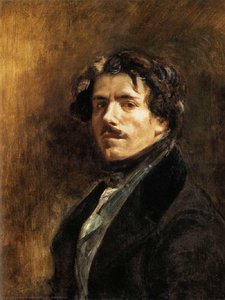
Ferdinand Victor Eugène Delacroix, born in Charenton-Saint-Maurice near Paris in 1798, was more than just a painter; he was the embodiment of Romanticism’s fervent spirit. Emerging as a leading figure in French art during a period of societal upheaval and shifting aesthetic ideals, Delacroix rejected the rigid formalism of Neoclassicism, instead embracing drama, emotion, and a vibrant palette that would forever alter the course of painting. His life, though marked by personal tragedy, became inextricably linked with his artistic vision—a quest to capture the sublime, explore exotic realms, and express the raw power of human experience.
Delacroix’s early years were shaped by a complex family history and a somewhat fragile health. Orphaned at sixteen, he found guidance in the influential figure of Charles-Maurice de Talleyrand-Périgord, who many believed to be his true father. This connection provided him with crucial patronage and access to the Parisian art world. He initially studied under Pierre-Narcisse Guérin, a respected academic painter, but it was the work of Théodore Géricault—particularly his monumental *The Raft of the Medusa*—that truly ignited Delacroix’s artistic passion. He even posed for Géricault, absorbing the elder artist's commitment to realism and emotional intensity.
From Historical Scenes to Exotic Visions
Delacroix burst onto the Salon scene in 1822 with *Dante and Virgil in Hell*, a work that immediately signaled his departure from established norms. Inspired by Dante Alighieri’s *Inferno*, the painting showcased a bold use of color, dynamic composition, and a palpable sense of psychological turmoil. This marked the beginning of a career dedicated to exploring themes of passion, conflict, and the human condition. While initially met with mixed reactions—some critics lauded his originality, others dismissed his work as chaotic and lacking in classical refinement—Delacroix persevered, developing a distinctive style characterized by loose brushwork, rich textures, and an emphasis on movement.
His fascination extended beyond historical and literary subjects. A pivotal journey to North Africa in 1832 profoundly impacted his artistic trajectory. Immersing himself in the vibrant culture of Morocco, Delacroix was captivated by the exotic landscapes, the nomadic lifestyle of the Arab tribes, and the intensity of their traditions. This experience infused his paintings with a newfound sense of color, light, and energy, as seen in works like *Arab Horses Fighting* and numerous studies of Algerian life. He wasn’t merely documenting these scenes; he was seeking to understand the underlying spirit of a culture vastly different from his own.
The Power of Color and Political Engagement
Delacroix's mastery of color is arguably his most enduring legacy. He drew inspiration from the Baroque exuberance of Rubens and the Venetian Renaissance masters, prioritizing chromatic intensity over precise draftsmanship. He understood that color could evoke emotion, create atmosphere, and convey meaning in ways that line alone could not. This innovative approach profoundly influenced subsequent generations of artists, paving the way for Impressionism and Post-Impressionism.
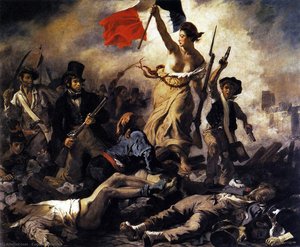
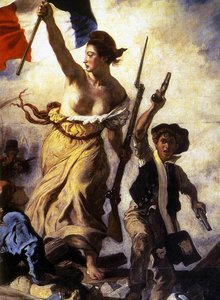
Beyond his aesthetic innovations, Delacroix was a politically engaged artist. His most iconic work, *Liberty Leading the People* (1830), is not simply a depiction of the July Revolution; it’s a powerful allegory for freedom and rebellion. The painting's dynamic composition, allegorical figures, and raw emotional power cemented its place in art history as a symbol of French national identity and revolutionary ideals. It wasn’t just about documenting an event; it was about capturing the spirit of a nation fighting for its liberty.
A Lasting Influence
Delacroix continued to paint prolifically throughout his life, exploring diverse themes ranging from Shakespearean tragedies to biblical narratives. He also made significant contributions as a lithographer, illustrating works by literary giants like William Scott and Johann Wolfgang von Goethe. His studio became a hub for artistic exchange, attracting aspiring painters who were drawn to his unconventional approach.
By the time of his death in 1863, Delacroix had firmly established himself as one of France’s greatest artists. His influence extended far beyond the Romantic movement, shaping the development of modern painting and inspiring countless artists with his bold use of color, dynamic compositions, and unwavering commitment to emotional expression. He remains a pivotal figure in art history—a testament to the power of individual vision and the enduring allure of the sublime.

Eugène Delacroix
1798 - 1863 , France
Quick Facts
- Artistic Movement Or Style: Romanticism
- Artists Or Movements Influenced By This Artist:
- Impressionism
- Post-Impressionism
- Artists Who Influenced This Artist:
- Rubens
- Venetian Renaissance painters
- Date Of Birth: April 26, 1798
- Date Of Death: August 13, 1863
- Full Name: Eugène Delacroix
- Nationality: French
- Notable Artworks:
- Liberty Leading the People
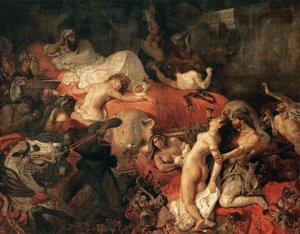
- The Death of Sardanapalus
- Arab Horses Fighting
- Place Of Birth: Chantonnay, France
Related Articles

Echoes of Olympus: Mythological Narratives in Western Art Through the Ages
Explore the captivating history of mythological narratives in Western art! From ancient Greece to modern masterpieces, discover iconic artworks & symbolism. Expert analysis and high-quality reproductions at AllPaintingsStore.

Echoes of the Past: Historical Painting from Narrative to Contemporary Interpretation
Explore the captivating world of historical painting! Discover iconic masterpieces, influential movements & expert insights for collectors. Learn about narrative art's evolution and find your perfect artwork at AllPaintingsStore.

From Snapshot to Canvas: The Art of Transforming Travel Photography into Timeless Oil Paintings
Transform your cherished travel photos into timeless oil paintings with expert artists at AllPaintingsStore.com. Museum-quality reproductions & custom portraits – preserve your memories beautifully.

Romanticism's Greatest Artworks: 10 Masterpieces for Your Home |
Journey through Romanticism's soul with 10 iconic artworks by Delacroix, Goya & Turner. Explore emotional landscapes and historical drama. Find museum-quality art reproductions to elevate your home at – Discover all masterpieces online!

From Imagination to Canvas: Commissioning Bespoke Fantasy Art with Traditional Oil Painting Techniques
Commission breathtaking bespoke fantasy art with skilled oil painters. Explore techniques, artist selection & preservation tips. Invest in a unique masterpiece today!