Money-Back Guarantee · 100 days Free Worldwide Delivery
449,587artworks 30,613artists 4,660museums 32languages
Catalogue entry

Untitled

Acrylic On Canvas.

Fig. 1. Francis Bacon, Untitled. Shown as the reproduction you are specifying: , .

§ 1Catalogue data

§ 2Abstract

Collectible Description

Explore "Untitled" by Francis Bacon: a haunting portrait evoking isolation & despair. Expressionist style, stark minimalism, & powerful emotional impact. Hand-painted reproductions available at AllPaintingsStore.

Artist Biography

Bacon used disturbing realism in Three Studies for Figures at the Base of a Crucifixion. Discover his visceral and powerful paintings now.

§ 3Commentary

A Study in Isolation: Decoding Human Anguish

This powerful and unsettling work by Francis Bacon delves into the depths of human isolation and psychological distress. The painting presents a solitary male figure, seemingly trapped within a stark, angular structure – a visual metaphor for confinement, whether internal or imposed by societal pressures. It’s a piece that doesn't offer easy answers but instead invites contemplation on the fragility of existence and the weight of modern alienation.

Expressionist Technique & Composition

Executed with Bacon’s signature expressive brushwork, the artwork showcases his mastery of oil paint applied in layered textures. The limited palette – predominantly blacks, grays, and muted whites, punctuated by subtle cool blues within the shadows – amplifies the somber mood. Angular lines define the confining space, contrasting with the softer, blurred rendering of the figure itself, suggesting a dissolving sense of self. The composition’s emphasis on verticality reinforces feelings of constraint and vulnerability. Bacon's technique, often described as a blend of abstraction and figuration, prioritizes emotional impact over precise representation.

Historical Context & Artistic Influences

Emerging in the post-World War II era, this piece reflects the anxieties and existential questioning prevalent at the time. Bacon was deeply influenced by earlier masters like Velázquez (whose *Portrait of Pope Innocent X* he famously reinterpreted) and Picasso, but forged a uniquely visceral style that set him apart. He rejected traditional notions of beauty in favor of raw emotional honesty, aligning himself with the broader Expressionist movement while simultaneously pushing its boundaries.

Symbolism & Interpretation

The suit worn by the figure hints at societal expectations and conformity, potentially symbolizing a loss of individuality within modern life. The cage-like structure can be interpreted as representing mental confinement or the pressures of external forces. Bacon deliberately avoids providing definitive meaning, allowing viewers to project their own experiences and interpretations onto the work. This ambiguity is central to its enduring power.

Emotional Resonance & Interior Impact

This painting evokes a profound sense of sadness, anxiety, and introspection. It's not a piece intended to provide comfort but rather to provoke thought and emotional response. In an interior setting, it would serve as a striking focal point – a conversation starter that adds depth and intellectual weight to any space. Its monochromatic palette lends itself well to both modern and traditional interiors, offering a sophisticated counterpoint to brighter or more colorful elements. For collectors seeking impactful and historically significant works, this piece represents a compelling addition to any collection.

Questions & Answers

Which color stands out most in "Untitled"?

black (#151413) is the leading color of "Untitled" by Francis Bacon.

How do contrast and harmony combine in "Untitled"?

The color analysis of "Untitled" by Francis Bacon records a serene contrast and a discordant palette harmony.

Is "Untitled" typical of what Francis Bacon usually created?

Francis Bacon's recurring themes include influenced by de kooning, existential angst & isolation, expressionist figure painting; "Untitled" focuses on isolation, anxiety, despair, confinement, figure, expressionism, darkness, vulnerability.
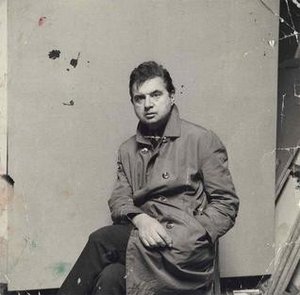
§ 4The artist

Francis Bacon

Francis Bacon

1909 - 1992, Ireland

Quick facts about Francis Bacon

  • Artistic Movement Or Style: Expressionism, Cubism, Surrealism
  • Artists Or Movements Influenced By This Artist: ['Post-War Expressionism']
  • Artists Who Influenced This Artist:
    • Pablo Picasso
    • Egon Schiele
    • Diego Velázquez
    • Sergei Eisenstein
  • Full Name: Francis Bacon
  • Nationality: Irish/British
  • Notable Artworks:
    • Three Studies for Figures at the Base of a Crucifixion
    • Study After Velázquez’s Portrait of Pope Innocent X
  • Place Of Birth: Dublin, Ireland
  • Date Of Birth: 1909
  • Date Of Death: 1992

Artist Biography

The Brutality of the Human Image

To look at a Francis Bacon canvas is to encounter a direct assault on the nervous system. He did not seek to decorate; he sought to capture the raw, often terrifying reality of existence through a distinctive and disturbing realism. While his contemporaries drifted toward the safety of abstraction, Bacon anchored himself in the human form, though he stripped that form of any dignity or comfort. His work functions as a visceral response to the mid-twentieth century, translating anxiety and physical vulnerability into smeared, violent colors and contorted limbs.

The power of his imagery stems from a refusal to look away from degradation. He utilized oils with a fluidity that allowed for the depiction of flesh that seems to be dissolving or bruising under pressure. By placing figures within geometric structures—transparent cages or architectural space-frames—he forced a sense of claustrophobia upon the viewer. These frames were not mere compositional tools; they were devices to concentrate the image and trap the subject in a state of permanent isolation.

A Life of Displacement and Design

Bacon’s path to the canvas was far from academic. Born in Dublin, Ireland, his early years were marked by instability and a difficult relationship with his parents. He moved through London, Berlin, and Paris, living a life that was often as turbulent as his later paintings. Before he was recognized as a painter, he worked as an interior designer and decorator. This period of his life produced tangible, structured objects:

  • Royal Wilton rugs featuring abstract motifs.
  • Cocktail shelves and room screens with geometric silhouettes.
  • Calfskin pouffes and tubular steel furniture.

This background in design provided a structural foundation that would later manifest in his use of cubic, architectural framing. He was a self-taught artist who bypassed the traditional art school route, instead absorbing influences through direct observation and chance encounters. His transition from decorator to painter was catalyzed by seeing Picasso’s work in Paris, which revealed the possibilities of using organic, bone-like structures to distort the human image.

The Mechanics of Terror

Bacon’s visual language was built from a specific set of cinematic and classical references. He did not invent his horrors in a vacuum; he reconfigured existing imagery to suit a more primal purpose. The screaming face, a recurring motif, finds its roots in the visceral imagery of Sergei Eisenstein's film Battleship Potemkin. Similarly, his fascination with the distortion of the body was informed by the works of Picasso and the studies of motion by Eadweard Muybridge.

His most famous reinterpretations involved taking established authority and breaking it. In his series of works based on Velázquez’s Portrait of Pope Innocent X, he transformed a dignified papal figure into a nightmarish, screaming specter. He used the concept of the crucifixion not as a religious statement, but as an armature to hang sensations of suffering. This approach allowed him to explore universal themes of mortality and the human condition without the distraction of spiritual solace.

The Final Verdict

Bacon’s significance lies in his ability to confront the darker corners of the soul with brutal honesty. He rejected the polished beauty of traditional portraiture in favor of an unflinching portrayal of agony and isolation. His later works, while often utilizing lighter colors, maintained this core intensity, focusing on the psychological weight of his subjects, including his lover George Dyer. He remains a central figure because he provided a visual language for the twentieth century's deepest anxieties, ensuring that the image of the suffering human remains impossible to ignore.

§ 5Comparanda

§ 6Questions

Quick Facts

  • subject: Portrait of a man
  • title: Untitled
  • notable_elements: Confined space, darkness, ambiguity, isolation, vulnerability
  • influences: Implied - Francis Bacon style similarities

Art Quiz

There is only one correct answer for each question.

Question 1:
The artwork's dominant atmosphere is best described as:
Question 2:
What compositional element strongly contributes to the feeling of confinement in this artwork?
Question 3:
Which artistic style does the artwork most closely align with, based on its emphasis on emotional intensity?
Question 4:
The limited color palette primarily consists of:

§ 7Cite this entry

AllPaintingsStore.com, “Francis Bacon, Untitled”, https://allpaintingsstore.com/en/art/francis-bacon-untitled-8EWGA5-en/ArtistReproduction/ (accessed 3 October 2026).

§ 8The reproduction

Hand Made Oil Reproduction

Hand-painted oil on canvas in your size and frame, made to order by our artists. ( Switch to Print Switch to Digital Image)

It is specified on the order sheet in the margin; the present state of that sheet reads as follows.

Untitled

Reproduction Medium

Reproduction Size

-

Elite Senior Artist

More detail, finesse, and extra production time

-

Reproduction Frame

-

-

For artworks or reproductions larger than 105 cm (approximately 41 inches) on any side, the frame will be shipped as a kit, disassembled. This method ensures safe delivery and prevents damage during transport.

Professional assembly required - this is not a DIY product.
The kit must be assembled and the canvas stretched by an experienced professional framer, using wood glue (not supplied), a canvas stretching plier and clamps to hold the bars square while the glue dries. Incorrect assembly or uneven canvas tension can permanently damage the artwork and is not covered by our warranty.

  • All solid wood bars are included, precisely cut to size.

  • Assembled with the screws provided, plus wood glue for the corner joints, which is not supplied and must be sourced by your framer.

  • Professional tools are required and not included: a canvas stretching plier (tensioner) and clamps to hold the bars square while the glue dries.

Important:
The corner joints require wood glue, the bars must be held with clamps until the glue is fully dry, and tightening the canvas on the assembled frame requires a canvas stretching plier. None of these are included in the kit. Please arrange an experienced professional framer before ordering this size.

Nameplate

-

-

Protective Varnish

Glossy Varnish (enhances colors, protects against light/moisture)

-

Customize My Artwork

Examples of what can be changed: Replace face with customer photo; Add pet (e.g., replace cat with dog); Include hidden message in background; Change background landscape or elements.

-

Urgent

Worldwide Delivery () in 3/4 weeks instead of standard 5 weeks. (1 November). No compromise on quality.

-

Express Shipping

Worldwide Delivery () in 5 weeks. (8 November).

Included

Total Price

$ 258

Included with every order

  • Free Worldwide Express Shipping
  • High-Quality Linen Canvas
  • Full Shipping Insurance
  • Customs Tax Refund Guarantee
  • True Color Matching Guarantee
  • 100-Day Return Policy (Defects Only)
  • 100% Money-Back Guarantee
  • Bulk Discount Offer
Order sheet