


 Preview
 Send
Send Share
Share
 Details

 Download
 Similars
 X-Ray
X-Ray Diaporama
White Trebol
 Cubism
 90.0 x 90.0 cm
 Read More
Giclée / Art Print
Museum-quality giclée or canvas print with fast production and flexible finish options. ( Switch to hand made Painting Switch to Image)




































Pick from our preset sizes that match the artwork's original proportions.

You may enter your own dimensions to fit a specific frame or space. If your selected size does not match the original image's proportions, we will either crop the artwork or extend the image with a mirrored or solid-fill edge. A digital mockup will be sent for your approval before production begins.
Please note that the on-screen preview does not reflect the actual cropping or extension. Only the mockup will accurately show the final composition.
While custom sizes are available, we recommend selecting a dimension from the predefined list to preserve the original proportions.
Worldwide Delivery () in 2 weeks instead of standard 4/5 weeks. (5 August)

Free Worldwide Express Shipping

High-Quality Linen Canvas

Full Shipping Insurance

Customs Tax Refund Guarantee

True Color Matching Guarantee

60-Day Return Policy (Defects Only)

100% Money-Back Guarantee

Bulk Discount Offer
 Glass option is only available in size under 110 CM

White Trebol
Giclée / Art Print
Reproduction Size
-


Total Price
$ 65
Related Artworks


Artist Biography
an avid world traveler, orozco, his wife maria gutierrez, and their son simón, divide their time between paris, new york and mexico city.
orozco was born in 1962 in veracruz, mexico to cristina fèlix romandía and mario orozco rivera, a mural painter and art professor at the universidad veracruzana. when orozco was six, the family relocated to the san àngel neighborhood of mexico city so that his father could work with artist david alfaro siquieros on various mural commissions. his father took him along to museum exhibitions and to work with him, where orozco overheard many conversations on art and politics.
orozco attended the escuela nacional de artes plásticas between 1981 and 1984, but found it to be a conservative program of study; in 1986 he moved to madrid and enrolled at the circulo de bellas artes. here his instructors introduced him to a broad range of post-war artists working in non-traditional formats. he has stated of his time in spain,
"what's important is to be confronted deeply with another culture. and also to feel that i am the other not the resident. that i am the immigrant. i was displaced and in a country where the relationship with latin america is conflicted. i came from a background that was very progressive. and then to travel to spain and confront a very conservative society that also wanted to be very avant-garde in the 1980s, but treated me as an immigrant, was shocking. that feeling of vulnerability was really important for developing my work. i think a lot of my work has to do with that kind of exposure, to expose vulnerability and make that your strength."
in 1987 orozco returned from his studies in madrid to mexico city where he formed weekly meetings with a group of other artists including damián ortega, gabriel kuri, abraham cruzvillegas and dr. lakra. this group met once a week for five years and over time the artist’s home became a place where many artistic and cultural projects took shape.
orozco’s nomadic way of living began to strongly inform his work around this time, and he took much inspiration from exploring the streets. his early practice was intended to break away from the mainstream work of the 1980s, which often incorporated huge studios with many assistants and elaborate techniques of production and distribution. in contrast, orozco has always worked alone or with one or two other assistants. his work revolves around many repeated themes and techniques that incorporate real life and common objects. the exploration of his chosen materials allows the audience's imagination to explore the creative associations between oft-ignored objects in today's world.
"for him , the decentralization of the manufacturing practice mirrors a rich heterogeneity of object and material. there is no way to identify a work by orozco in terms of physical product. instead it must be discerned through leitmotifs and strategies that constantly recur, but in always mutating forms and configurations." – ann temkin
“what is most important is not so much what people see in the gallery or the museum, but what people see after looking at these things, how they confront reality again”.- gabriel orozco from an interview with benjamin h. d. buchloh
gabriel orozco married maria gutierrez on august 2, 1994, at city hall in new york. they have one son, simόn, born in november 2004. orozco lives and works in new york, mexico and france.
gabriel orozco is represented by the marian goodman gallery in new york, galerie chantal crousel in paris, and galeria kurimanzutto in mexico city.
important solo exhibitions have included his mid-career retrospective which began in december 2009 at the museum of modern art in new york and traveled to the kunstmuseum basel, the centre pompidou, paris, and ended at the tate modern, london, in may 2011. other recent solo exhibitions include asterisms, deutsche guggenheim (2012) and the guggenheim, new york (2012), exhibitions at the museo del palacio de bellas artes, mexico city (2006); the museum ludwig, cologne (2006), palacio de cristal, the museo nacional centre de arte reina sofia, madrid, (2005), the hirshhorn museum, washington d.c. (2004), and the serpentine gallery, london (2004).
orozco participated in the venice biennale in 1993, 2003, and 2005, the whitney biennial (1995 and 1997), as well as documenta x (1997) and documenta xi (2002). he has received numerous awards, including the seccio espacios alternativos prize at the salon nacional de artes plasticas in mexico city (1987), a daad artist-in-residence grant in berlin (1995), and the german blue orange prize (2006).

gabriel orozco
1962 - , Mexico
Related Articles

The Subtleties of Shade: Exploring Black, White & Gray Abstraction in Modern Interior Design
Explore the power of black, white & gray abstraction in modern interior design. Discover how minimalist art impacts spatial perception & creates sophisticated hotel spaces. Expert insights for designers.

Minimalist Masterpieces: 10 Artworks for Serene Home Decor | AllPaintingsStore
Find serenity with 10 minimalist masterpieces! Explore Agnes Martin, Rothko & more. Discover the stories behind iconic abstract art, neutral palettes & calming designs. Museum-quality reproductions at AllPaintingsStore.com – elevate your home decor today!
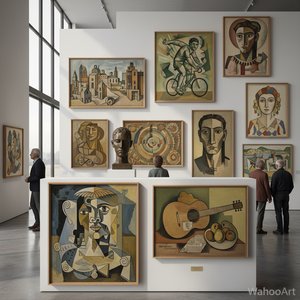
Cubism's Revolution: 10 Masterpieces That Redefined Modern Art |
Journey through Cubism's evolution with 10 iconic masterpieces by Picasso, Braque & more. Explore the stories behind these revolutionary paintings and find museum-quality art reproductions to elevate your home decor at .

Beyond Form & Color: Geometric Abstraction's Evolution in 20th/21st Century Art
Explore the evolution of geometric abstraction from Cubism to contemporary art. Discover key artists like Malevich & Mondrian, investment insights, and expert collecting advice at AllPaintingsStore.
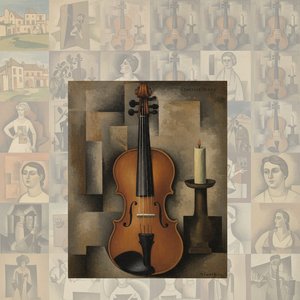
Georges Braque's Masterpieces: 25 Paintings That Defined Cubism & Modern Art | AllPaintingsStore
Explore 25 iconic Georges Braque paintings that revolutionized Cubism & modern art. Discover the stories behind his masterpieces, from Fauvism to Analytical Cubism. Find museum-quality reproductions & elevate your home decor with AllPaintingsStore.com.





