

- Home

- Oil Painting Reproduction
- George Edward Bonsor Saint Martin
- East gate of Baelo Claudia
 Buy print
 Send
Send Share
Share
 Details

 Download
 Similars
 X-Ray
X-Ray Diaporama
East gate of Baelo Claudia


 Read More
Hand Made Oil Reproduction
Hand-painted oil on canvas in your size and frame, made to order by our artists.




































Pick from our preset sizes that match the artwork's original proportions.

You may enter your own dimensions to fit a specific frame or space. If your selected size does not match the original image's proportions, we will either crop the artwork or extend the painting with additional hand-painted elements. A digital mockup will be sent for your approval before production begins.
Please note that the on-screen preview does not reflect the actual cropping or extension. Only the mockup will accurately show the final composition.
While custom sizes are available, we recommend selecting a dimension from the predefined list to preserve the original proportions.
After order, AllPaintingsStore.com team will email client for instructions and provide a mockup preview
Worldwide Delivery () in 3/4 weeks instead of standard 5 weeks. (16 July). No compromise on quality.

Free Worldwide Express Shipping

High-Quality Linen Canvas

Full Shipping Insurance

Customs Tax Refund Guarantee

True Color Matching Guarantee

60-Day Return Policy (Defects Only)

100% Money-Back Guarantee

Bulk Discount Offer
 Glass option is only available in size under 110 CM

East gate of Baelo Claudia
Reproduction Medium
Reproduction Size
-


Total Price
-
Artwork Description
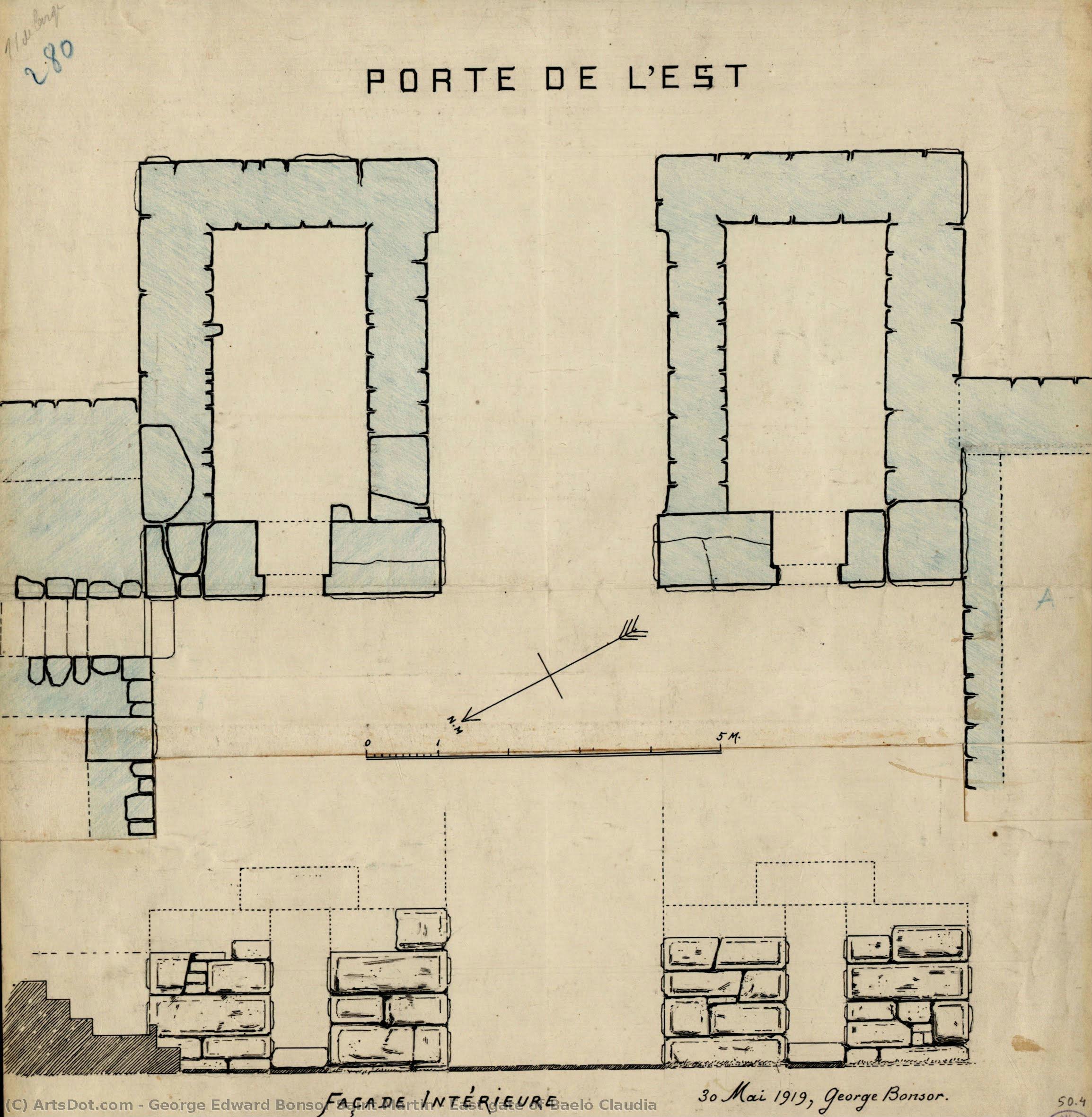
East Gate of Baelo Claudia: A Blueprint for Roman Legacy
The drawing by George Edward Bonsor Saint Martin—a meticulous depiction of the east gate of Baelo Claudia, excavated in 1919—stands as a poignant testament to both artistic vision and archaeological scholarship. Lost tragically during the tumultuous events of the Spanish Civil War when the School of Hispanic Studies’ archives succumbed to flames, this plan represents one of the few surviving documents from Pierre Paris's groundbreaking expeditions into Roman Spain. Its preservation is remarkable, thanks to a loan by the City Council of Mairena de la Alcor, allowing us to appreciate its significance beyond mere architectural representation.- Subject Matter: The drawing focuses squarely on the monumental east gate of Baelo Claudia—a fortified Roman city nestled in Andalusia, Spain—facing the necropolis established by Bonsor himself during his excavations. This deliberate pairing underscores the archaeologist’s fascination with understanding not only the grandeur of imperial Rome but also its funerary rituals and beliefs.
- Style & Technique: Executed in black and white ink on paper, Saint Martin's drawing embodies the precision characteristic of architectural blueprints from the early 20th century. The artist’s meticulous attention to detail—evident in the rendering of columns, arches, and geometric patterns—reflects a commitment to faithfully capturing the structure’s form.
- Historical Context: Baelo Claudia represents one of the most important Roman sites in Spain, offering invaluable insights into daily life, religion, and urban planning during the reign of Emperor Augustus. Saint Martin's drawing captures this pivotal moment in archaeological discovery—a concerted effort to reconstruct Rome’s influence on Iberian culture.
- Symbolism: The repetition of columns symbolizes stability and grandeur, mirroring the enduring legacy of Roman civilization. Furthermore, the arches represent a harmonious balance between strength and elegance, reflecting the architectural ideals prevalent during the period.
- Emotional Impact: Viewing this drawing evokes a sense of awe at the scale of Roman engineering prowess and inspires contemplation on the passage of time—a reminder that even ruins hold profound stories about human history. It’s an image that speaks to the enduring power of art to illuminate the past.
A Window into Architectural Representation
Saint Martin's drawing isn’t merely a depiction of stone; it’s a carefully considered artistic statement. The artist skillfully employs linear perspective—a technique pioneered during this era—to convey depth and accurately portray the gate’s architectural dimensions. This meticulous approach demonstrates Saint Martin’s mastery of draughtsmanship and his dedication to conveying visual information with remarkable accuracy.Beyond Documentation: Artistic Interpretation
While serving as a crucial record of archaeological research, Saint Martin's drawing transcends its utilitarian function. It reveals an artist’s ability to transform factual observation into emotive expression—a testament to the enduring relationship between art and science. The drawing invites viewers to consider not only what was built but also *why* it was built, fostering appreciation for both Roman history and artistic innovation.Ideal Reproduction
A high-quality reproduction of East Gate of Baelo Claudia by George Edward Bonsor Saint Martin would allow art enthusiasts to experience the drawing’s beauty and detail firsthand. Utilizing archival inks on textured paper ensures that the artwork's original character is faithfully preserved, capturing the subtle nuances of Saint Martin’s technique and conveying the profound historical significance of this remarkable piece.Related Artworks


Artist Biography
A Life Bridging Art and Antiquity: The World of George Edward Bonsor Saint Martin
George Edward Bonsor Saint Martin, a name perhaps less familiar than those of his artistic contemporaries, nonetheless represents a fascinating intersection of disciplines – a life dedicated to both the aesthetic pursuit of painting and the meticulous investigation of history through archaeology. Born in Lille, France, on March 30, 1855, to an English father and a French mother, Bonsor Saint Martin’s early years were marked by a cosmopolitan upbringing that instilled within him a deep curiosity about different cultures and a keen observational eye. This formative period, spent traversing schools in Belgium, Russia, and France before finally settling for studies in England, laid the groundwork for his future endeavors. The wealth of his family afforded him an education steeped in diverse environments, nurturing not only intellectual growth but also a profound appreciation for geography and the visual world – elements that would become central to his life’s work. The early loss of his mother deeply affected him, leading to periods spent with relatives in both England and France, further shaping his dual cultural identity.From Artistic Training to Archaeological Pioneer
Initially drawn to the fine arts, Bonsor Saint Martin pursued formal training at academies in London and Brussels. It was during his time at the Académie Royale des Beaux-Arts in Brussels that he distinguished himself, winning a significant prize for “archaeological technical drawing.” This achievement foreshadowed his later groundbreaking approach to archaeological documentation. While proficient as a painter – his style showing affinities with Impressionist artists like Berthe Morisot in its attention to light and everyday life – Bonsor Saint Martin’s true calling lay elsewhere. He soon realized that the act of meticulously recording historical sites through detailed drawings was, in itself, an artistic endeavor. He became a self-taught archaeologist, remarkably ahead of his time in advocating for systematic documentation using technical illustrations, believing these records were as valuable and artistically significant as the artifacts themselves. This conviction set him apart from many of his contemporaries who viewed archaeology primarily as a treasure hunt.Unearthing Roman Spain: A Legacy of Discovery
Bonsor Saint Martin’s focus soon turned to Spain, where he embarked on a series of excavations that would define his career and leave an indelible mark on the field of Iberian archaeology. He dedicated decades to uncovering and studying significant Roman sites, most notably the necropolis and amphitheater at Carmona, the ancient town of Baelo Claudia in Cádiz, and the Setefilla zone near Lora del Río. His work at Carmona, beginning in 1880, was particularly transformative; he not only unearthed remarkable archaeological remains but also established a museum to house and display his findings, recognizing the importance of public access to historical knowledge. At Baelo Claudia, he meticulously mapped and documented the ruins of this once-thriving Roman port city, providing invaluable insights into its history and daily life. He wasn’t merely excavating; he was reconstructing narratives from fragments of the past, using his artistic skills to visualize and communicate these stories.A Champion of Preservation and Historical Understanding
Beyond his archaeological discoveries, George Edward Bonsor Saint Martin distinguished himself as a passionate advocate for the preservation of historical sites. He understood that these places were not simply collections of artifacts but vital links to our collective past, deserving of protection for future generations. This commitment is reflected in his meticulous documentation and his efforts to raise awareness about the importance of archaeological heritage. He corresponded with scholars across Europe and America, sharing his findings and promoting best practices in preservation. Though he often worked independently, relying on personal funds and a small team, his influence extended far beyond his immediate projects. He believed that archaeology was not just an academic pursuit but a civic responsibility – a means of connecting people to their history and fostering a sense of cultural identity. He died in Mairena del Alcor, Spain, on August 15, 1930, leaving behind a legacy as a true pioneer who seamlessly blended artistic vision with archaeological rigor. His work continues to inspire those dedicated to uncovering and safeguarding the treasures of our shared human story.
George Edward Bonsor Saint Martin
1855 - 1930 , France
Quick Facts
- Artistic Movement Or Style: Archaeological drawing
- Artists Who Influenced This Artist: ['Berthe Morisot']
- Date Of Birth: March 30, 1855
- Date Of Death: 1930
- Full Name: George Edward Bonsor Saint Martin
- Nationality: British-French
- Notable Artworks: ['East gate of Baelo Claudia']
- Place Of Birth: Lille, France
Related Articles

Georges de La Tour: Luminosity, Spirituality & Realism in Baroque Painting
Discover the captivating world of Georges de La Tour, a Baroque master renowned for his dramatic chiaroscuro & spiritual realism. Explore key works, influences, and his remarkable rediscovery. Learn more at AllPaintingsStore.

George Barret the Elder: Pioneering British Pastoral Painting & Landscape's Rise
Explore the life & art of George Barret Sr., a pioneer of British pastoral painting. Discover his influence on Romantic landscape art, patronage, and collecting tips from AllPaintingsStore.

Georges Seurat: Pointillism, Perception & the Scientific Foundations of Modern Art
Explore the revolutionary art of Georges Seurat and the science behind Pointillism. Discover chromoluminarism, optical mixing, and the lasting impact of Neo-Impressionism on modern art history.

George Goodwin Kilburne: Capturing Victorian Sentimentality Through Genre Painting
Explore the evocative Victorian paintings of George Goodwin Kilburne. Discover his detailed scenes of domestic life, masterful use of light, and lasting impact on British genre painting. Learn more at AllPaintingsStore.

Georges Seurat's Masterpieces: 25 Paintings That Defined Pointillism | AllPaintingsStore
Explore 25 iconic Georges Seurat paintings & discover the brilliance of Pointillism. From 'La Grande Jatte' to his harbor scenes, delve into art history with AllPaintingsStore.com. Find museum-quality reproductions for your home decor. Explore the full collection online!




