Money-Back Guarantee · 100 days Free Worldwide Delivery
449,564artworks 30,613artists 4,660museums 32languages
Catalogue entry

Fire

1566. Oil On Canvas, 67.0 x 51.0 cm. Kunsthistorisches Museum.

Fig. 1. Giuseppe Arcimboldo, Fire, 1566. Shown as the reproduction you are specifying: , .

§ 1Catalogue data

Dimensions
67.0 x 51.0 cm

§ 2Abstract

Collectible Description

Discover Giuseppe Arcimboldo’s ‘Fire’: a stunning Mannerist portrait of regal armor & detail. Explore this opulent oil painting's symbolism & masterful technique.

Artist Biography

Discover Giuseppe Arcimboldo (1527-1593), the Italian Mannerist master renowned for his surreal portraits composed of fruits, vegetables & objects. Explore his whimsical yet insightful art!

§ 3Commentary

Giuseppe Arcimboldo’s Fire: A Symphony of Symbol and Texture

Giuseppe Arcimboldo’s “Fire,” painted in 1566, stands as a singular achievement within the Renaissance artistic landscape—a testament to inventive visual storytelling and masterful execution. More than just a portrait, it's an elaborate allegory embodying the element of fire itself, reflecting Arcimboldo’s fascination with humanist ideals and his desire to communicate complex ideas through unconventional means.

The artwork depicts the head of a noble figure rendered entirely from meticulously arranged fruits, vegetables, flowers, and stylized avian elements. This audacious technique—characteristic of Arcimboldo's celebrated “Four Elements” series—immediately distinguishes it from traditional portraiture. Rather than striving for realistic representation, Arcimboldo prioritized conveying an overarching concept: the transformative power of fire, its destructive beauty, and its association with divine illumination.

A Masterful Synthesis of Style and Technique

  • Style: Arcimboldo’s approach leans heavily into Mannerism, a stylistic movement that favored elongated figures, stylized poses, and exaggerated expressions. This deliberate distortion serves not to undermine realism but rather to heighten the dramatic impact of the composition and emphasize the symbolic significance of each element.
  • Technique: The painting demonstrates exceptional skill in oil paint application—a technique prevalent during Arcimboldo’s time—characterized by layering thin glazes over textured surfaces. This meticulous brushwork creates a palpable sense of depth and luminosity, simulating the shimmering surface of gold and capturing the subtle nuances of light and shadow.
  • Materials: Primarily executed on canvas using oil paints, “Fire” exemplifies Arcimboldo’s dedication to crafting artworks that are both visually arresting and intellectually stimulating.

Historical Context and Symbolism

Created during the height of the Renaissance in Milan—a city renowned for its artistic patronage—Arcimboldo's work reflects the humanist spirit of the era, which championed observation of nature and explored philosophical concepts rooted in classical antiquity. The element of fire itself held profound symbolic meaning: representing divine illumination, purification, and transformation – mirroring Arcimboldo’s belief that art could elevate the human intellect.

The carefully chosen fruits—apples, pears, peaches—suggest ripeness and abundance, symbolizing vitality and earthly pleasures. Flowers contribute to the overall aesthetic beauty while subtly hinting at spiritual contemplation. The stylized bird represents aspiration and transcendence, elevating the figure’s gaze beyond the mundane realm. Arcimboldo's masterful manipulation of texture and color reinforces these symbolic associations, creating a visual experience that transcends mere representation.

Emotional Resonance and Artistic Legacy

"Fire" captivates viewers with its arresting juxtaposition of organic forms and geometric precision—a stylistic hallmark of Arcimboldo’s oeuvre. The melancholic expression on the figure's face underscores the painting’s contemplative mood, inviting reflection on themes of mortality and spiritual enlightenment. More than just a decorative masterpiece, “Fire” remains an enduring symbol of artistic innovation and intellectual curiosity—a testament to Arcimboldo’s ability to transform visual conventions into vehicles for profound philosophical inquiry.

Questions & Answers

Does "Fire" show strong light-dark contrasts?

The light-dark contrast of "Fire" is recorded as balanced. Contrast describes how strongly light and dark areas differ.

Where can I download "Fire" by Giuseppe Arcimboldo?

"Fire" by Giuseppe Arcimboldo can be downloaded from the artwork's Download page, as a high-resolution digital image download.

What kind of colors does "Fire" use?

The colors of "Fire" form an earthy palette. This classification describes the dominant color families.
§ 4The artist

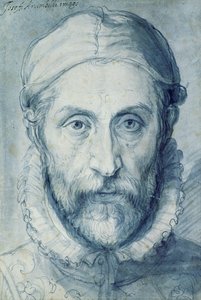
Giuseppe Arcimboldo

Giuseppe Arcimboldo

1527 - 1593, Italy

Quick facts about Giuseppe Arcimboldo

  • Full Name: Giuseppe Arcimboldo
  • Nationality: Italian
  • Date Of Birth: 1527
  • Date Of Death: 1593
  • Place Of Birth: Milan, Italy
  • Notable Artworks:
    • Floral Still Life
    • The Four Seasons
    • Vertumnus
    • The Librarian
  • Artistic Movement Or Style: Mannerism, Surrealism
  • Artists Or Movements Influenced By This Artist:
    • Salvador Dalí
    • Surrealism

Artist Biography

A World Reimagined: The Enigmatic Art of Giuseppe Arcimboldo

Giuseppe Arcimboldo, a name that conjures images both whimsical and profoundly strange, remains one of the most singular figures in Renaissance art. Born in Milan in 1527, his career unfolded against the backdrop of a Europe steeped in intellectual ferment, religious upheaval, and an insatiable curiosity about the natural world. While initially recognized for more conventional works – frescoes adorning cathedrals and portraits adhering to established courtly standards – Arcimboldo’s enduring legacy rests upon a series of composite heads constructed entirely from meticulously arranged objects: fruits, vegetables, flowers, books, even musical instruments. These weren't mere playful exercises in visual trickery; they were complex allegories, imbued with symbolism that resonated deeply within the Renaissance worldview and continue to fascinate audiences today. His father, Biagio Arcimboldo, was an artist himself, providing young Giuseppe with early artistic training and likely influencing his initial foray into design work for stained glass windows and frescoes at Milan Cathedral beginning around 1549. This foundational experience honed his technical skill and eye for detail—qualities that would become hallmarks of his later, more unconventional creations.

Courtly Commissions and the Rise of a Unique Style

Arcimboldo’s trajectory took a significant turn in 1562 when he was appointed court portraitist to Ferdinand I at the Habsburg court in Vienna. This marked the beginning of over two decades serving as an artistic polymath for three successive Habsburg rulers: Maximilian II and his son, Rudolf II. Beyond painting portraits – though even these often displayed subtle eccentricities – Arcimboldo’s duties encompassed costume design, festival decorations, and the organization of imperial collections. It was within this environment of refined taste and intellectual curiosity that his signature style began to blossom. The courtly demand for novelty and spectacle provided fertile ground for experimentation, allowing him to move beyond traditional portraiture towards the creation of his celebrated “composite heads.” These weren’t born from a sudden impulse but evolved gradually, building upon Renaissance fascination with puzzles, riddles, and the exploration of hidden meanings within seemingly ordinary objects. The influence of earlier artists who experimented with *trompe l'oeil* effects and distorted perspectives can be detected, yet Arcimboldo synthesized these elements into something entirely his own—a unique visual language that challenged conventional notions of representation.

Decoding the Symbolism: More Than Meets the Eye

To dismiss Arcimboldo’s work as mere whimsicality is to overlook its profound intellectual depth. Each object within his composite portraits was carefully chosen, laden with symbolic meaning related to the sitter's character, profession, or social status. *The Librarian*, for example, isn’t simply a face constructed from books; it’s a subtle critique of scholarly pretension—a commentary on those who amass knowledge without truly engaging with its content. The animal tails forming the beard represent dusters, hinting at neglected volumes gathering dust on shelves. Similarly, his portraits of the seasons – particularly *Vertumnus*, depicting Emperor Rudolf II as the Roman god of gardens and change – are rich in botanical symbolism, reflecting the emperor’s patronage of science and natural history. These weren't intended to be immediately deciphered; they were designed to provoke contemplation, inviting viewers to unravel layers of meaning hidden within the seemingly playful arrangement of objects. The very act of constructing a human likeness from inanimate matter served as a meditation on the interconnectedness of all things—a reflection of Renaissance Neoplatonism’s belief in the underlying harmony of the universe.

Legacy and Rediscovery: A Precursor to Surrealism

Despite his success during his lifetime, Arcimboldo's reputation waned in the centuries following his death in 1593. His work was often relegated to the realm of curiosities—appreciated for its technical skill but dismissed as lacking serious artistic merit. It wasn’t until the 20th century that a renewed appreciation for his art emerged, fueled by the rise of Surrealism. Artists like Salvador Dalí recognized in Arcimboldo a kindred spirit—a visionary who dared to challenge conventional perceptions and explore the subconscious through unexpected juxtapositions of imagery. The influence of Arcimboldo can be seen in Dalí’s own dreamlike compositions and his fascination with metamorphosis and illusion. Today, Arcimboldo is celebrated as a pivotal figure in art history—a precursor to Surrealism whose innovative use of symbolism and playful distortion continues to inspire artists and captivate audiences worldwide. His paintings are housed in prestigious museums such as the Kunsthistorisches Museum in Vienna and the Louvre in Paris, ensuring that his unique vision will continue to resonate for generations to come. His legacy is a testament to the enduring power of imagination and the ability of art to transform our understanding of the world around us.

§ 5Comparanda

§ 6Questions

Quick Facts

  • Artist: Giuseppe Arcimboldo
  • Influences: Renaissance
  • Medium: Oil on canvas
  • Subject or theme: Allegory of Fire; Elemental symbolism
  • Dimensions: 67 x 51 cm
  • Year: 1566

Art Quiz

There is only one correct answer for each question.

Question 1:
What artistic movement is Giuseppe Arcimboldo’s ‘Fire’ primarily associated with?
Question 2:
The painting depicts a portrait of which subject?
Question 3:
What is the dominant color scheme employed in ‘Fire’?
Question 4:
The artist utilized a technique known for creating illusionistic depth, characteristic of which artistic style?
Question 5:
Symbolically, what might the extensive use of gold in Arcimboldo’s composition represent?

§ 7Cite this entry

AllPaintingsStore.com, “Giuseppe Arcimboldo, Fire (1566)”, https://allpaintingsstore.com/en/art/giuseppe-arcimboldo-fire-8XZ9BR-en/ArtistReproduction/ (accessed 10 October 2026).

§ 8The reproduction

Hand Made Oil Reproduction

Hand-painted oil on canvas in your size and frame, made to order by our artists. ( Switch to Print Switch to Digital Image)

It is specified on the order sheet in the margin; the present state of that sheet reads as follows.

Fire

Reproduction Medium

Reproduction Size

-

Elite Senior Artist

More detail, finesse, and extra production time

-

Reproduction Frame

-

-

For artworks or reproductions larger than 105 cm (approximately 41 inches) on any side, the frame will be shipped as a kit, disassembled. This method ensures safe delivery and prevents damage during transport.

Professional assembly required - this is not a DIY product.
The kit must be assembled and the canvas stretched by an experienced professional framer, using wood glue (not supplied), a canvas stretching plier and clamps to hold the bars square while the glue dries. Incorrect assembly or uneven canvas tension can permanently damage the artwork and is not covered by our warranty.

  • All solid wood bars are included, precisely cut to size.

  • Assembled with the screws provided, plus wood glue for the corner joints, which is not supplied and must be sourced by your framer.

  • Professional tools are required and not included: a canvas stretching plier (tensioner) and clamps to hold the bars square while the glue dries.

Important:
The corner joints require wood glue, the bars must be held with clamps until the glue is fully dry, and tightening the canvas on the assembled frame requires a canvas stretching plier. None of these are included in the kit. Please arrange an experienced professional framer before ordering this size.

Nameplate

-

-

Protective Varnish

Glossy Varnish (enhances colors, protects against light/moisture)

-

Customize My Artwork

Examples of what can be changed: Replace face with customer photo; Add pet (e.g., replace cat with dog); Include hidden message in background; Change background landscape or elements.

-

Urgent

Worldwide Delivery () in 3/4 weeks instead of standard 5 weeks. (7 November). No compromise on quality.

-

Express Shipping

Worldwide Delivery () in 5 weeks. (14 November).

Included

Total Price

$ 258

Included with every order

  • Free Worldwide Express Shipping
  • High-Quality Linen Canvas
  • Full Shipping Insurance
  • Customs Tax Refund Guarantee
  • True Color Matching Guarantee
  • 100-Day Return Policy (Defects Only)
  • 100% Money-Back Guarantee
  • Bulk Discount Offer
Order sheet