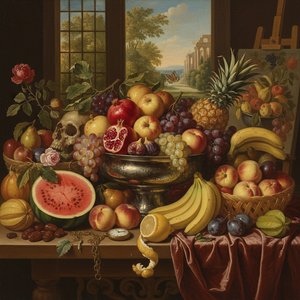
1563. Oil On Canvas, 67.0 x 51.0 cm. Kunsthistorisches Museum.

§ 1Catalogue data

- 67.0 x 51.0 cm


§ 2Abstract
Collectible Description
Discover Giuseppe Arcimboldo’s ‘Winter’! A stunning Mannerist oil painting of a tree-figure, rich in detail & symbolism. Explore this unique artwork's beauty & historical significance.
 Read More
Artist Biography
Discover Giuseppe Arcimboldo (1527-1593), the Italian Mannerist master renowned for his surreal portraits composed of fruits, vegetables & objects. Explore his whimsical yet insightful art!
§ 3Commentary
A Frozen Tableau: The Surreal Majesty of Winter
In the quiet, chilling depths of Giuseppe Arcimboldo’s Winter, we encounter one of the most profound enigmas of the Late Renaissance. Painted around 1563, this masterpiece does not merely depict a season; it breathes life into an allegory of survival and transformation. At first glance, the viewer is met with a striking, anthropomorphic figure—a creature born from the very essence of the earth’s dormant period. This is not a traditional portrait of flesh and bone, but a surrealist precursor that uses the textures of nature to construct a human likeness. The composition centers on a tree-like entity emerging from a woven wicker basket, creating a sense of grounded, organic weight that commands the room. It is a work that demands a second, third, and fourth look, rewarding the observant eye with a hidden world of intricate detail.
The technique employed by Arcimboldo is nothing short of miraculous, showcasing a mastery of Mannerist precision. Using oil paints on canvas, the artist meticulously layered pigments to achieve a tactile richness that feels almost sculptural. One can trace the rugged, furrowed bark of the branches and the delicate, frost-like textures of the foliage through his expert brushwork. The lighting is intentionally dramatic, casting deep shadows against an abyssal black background, which serves to push the illuminated subject forward into the viewer's space. This high-contrast approach, reminiscent of later chiaroscuro, lends the piece a theatrical intensity, making the organic forms appear to glow with an inner, ancient light.
Symbolism and the Cycle of Existence
Beyond its visual trickery, Winter is steeped in the complex intellectual currents of the 16th century. To the Renaissance mind, every element was a vessel for meaning. The choice of a tree-like figure emerging from a basket suggests the concept of latent life—the idea that even in the dead of winter, the seeds of spring are held in a state of suspended animation. The fruits and organic shapes nestled within the composition act as symbols of abundance and the cyclical nature of time, representing the transition between decay and rebirth. For the collector or interior designer, this piece offers more than mere decoration; it provides a profound philosophical anchor, evoking themes of resilience, patience, and the enduring strength of the natural world.
The emotional impact of the artwork is a delicate balance of mystery and unsettling beauty. There is a certain melancholic grandeur in the way the figure stands solitary against the darkness, yet there is also an undeniable sense of wonder. It is a piece that invites contemplation, making it an ideal centerpiece for a sophisticated study, a grand library, or a curated gallery space. As a high-quality reproduction, this painting brings the whimsical yet profound spirit of Arcimboldo into the modern home, offering a window into a time when art was a puzzle to be solved and a mirror held up to the mysteries of the universe.
Questions & Answers
Where do the visitors of "Winter" by Giuseppe Arcimboldo come from?
Statistics about "Winter" by Giuseppe Arcimboldo are on the artwork's Stats page: monthly visits of the artwork, visits of the artist's works, and country and language breakdowns of recent visitors.
How saturated is the palette of "Winter"?
The palette of "Winter" is subtle color in saturation.
What is the creation date of "Winter" by Giuseppe Arcimboldo?
The creation of "Winter" by Giuseppe Arcimboldo is dated 1563.



 Switch to Print


 For artworks or reproductions larger than 105 cm (approximately 41 inches) on any side, the frame will be shipped as a kit, disassembled. This method ensures safe delivery and prevents damage during transport.