- Home

- Oil Painting Reproduction
- Grant Wood
- American Gothic
 Buy print
 Send
Send Share
Share
 Details

 Download
 Similars
 X-Ray
X-Ray Diaporama
American Gothic
 Oil On Canvas
- WallArt
- Regionalism
 1930
1930- Modern
 74.0 x 62.0 cm
 Art Institute of Chicago
 Read More
Hand Made Oil Reproduction
Hand-painted oil on canvas in your size and frame, made to order by our artists.




P118B $10

P118H $10

P118W $10

P438Z $10

P508JH $12

P508YH $12

P805H $10

P805Z $10

P919BZ $10

P919G $10

P919XJ $10

P959ZH $10

P968JZ $12

W106C $8

W218G $10

W218JH $8

W218Y $10

W307PJ $10

W316G $10

W316PJ $8

W316Y $10

W398PJ $8

W4111J $10

W500HY $15

W500JH $15

W692G $12

W849H $8

W940BG $15

W953PJ $8




Pick from our preset sizes that match the artwork's original proportions.

You may enter your own dimensions to fit a specific frame or space. If your selected size does not match the original image's proportions, we will either crop the artwork or extend the painting with additional hand-painted elements. A digital mockup will be sent for your approval before production begins.
Please note that the on-screen preview does not reflect the actual cropping or extension. Only the mockup will accurately show the final composition.
While custom sizes are available, we recommend selecting a dimension from the predefined list to preserve the original proportions.
After order, AllPaintingsStore.com team will email client for instructions and provide a mockup preview
Worldwide Delivery () in 3/4 weeks instead of standard 5 weeks. (16 July). No compromise on quality.

Free Worldwide Express Shipping

High-Quality Linen Canvas

Full Shipping Insurance

Customs Tax Refund Guarantee

True Color Matching Guarantee

60-Day Return Policy (Defects Only)

100% Money-Back Guarantee

Bulk Discount Offer
 Glass option is only available in size under 110 CM

American Gothic
Reproduction Medium
Reproduction Size
-


Total Price
-
Artwork Description
A Quintessential American Vision
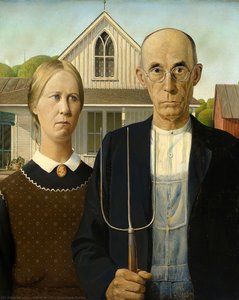
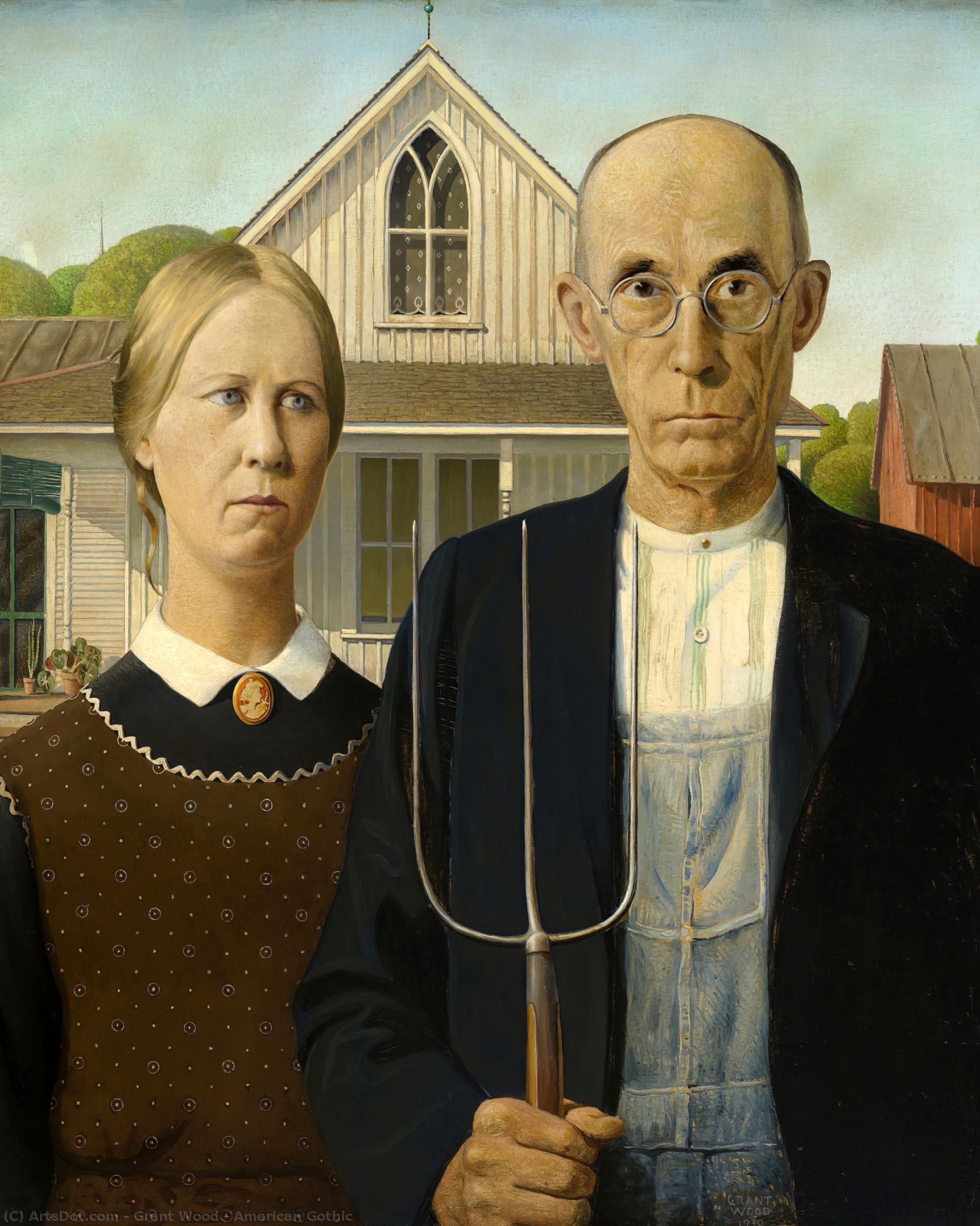
Grant Wood’s 1930 masterpiece, *American Gothic*, transcends its status as a painting; it is a cultural touchstone. More than just a portrait of rural life, this work encapsulates the anxieties and enduring values of a nation grappling with the Great Depression. The iconic image depicts a farmer standing beside his daughter (often mistakenly identified as his wife) before their Carpenter Gothic-style farmhouse – a scene that has become synonymous with American identity itself. Its power lies not only in its realistic depiction but also in its subtle complexities, inviting viewers to contemplate the spirit of a generation.Regionalism & Masterful Technique
*American Gothic* is a cornerstone of the American Regionalist movement, a deliberate rejection of European abstraction in favor of celebrating distinctly American themes and landscapes. Wood’s meticulous technique showcases an almost photographic clarity achieved through oil on beaverboard.- Smooth Brushwork: He employed remarkably smooth brushwork and precise rendering, influenced by his study of Flemish Renaissance masters like Jan van Eyck.
- Flattened Space & Geometric Forms: The deliberate flattening of space and emphasis on geometric forms – the rectangular house, oval faces, triangular pitchfork – contribute to the painting's unique visual impact, setting it apart from traditional portraiture.
- Influence of Flemish Masters: Wood’s dedication to detail and realistic representation echoes the techniques of artists like Jan van Eyck, particularly in the rendering of textures and light.
Decoding the Layers of Symbolism
Every element within *American Gothic* carries symbolic weight. The painting is rich with meaning, inviting ongoing interpretation:- The Pitchfork: Represents hard labor, a direct connection to the land, and American resilience.
- Carpenter Gothic Window: Alludes to religious faith, moral uprightness, and a yearning for traditional values.
- Colonial Print Dress & Somber Expression: Evokes a sense of traditional domesticity and the quiet dignity of rural life. The woman’s expression is deliberately ambiguous, hinting at both strength and constraint.
- Botanical Details: The carefully chosen plants – mother-in-law’s tongue and beefsteak begonia – reappear in Wood's earlier portrait of his mother, adding layers of personal meaning and domestic intimacy.
Emotional Resonance & Enduring Appeal
Beyond its historical significance, *American Gothic* evokes a powerful emotional response. The figures’ stoic expressions invite contemplation on themes of perseverance, tradition, and the complexities of rural existence. Its muted color palette – browns, grays, whites, and pale blues – lends itself beautifully to a variety of interior design styles, from farmhouse chic to modern minimalist spaces. A reproduction brings a touch of American history and artistic sophistication to any room, sparking conversation and inspiring reflection. The painting’s enduring popularity speaks to its ability to resonate with audiences across generations, solidifying its place as an iconic representation of the American spirit.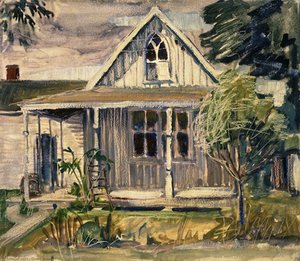


Artist Biography
Early Life and Career
Grant DeVolson Wood, an American painter, was born on February 13, 1891, in rural Iowa. His life changed dramatically after the death of his father in 1901, when his mother relocated the family to Cedar Rapids. Wood began his artistic journey as an apprentice in a local metal shop before enrolling at the Handicraft Guild in Minneapolis in 1910—an art school notable for being run by women and focused on the Arts and Crafts movement.
Artistic Influences and Style
Wood’s art was deeply influenced by Jan van Eyck, the 15th-century Flemish master renowned for his precise and luminous technique. This meticulous clarity became a hallmark of Wood’s own style, best exemplified in his most celebrated work, American Gothic. As a leading figure in the American Regionalism movement—a style emphasizing the realistic depiction of rural and small-town America—Wood developed a uniquely American voice that combined European craftsmanship with Midwestern authenticity.
Notable Works and Contributions
American Gothic (1930): A defining image of 20th-century American art, often compared to Leonardo da Vinci’s Mona Lisa and Edvard Munch’s The Scream for its cultural resonance. The Stone City Art Colony (1932): Founded by Wood near his hometown, the colony provided vital support for artists during the Great Depression. University of Iowa School of Art (1934–1941): As a teacher, Wood inspired a generation of artists to find beauty and meaning in the familiar landscapes of the American Midwest.
Legacy and Later Life
Grant Wood passed away on February 12, 1942, at the age of 51, due to pancreatic cancer. His estate was left to his sister, Nan Wood Graham—immortalized as the female figure in American Gothic. Today, his personal belongings and many of his works are preserved at the Figge Art Museum in Davenport, Iowa. Wood’s devotion to portraying the dignity of everyday American life continues to influence artists and scholars worldwide.

Grant Wood
1891 - 1942 , United States of America
Quick Facts
- Artistic Movement Or Style: American Regionalism
- Artists Or Movements Influenced By This Artist: ['Regionalism']
- Artists Who Influenced This Artist: ['Jan van Eyck']
- Date Of Birth: February 13, 1891
- Date Of Death: February 12, 1942
- Full Name: Grant DeVolson Wood
- Nationality: American
- Notable Artworks:
- American Gothic
- Portrait of Nan
- The Appraisal
- Spring In Town
- Place Of Birth: Anamosa, USA
Related Articles

Grant Wood & American Regionalism: Identity, Myth & the Rural Landscape
Explore the world of Grant Wood & American Regionalism with AllPaintingsStore. Discover the symbolism behind 'American Gothic', recurring themes, and the movement's lasting impact on art history. High-quality reproductions available.

Evoking Arcadia: A Historical & Aesthetic Exploration of Rural Landscape Art
Explore the rich history of pastoral landscape art, from classical Arcadia to Impressionism & beyond. Discover key artists, movements, and how to collect serene rural scenes for your home. Expert insights at AllPaintingsStore.
Echoes of Place: Regionalism & American Identity in Interwar Art
Explore the rise of American Regionalism in interwar art! Discover Grant Wood, Thomas Hart Benton & the movement's impact on American identity. Expert analysis & historical context.

Concrete Visions: Exploring the Urban Landscape in Painting – From Realism to Contemporary Art
Explore the evolution of cityscape painting from Realism to contemporary art with AllPaintingsStore. Discover key artists & invest in timeless urban visions. Expert guidance, museum-quality reproductions.

Cultivating Visions: A Historical Journey Through Rural Landscapes in Art
Explore the rich history of rural landscape painting with AllPaintingsStore. Discover Impressionist masterpieces, key artists & movements. Find your perfect serene artwork and bring nature's beauty home.