

- Home

- Oil Painting Reproduction
- Grant Wood
- Daughters of Revolution

 Buy print
 Send
Send Share
Share
 Details

 Download
 Similars
 X-Ray
X-Ray Diaporama
Daughters of Revolution
 Oil On Panel
- Other
- Regionalism
 1932
1932- Modern
 101.0 x 50.0 cm
 Read More
Hand Made Oil Reproduction
Hand-painted oil on canvas in your size and frame, made to order by our artists.




































Pick from our preset sizes that match the artwork's original proportions.

You may enter your own dimensions to fit a specific frame or space. If your selected size does not match the original image's proportions, we will either crop the artwork or extend the painting with additional hand-painted elements. A digital mockup will be sent for your approval before production begins.
Please note that the on-screen preview does not reflect the actual cropping or extension. Only the mockup will accurately show the final composition.
While custom sizes are available, we recommend selecting a dimension from the predefined list to preserve the original proportions.
After order, AllPaintingsStore.com team will email client for instructions and provide a mockup preview
Worldwide Delivery () in 3/4 weeks instead of standard 5 weeks. (16 July). No compromise on quality.

Free Worldwide Express Shipping

High-Quality Linen Canvas

Full Shipping Insurance

Customs Tax Refund Guarantee

True Color Matching Guarantee

60-Day Return Policy (Defects Only)

100% Money-Back Guarantee

Bulk Discount Offer
 Glass option is only available in size under 110 CM

Daughters of Revolution
Reproduction Medium
Reproduction Size
-


Total Price
-
Artwork Description
A Quiet Commentary on American Identity
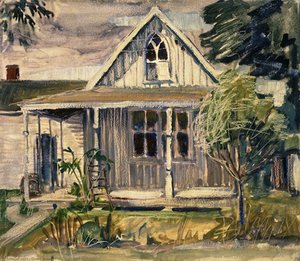
Grant Wood’s 1932 painting is a striking example of Regionalism, an artistic movement that rejected European abstraction in favor of depicting realistic scenes of rural American life. This work, however, transcends simple representation; it's a subtly provocative statement about history, memory, and the evolving role of women within American society. The composition presents three figures – two flanking portraits of women positioned before a depiction of Washington Crossing the Delaware.Decoding the Composition & Style
The artwork’s triptych-like structure immediately draws the eye. Wood employs a deliberate flatness and simplified forms reminiscent of folk art, creating an intriguing contrast with the detailed rendering of the female subjects. The symmetry lends balance but also a sense of formality, emphasizing the connection between the women and the historical event unfolding behind them. This isn’t merely observation; it's carefully constructed dialogue. Wood masterfully uses scale, positioning the figures prominently to assert their presence within the narrative.Technique & Palette: A Muted Resonance
Executed in oil on panel, the painting showcases Wood’s meticulous technique. Brushwork is smooth yet not overly refined, lending a tactile quality to the surfaces. The color palette is deliberately muted – earthy tones dominate, with skin tones ranging from peach to brown and clothing rendered in blues and grays. Touches of red within the historical scene's flags provide subtle focal points. Gold frames around each panel add warmth but don’t distract from the overall somber mood. This restrained use of color contributes significantly to the artwork’s introspective atmosphere.Historical Context & Symbolic Weight
Painted in 1932, this work directly references a contentious moment in American history and Wood's own experiences. The Daughters of the American Revolution (DAR) had publicly criticized his use of German-made glass for a veterans memorial, fueling his satirical intent. The inclusion of Emanuel Leutze’s iconic *Washington Crossing the Delaware* – itself painted by a German-American artist – adds another layer of irony. The teacup held by the central figure is particularly poignant, symbolizing domesticity and perhaps questioning traditional feminine roles against the backdrop of wartime heroism.Emotional Impact & Lasting Appeal
The women’s stoic expressions and direct gaze invite contemplation. They aren't active participants in the historical scene; rather, they are observers, inheritors of a legacy. This creates an emotional weight conveyed through stillness and quiet resilience. Wood described it as his only satire, and that critical edge resonates even today. It prompts viewers to consider how history is remembered, who gets to tell those stories, and the often-overlooked contributions of women in shaping national identity. Owning a reproduction of this artwork isn’t just acquiring a beautiful image; it's inviting a conversation starter and a piece of American art history into your space.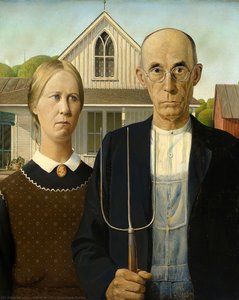


Artist Biography
Early Life and Career
Grant DeVolson Wood, an American painter, was born on February 13, 1891, in rural Iowa. His life changed dramatically after the death of his father in 1901, when his mother relocated the family to Cedar Rapids. Wood began his artistic journey as an apprentice in a local metal shop before enrolling at the Handicraft Guild in Minneapolis in 1910—an art school notable for being run by women and focused on the Arts and Crafts movement.
Artistic Influences and Style
Wood’s art was deeply influenced by Jan van Eyck, the 15th-century Flemish master renowned for his precise and luminous technique. This meticulous clarity became a hallmark of Wood’s own style, best exemplified in his most celebrated work, American Gothic. As a leading figure in the American Regionalism movement—a style emphasizing the realistic depiction of rural and small-town America—Wood developed a uniquely American voice that combined European craftsmanship with Midwestern authenticity.
Notable Works and Contributions
American Gothic (1930): A defining image of 20th-century American art, often compared to Leonardo da Vinci’s Mona Lisa and Edvard Munch’s The Scream for its cultural resonance. The Stone City Art Colony (1932): Founded by Wood near his hometown, the colony provided vital support for artists during the Great Depression. University of Iowa School of Art (1934–1941): As a teacher, Wood inspired a generation of artists to find beauty and meaning in the familiar landscapes of the American Midwest.
Legacy and Later Life
Grant Wood passed away on February 12, 1942, at the age of 51, due to pancreatic cancer. His estate was left to his sister, Nan Wood Graham—immortalized as the female figure in American Gothic. Today, his personal belongings and many of his works are preserved at the Figge Art Museum in Davenport, Iowa. Wood’s devotion to portraying the dignity of everyday American life continues to influence artists and scholars worldwide.

Grant Wood
1891 - 1942 , United States of America
Quick Facts
- Artistic Movement Or Style: American Regionalism
- Artists Or Movements Influenced By This Artist: ['Regionalism']
- Artists Who Influenced This Artist: ['Jan van Eyck']
- Date Of Birth: February 13, 1891
- Date Of Death: February 12, 1942
- Full Name: Grant DeVolson Wood
- Nationality: American
- Notable Artworks:
- American Gothic
- Portrait of Nan
- The Appraisal
- Spring In Town
- Place Of Birth: Anamosa, USA
Related Articles

Grant Wood & American Regionalism: Identity, Myth & the Rural Landscape
Explore the world of Grant Wood & American Regionalism with AllPaintingsStore. Discover the symbolism behind 'American Gothic', recurring themes, and the movement's lasting impact on art history. High-quality reproductions available.

The Ashcan School: Realism, Urban Life & the Democratization of American Art
Explore the revolutionary Ashcan School! Discover how artists like Henri & Sloan challenged tradition with gritty realism, capturing urban life in early 20th-century America. Learn about their impact on American art history.

Oil on Canvas Masters: 10 Paintings That Redefined Art History |
Journey through art history with our guide to 10 legendary oil on canvas masterpieces! Explore iconic works by Van Gogh, Monet & Rembrandt. Find museum-quality reproductions and elevate your home decor at . Discover all masterpieces online.

Framing the Past: Art as a Window into Human History – A Cultural Chronicle of Empires, Revolutions, and Social Transformations
Explore art history's profound stories! Discover how masterpieces reflect empires, revolutions & culture. Expert analysis, collecting guides & bespoke reproductions at AllPaintingsStore.

American Realism: Social Commentary & Artistic Representation in Early 20th-Century Painting
Explore the powerful social commentary & artistic representation of American Realism. Discover key artists like Bellows & Sloan, and understand the movement's lasting impact on 20th-century art history.





