

Composition Design for
1882. Acrylic On Canvas. Albertina.

§ 1Catalogue data


§ 2Abstract
Collectible Description
 Read More
Artist Biography
Gustav Klimt was an Art Nouveau master known for The Kiss. Explore his shimmering golden phase and iconic portraits today.
§ 3Commentary
A Glimpse Behind the Veil: Gustav Klimt’s Composition Design for “Composition Design for”
Gustav Klimt's "Composition Design for," dated 1882, isn’t merely a preparatory sketch; it’s a tantalizing window into the genesis of one of his most iconic paintings. This drawing, rendered with a confident hand and a nascent understanding of the opulent style that would define his career, offers a remarkably intimate view of Klimt's creative process – a world of swirling patterns, veiled figures, and the shimmering promise of gold. The work itself is deceptively simple in its execution, yet brimming with the seeds of the complex symbolism and decorative intensity that would characterize his mature oeuvre. It’s a testament to Klimt’s early experimentation, a crucial stepping stone on his path toward revolutionizing Viennese art.
Born in Baumgarten near Vienna in 1862, Klimt's artistic lineage was inextricably linked to the world of craftsmanship. His father, Ernst Klimt, a gold engraver, instilled within young Gustav not just an appreciation for intricate detail and luxurious materials – qualities vividly reflected in the drawing’s subtle layering of charcoal – but also a deep understanding of how surfaces could be manipulated to create illusion and depth. This familial connection to the decorative arts would prove profoundly influential, shaping Klimt's later embrace of gold leaf and his exploration of patterns as vehicles for emotional expression. The transient upbringing that followed, marked by frequent moves within Vienna, undoubtedly sharpened his observational skills, allowing him to capture the nuances of human interaction with a remarkable sensitivity.
The Dance of Form and Figure
The drawing depicts a group of figures engaged in various activities – seated on a bench, standing in conversation, seemingly lost in their own thoughts. The arrangement is deliberately loose, prioritizing gesture and atmosphere over precise representation. Klimt isn’t striving for photographic realism; instead, he's capturing the *feeling* of a social gathering, the unspoken dynamics between individuals. Notice how he uses overlapping forms to create a sense of spatial ambiguity – figures seem to emerge from and recede into one another, blurring the boundaries between foreground and background. This technique anticipates Klimt’s later development of his signature flattened picture plane, where decorative elements become integral to the narrative.
The seated figure, positioned centrally, is particularly intriguing. Their posture suggests a moment of contemplation or perhaps even melancholy. The surrounding figures, though less defined, contribute to the overall mood of quiet intimacy. Klimt’s masterful use of shading and line work subtly reveals their forms, hinting at clothing, facial features, and body language without resorting to detailed rendering. This restraint is deliberate; it allows the viewer's imagination to fill in the gaps, creating a more personal connection with the scene.
Symbolism and the Dawn of Ornamentation
Even in this preliminary sketch, traces of Klimt’s future symbolic language begin to emerge. The use of geometric patterns – particularly evident in the suggestion of drapery and architectural elements – foreshadows his later obsession with ornamentation. These aren't merely decorative flourishes; they represent a deeper engagement with themes of sexuality, spirituality, and the duality of masculine and feminine energies. The potential for gold, so central to Klimt’s mature work, is already palpable in the drawing’s subtle tonal variations and the suggestion of shimmering surfaces.
Considering the historical context – Vienna at the turn of the 20th century was a hub of artistic innovation, grappling with issues of modernity, sexuality, and social change – “Composition Design for” can be seen as a reflection of these turbulent times. Klimt’s work challenged conventional notions of beauty and representation, paving the way for new forms of artistic expression. The drawing itself embodies this spirit of experimentation, offering a glimpse into an artist on the cusp of greatness.
Bringing Klimt to Your Space: A High-Quality Reproduction
AllPaintingsStore offers meticulously crafted hand-painted reproductions of Gustav Klimt’s “Composition Design for,” capturing the essence of this pivotal work with unparalleled fidelity. Our artists utilize traditional techniques and archival-quality materials to ensure that each reproduction faithfully replicates the drawing's delicate details, nuanced tonal range, and atmospheric depth. Whether you are an art collector, interior designer seeking a touch of Viennese elegance, or simply an admirer of Klimt’s genius, our reproductions provide a beautiful and authentic way to experience this remarkable piece of art history. Explore the collection today and bring the captivating world of Gustav Klimt into your home.
Questions & Answers
Where in Gustav Klimt's career does "Composition Design for" fall, given its date?
Given its 1882 date, "Composition Design for" falls in Gustav Klimt's Early Maturity.
What is "Composition Design for" about?
The subjects of "Composition Design for" are klimt, vienna, figures, bench, conversation, gold, ornamentation, sketch.
Which color stands out most in "Composition Design for"?
The dominant color of "Composition Design for" by Gustav Klimt is putty (#e6ceb2).
§ 4The artist
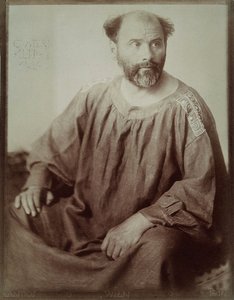
Gustav Klimt
1862 - 1918, Austria
Quick Facts
- Artistic Movement Or Style:
- Symbolism
- Art Nouveau
- Vienna Secession
- Artists Or Movements Influenced By This Artist:
- Egon Schiele
- Art Nouveau
- Artists Who Influenced This Artist: ['Hans Makart']
- Full Name: Gustav Klimt
- Nationality: Austrian
- Notable Artworks:
- The Kiss
- Portrait of Adele Bloch-Bauer I
- Place Of Birth: Baumgarten, Austria
- Date Of Birth: 1862
- Date Of Death: 1918
Artist Biography
A Life Forged in Gold and Shadow
Born on July 14, 1862, in Baumgarten, near Vienna, Gustav Klimt entered a world where the boundaries of art and craft were intimately linked. His father, Ernst Klimt, worked as a gold engraver, a profession that left an indelible mark on his son’s visual language. The young Gustav learned to appreciate the weight of precious metals and the precision of fine detail long before he ever held a brush. This early exposure to the luster of gold leaf would later define his most famous period. Despite the financial hardships that forced his family through frequent moves within Vienna, his talent was undeniable. By 1876, he had entered the Vienna Kunstgewerbeschule, focusing on architectural painting under Ferdinand Laufberger.
His early professional years were marked by a steady, academic success. Alongside his brother Ernst and Franz von Matsch, Klimt formed a partnership that secured essential commissions for decorative murals and ceilings. These works required a disciplined hand and an eye for large-scale ornamentation. He found himself working on significant projects, such as the staircases of the Burgtheater in Vienna, earning the Gold Cross of Merit from Emperor Franz Joseph I. During this time, he looked toward the historical styles of Hans Makart, yet a restless energy was already beginning to stir beneath his formal training.
The Rebellion of the Secession
By the late 1890s, the constraints of the Viennese academic establishment had become stifling. Klimt sought a space where innovation could exist outside the rigid dictates of tradition. In 1897, he became the first president of the Vienna Secession, a movement designed to embrace new currents like Art Nouveau, Symbolism, and Japonism. This was an era of profound change, and Klimt stood at its center. He rejected the heavy, historical academicism in favor of organic lines and symbolic depth. His work began to explore the complexities of human intimacy, sexuality, and mortality with a frankness that often unsettled the conservative public.
This period of defiance brought both significant friction and profound creative growth. A notable instance occurred around 1900, when his commissions for the University of Vienna ceiling paintings—specifically Philosophy—were criticized as being too provocative. The backlash was severe enough that Klimt eventually withdrew from further public commissions, choosing instead to focus on private patronage. This shift allowed him to refine a more personal, decorative style. He drew heavily from the flattened perspectives and patterned aesthetics of Japanese art, integrating these elements into compositions that blurred the distinction between fine painting and ornamental design.
The Golden Era and Final Transitions
Around 1900, Klimt entered his most recognizable phase, often called his golden period. Inspired by the mosaics of Ravenna and medieval manuscripts, he began using gold leaf to create surfaces that seemed to radiate their own light. Works such as The Kiss (1907-1908) demonstrate this mastery, featuring figures enveloped in a shimmering, patterned aura. His portraits from this time, including the Portrait of Adele Bloch-Bauer I, captured more than mere physical likeness; they conveyed a psychological weight through the use of intricate, mosaic-like textures.
As his life drew toward its end, Klimt’s style underwent another subtle transformation. The heavy ornamentation of the golden phase began to give way to a more restrained and angular aesthetic. In works completed in 1918, such as The Jurisprudence, there is a move toward expressive simplification and sharper lines, perhaps reflecting the influence of the burgeoning Expressionist movement. His final years were marked by this continued evolution, even as he faced the physical toll of the Spanish Flu pandemic. He passed away on February 6, 1918, leaving behind a body of work that fundamentally altered the trajectory of Austrian modernism.
§ 5Comparanda
Related Artworks


§ 6Questions
§ 7Further reading
Related Articles

The Vienna Secession: A Golden Revolution of Modernism and the Legacy of Gustav Klimt
Explore the profound impact of the Vienna Secession movement. Discover how visionaries like Gustav Klimt revolutionized modern art through symbolism, gold leaf, and the concept of Gesamtkunstwerk in this expert-led historical guide.

Art Nouveau's Golden Age: 10 Masterpieces for Your Home |
Journey into Art Nouveau's golden age! Explore 10 masterpieces by Klimt, Mucha & more. Discover captivating stories behind iconic paintings, floral motifs & flowing lines. Find museum-quality art reproductions for your home at .
25 Klimt Masterpieces: A Journey Through Iconic Art & Decor
Delve into the world of Gustav Klimt with our top 25 masterpieces! Explore his iconic paintings – 'The Kiss,' 'Portrait of Adele,' and more. Discover museum-quality reproductions & curated decor ideas. Explore the full collection online at AllPaintingsStore.com.

Golden Masterpieces: 10 Paintings That Define Art History | AllPaintingsStore
Explore 10 breathtaking paintings where gold leaf shines! From Klimt to Byzantine icons, discover art history’s most gilded masterpieces. Find museum-quality reproductions & elevate your home decor with AllPaintingsStore. Explore the full collection online.

Gustav Klimt: A Golden Legacy of Sensuality & Symbolism in Viennese Art
Explore the captivating world of Gustav Klimt with AllPaintingsStore. Discover his iconic paintings, the Vienna Secession movement, & enduring legacy. High-quality reproductions available.
Cite this entry
AllPaintingsStore.com, “Gustav Klimt, Composition Design for (1882)”, https://allpaintingsstore.com/en/art/gustav-klimt-composition-design-for-D3WVGH-en/ArtistReproduction/ (accessed 1 October 2026).
§ 8The reproduction
Hand Made Oil Reproduction
Hand-painted oil on canvas in your size and frame, made to order by our artists. ( Switch to Print Switch to Digital Image)
It is specified on the order sheet in the margin; the present state of that sheet reads as follows.

Composition Design for
Reproduction Medium
Reproduction Size
-

Elite Senior Artist
More detail, finesse, and extra production time
-

Reproduction Frame
-
-
For artworks or reproductions larger than 105 cm (approximately 41 inches) on any side, the frame will be shipped as a kit, disassembled. This method ensures safe delivery and prevents damage during transport.
Professional assembly required - this is not a DIY product.
The kit must be assembled and the canvas stretched by an experienced professional framer, using wood glue (not supplied), a canvas stretching plier and clamps to hold the bars square while the glue dries. Incorrect assembly or uneven canvas tension can permanently damage the artwork and is not covered by our warranty.
 For artworks or reproductions larger than 105 cm (approximately 41 inches) on any side, the frame will be shipped as a kit, disassembled. This method ensures safe delivery and prevents damage during transport.
All solid wood bars are included, precisely cut to size.
Assembled with the screws provided, plus wood glue for the corner joints, which is not supplied and must be sourced by your framer.
Professional tools are required and not included: a canvas stretching plier (tensioner) and clamps to hold the bars square while the glue dries.
Important:
The corner joints require wood glue, the bars must be held with clamps until the glue is fully dry, and tightening the canvas on the assembled frame requires a canvas stretching plier. None of these are included in the kit. Please arrange an experienced professional framer before ordering this size.

Nameplate
-
-

Protective Varnish
Glossy Varnish (enhances colors, protects against light/moisture)
-

Customize My Artwork
Examples of what can be changed: Replace face with customer photo; Add pet (e.g., replace cat with dog); Include hidden message in background; Change background landscape or elements.
-

Urgent
Worldwide Delivery () in 3/4 weeks instead of standard 5 weeks. (29 October). No compromise on quality.
-
Express Shipping
Worldwide Delivery () in 5 weeks. (5 November).
Included
Total Price
$ 258
Included with every order
- Free Worldwide Express Shipping
- High-Quality Linen Canvas
- Full Shipping Insurance
- Customs Tax Refund Guarantee
- True Color Matching Guarantee
- 100-Day Return Policy (Defects Only)
- 100% Money-Back Guarantee
- Bulk Discount Offer


