

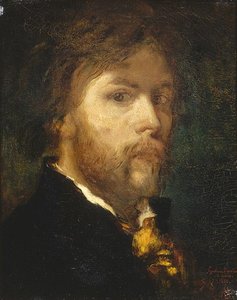
1874. Acrylic On Canvas. Musée Gustave Moreau.

§ 1Catalogue data


§ 2Abstract
Collectible Description
 Read More
Artist Biography
Explore the captivating Symbolist art of Gustave Moreau (1826-1898), famed for mythological & biblical paintings like 'Salome'. Influenced Matisse & Rouault. Discover his dreamlike world!
§ 3Commentary
A Descent into Mythic Reverie: Exploring Gustave Moreau’s “Messalina”
Gustave Moreau's "Messalina," completed in 1874, stands as a cornerstone of Symbolist painting—a testament to an artist who deliberately rejected the observational realism championed by his contemporaries and instead sought to distill profound spiritual truths from the depths of imagination. Housed within the Musée Gustave Moreau in Paris, this watercolor offers more than just visual beauty; it invites contemplation on themes of morality, desire, and the inescapable influence of mythology upon human experience. ### The Visual Narrative: Composition and Symbolism’s Dance Moreau meticulously crafted a scene steeped in dramatic tension and layered symbolism. Two nude women dominate the composition, positioned intimately within a richly ornamented room—a deliberate choice mirroring classical depictions of Venus and Adonis. One woman cradles the other, creating an image of vulnerability and dependence that speaks to broader anxieties about female sexuality and societal expectations during the Victorian era. Scattered throughout the space are figures representing various allegorical elements: a standing man embodies authority and judgment, while three others contribute to the unsettling atmosphere—perhaps symbolizing hidden desires or unresolved conflicts. Crucially, two birds – one perched atop a chandelier and another nestled amongst foliage – serve as potent symbols of transcendence and divine grace, subtly elevating the scene beyond mere earthly concerns. Moreau’s masterful use of watercolor lends an ethereal quality to the artwork, blurring boundaries between reality and dream—a characteristic hallmark of Symbolist aesthetics. ### Technique and Artistic Vision: Watercolor's Delicate Embrace Moreau’s technique exemplifies the meticulous precision demanded by Symbolist painting. He employed a glazing method—applying thin layers of translucent pigment over previously painted surfaces—to build up color gradually, achieving luminous effects that capture the subtle nuances of light and shadow. The artist’s painstaking attention to detail is evident in every brushstroke, from the intricate drapery folds to the delicate rendering of textures—particularly noticeable in the opulent furnishings of the room. This deliberate process underscores Moreau's belief that art should strive for an idealized representation of inner experience rather than a slavish imitation of external appearances. The watercolor medium itself was chosen not merely for its aesthetic qualities but also for its ability to convey mood and emotion with unparalleled subtlety. ### Historical Context: Symbolism’s Rebellion Against Impressionism “Messalina” emerged during a period of significant artistic ferment—the burgeoning Symbolist movement challenged the dominant Impressionist preoccupation with capturing fleeting sensory impressions. Artists like Moreau rejected the scientific objectivity favored by Impressionists, arguing instead for the primacy of emotion and intuition as sources of artistic inspiration. Influenced by thinkers such as Nietzsche and Wagner, Symbolism sought to explore the subconscious mind and grapple with existential questions—themes that resonated deeply within the intellectual climate of late 19th-century France. Moreau’s work aligns perfectly with this broader cultural shift, reflecting a desire to reconnect with spiritual traditions and confront the anxieties of modernity. ### Emotional Resonance: A Portrait of Inner Turmoil Ultimately, “Messalina” transcends its formal elements—composition, technique, and historical context—to convey a profound emotional resonance. The painting evokes feelings of unease, contemplation, and perhaps even melancholy—a reflection of Moreau’s own preoccupation with themes of morality and the complexities of human relationships. Its haunting beauty lies in its ability to provoke introspection and invite viewers to confront uncomfortable truths about desire, judgment, and the enduring power of mythic narratives. It remains a captivating masterpiece that continues to inspire admiration for its artistic innovation and its capacity to communicate timeless psychological insights.Questions & Answers
Where is "Messalina" by Gustave Moreau on display today?
"Messalina" by Gustave Moreau is on display at the Musée Gustave Moreau, Paris, France. The museum listing refers to the original work, not to reproductions.
Is a high-resolution download of "Messalina" available?
"Messalina" is available as a high-resolution digital image download, purchased directly on its Digital Image page.
How does the subject of "Messalina" relate to Gustave Moreau's usual themes?
Among Gustave Moreau's recorded themes - mythological imagery, spiritual symbolism, dramatic composition, artist’s vision, oeuvre significance - "Messalina" brings its own focus on mythology, symbolism, nakedness, watercolor, allegory, drama, birds.


 Switch to Print


 For artworks or reproductions larger than 105 cm (approximately 41 inches) on any side, the frame will be shipped as a kit, disassembled. This method ensures safe delivery and prevents damage during transport.


