Money-Back Guarantee · 100 days Free Worldwide Delivery
449,587artworks 30,613artists 4,660museums 32languages
Currency
    Language
      Atelier · Est. 2015 · Paris, France
      AllPaintingsStore
      allpaintingsstore.com
      Catalogue entry

      St Christopher

      Oil On Panel.

      Fig. 1. Hieronymus Bosch, St Christopher. Shown as the reproduction you are specifying: , .

      § 1Catalogue data

      § 2Abstract

      Collectible Description

      Bosch’s haunting St Christopher portrays a surreal landscape populated by symbolic birds amidst a mountainous backdrop—a masterpiece of the Early Netherlandish Renaissance that captures unsettling beauty and invites contemplation.

      Artist Biography

      Discover Hieronymus Bosch (c. 1450-1516), Dutch Renaissance master of surrealism & symbolism. Explore his iconic paintings, religious themes, and nightmarish visions – a lasting influence on art history.

      § 3Commentary

      The Vision of Saint Christopher

      In the hauntingly beautiful realm of Hieronymus Bosch, the painting St Christopher emerges as a profound window into the Early Netherlandish Renaissance. The scene captures a moment of immense spiritual and physical weight, as the giant Saint Christopher carries the Christ child across a river. As he traverses the water, the child’s presence becomes an unbearable burden, for he carries within him the weight of all the sins of the world. This singular act of devotion transforms a simple crossing into a monumental encounter between the earthly and the divine.

      The landscape itself is a surreal tapestry of symbolic elements set against a backdrop of distant mountains. Within this meticulously detailed environment, several figures are positioned throughout the scene, including individuals near the left, center, and right sides of the composition. The atmosphere is further populated by birds that drift through the sky—one located above the center-left, another on the far right, and a third near the top left corner. Through this blend of meticulous detail and imaginative imagery, Bosch invites the viewer into a world where the boundaries between reality and the supernatural are beautifully blurred.

      Technical Details and Composition

      The artwork is characterized by its use of oil on panel, a medium that allows for the luminous colors and intricate textures so central to Bosch's style. The composition is structured around the movement of the saint through the landscape, utilizing a palette that includes pigments such as azurite, lead-tin yellow, vermilion, red lake, and ochres. These elements work together to define the river, the green and blue landscapes, and the sky.

      Key visual components include:

      • A mountainous background providing depth to the scene.
      • The central figure of Saint Christopher bearing the Christ child.
      • Various individuals placed in different positions across the landscape.
      • Three distinct birds positioned in the upper portions of the painting.

      Questions & Answers

      Is "St Christopher" by Hieronymus Bosch a bright or a dark artwork?

      Overall, "St Christopher" is recorded as deep_shadow. Perceived brightness describes how light or dark the work appears.

      Can I watch "St Christopher" as a full-screen slideshow?

      The diaporama of "St Christopher" can be watched on the artwork's Diaporama page.

      Is there a guide for "St Christopher" by Hieronymus Bosch?

      The guide to "St Christopher" is the artwork's Guide page - a printable factsheet showing the artwork with its caption, credit line and identity table (artist, dates, medium, original size, collection).
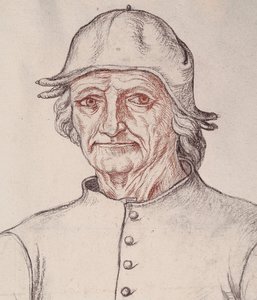
      § 4The artist

      Hieronymus Bosch

      Hieronymus Bosch

      1450 - 1516, Netherlands

      Artist Biography

      A Netherlandish Enigma: The Life and Art of Hieronymus Bosch

      Born around 1450 in the vibrant, bustling town of ’s-Hertogenbosch in the Netherlands—then part of Brabant—Hieronymus Bosch, originally Jheronimus van Aken, remains one of art history’s most compelling and mysterious figures. His world was steeped in late medieval religious fervor, folklore, and a growing sense of societal unease, all of which would profoundly shape his uniquely unsettling artistic vision. Coming from a family with a long tradition of painting—his grandfather, Jan van Aken, and father, Anthonius van Aken, were both artists—Bosch likely received his earliest training within the family workshop, absorbing the techniques and conventions of Netherlandish painting. However, even in his formative years, he began to diverge from established norms, hinting at the extraordinary imagination that would define his career. Biographical details are frustratingly scarce; records are fragmented, leaving much open to speculation and interpretation, adding to the aura of mystique surrounding both the man and his work. He married Aleyt Goyaerts van den Meerveen sometime before 1481, a union that provided him with some financial security through her family’s holdings, but little else is known about their personal life.

      Fantastical Visions and Symbolic Depths

      Bosch's artistic style is instantly recognizable—a captivating blend of meticulous detail and wildly imaginative imagery. He primarily worked with oil on oak panels, demonstrating a masterful command of the medium, achieving luminous colors and intricate textures. While his early works show influences from traditional Netherlandish painting, particularly in their realism and attention to detail, he quickly moved beyond mere imitation, developing a profoundly original vision. His paintings are not simply representations of reality; they are allegorical landscapes populated by bizarre creatures, hybrid beings, and unsettling scenes that seem plucked from dreams—or nightmares. Religious themes form the core of much of his work, but these are rarely straightforward depictions of biblical stories. Instead, Bosch uses symbolism to explore complex moral and theological concepts, often focusing on the dangers of sin, the fragility of earthly pleasures, and the inevitability of divine judgment. His creatures—grotesque demons, fantastical animals, and strangely human figures—are not merely decorative elements; they are embodiments of vice, temptation, and spiritual corruption. The blending of the sacred and the profane, the beautiful and the grotesque, creates a uniquely unsettling effect that continues to captivate viewers centuries later.

      Masterpieces of Moral Allegory

      Among Bosch’s most celebrated achievements is The Garden of Earthly Delights (c. 1490-1510), a triptych that remains one of the most enigmatic and debated works in art history. When opened, it presents a panoramic vision of paradise, earthly life, and hell—a complex allegorical representation of humanity’s fall from grace. The left panel depicts the Garden of Eden, teeming with fantastical creatures and lush vegetation; the central panel portrays a world consumed by sensual pleasure and unrestrained desire; and the right panel offers a terrifying glimpse into the torments of hell. The Triptych of the Last Judgement (c. 1480-1490) is another powerful example of his skill in portraying both heavenly bliss and infernal torment, while The Ascent of the Blessed (c. 1480-1490) demonstrates his ability to create ethereal and dreamlike scenes. Even smaller works like Epiphany (c. 1495) showcase his innovative use of oil on wood and complex symbolism, revealing a mind constantly grappling with profound questions about faith, morality, and the human condition.

      Legacy and Enduring Influence

      Identifying Bosch’s direct influences is a challenging task, given the originality of his vision. Scholars suggest possible connections to medieval folklore, religious texts—particularly those emphasizing apocalyptic themes—and the prevailing anxieties of the time, including fears of heresy and social upheaval. However, it's clear that he synthesized these elements into something entirely new and uniquely his own. His impact on subsequent artists is undeniable. Pieter Bruegel the Elder directly followed in his footsteps, adopting similar themes and compositional techniques, while later movements, such as Surrealism, also drew inspiration from Bosch’s dreamlike imagery and exploration of the subconscious. Artists like Salvador Dalí and Max Ernst openly acknowledged their debt to his unsettling visions. Even today, Bosch's work continues to fascinate and provoke debate, solidifying his place as a master of Netherlandish painting and a visionary artist whose influence extends far beyond his own time. His paintings offer valuable insights into the religious, social, and psychological climate of the late 15th and early 16th centuries, challenging conventional norms and paving the way for new forms of artistic expression. He died in 1516, leaving behind a body of work that continues to haunt and inspire, ensuring his enduring legacy as one of art history’s most singular and unforgettable voices.

      § 5Comparanda

      § 6Questions

      Quick Facts

      • Subject or theme: Saint Christopher carrying a child
      • Movement: Late Gothic Style
      • Notable elements or techniques: Symbolic birds and mountainous backdrop

      Art Quiz

      There is only one correct answer for each question.

      Question 1:
      Who is the artist of the painting 'St Christopher'?
      Question 2:
      What is being depicted in the scene of the painting?
      Question 3:
      Where can the mountains mentioned in the description be seen?
      Question 4:
      How many birds are visible in the painting according to the description?
      Question 5:
      What is the location of the bird mentioned as being near the top left corner?

      § 7Cite this entry

      AllPaintingsStore.com, “Hieronymus Bosch, St Christopher”, https://allpaintingsstore.com/en/art/hieronymus-bosch-st-christopher-9H69TL-en/ArtistReproduction/ (accessed 2 October 2026).

      § 8The reproduction

      Hand Made Oil Reproduction

      Hand-painted oil on canvas in your size and frame, made to order by our artists. ( Switch to Print Switch to Digital Image)

      It is specified on the order sheet in the margin; the present state of that sheet reads as follows.

      St Christopher

      Reproduction Medium

      Reproduction Size

      -

      Elite Senior Artist

      More detail, finesse, and extra production time

      -

      Reproduction Frame

      -

      -

      For artworks or reproductions larger than 105 cm (approximately 41 inches) on any side, the frame will be shipped as a kit, disassembled. This method ensures safe delivery and prevents damage during transport.

      Professional assembly required - this is not a DIY product.
      The kit must be assembled and the canvas stretched by an experienced professional framer, using wood glue (not supplied), a canvas stretching plier and clamps to hold the bars square while the glue dries. Incorrect assembly or uneven canvas tension can permanently damage the artwork and is not covered by our warranty.

      • All solid wood bars are included, precisely cut to size.

      • Assembled with the screws provided, plus wood glue for the corner joints, which is not supplied and must be sourced by your framer.

      • Professional tools are required and not included: a canvas stretching plier (tensioner) and clamps to hold the bars square while the glue dries.

      Important:
      The corner joints require wood glue, the bars must be held with clamps until the glue is fully dry, and tightening the canvas on the assembled frame requires a canvas stretching plier. None of these are included in the kit. Please arrange an experienced professional framer before ordering this size.

      Nameplate

      -

      -

      Protective Varnish

      Glossy Varnish (enhances colors, protects against light/moisture)

      -

      Customize My Artwork

      Examples of what can be changed: Replace face with customer photo; Add pet (e.g., replace cat with dog); Include hidden message in background; Change background landscape or elements.

      -

      Urgent

      Worldwide Delivery () in 3/4 weeks instead of standard 5 weeks. (30 October). No compromise on quality.

      -

      Express Shipping

      Worldwide Delivery () in 5 weeks. (6 November).

      Included

      Total Price

      $ 258

      Included with every order

      • Free Worldwide Express Shipping
      • High-Quality Linen Canvas
      • Full Shipping Insurance
      • Customs Tax Refund Guarantee
      • True Color Matching Guarantee
      • 100-Day Return Policy (Defects Only)
      • 100% Money-Back Guarantee
      • Bulk Discount Offer
      Order sheet