Early Life and Formation in a World of Conflict
Jacques Courtois, born Giacomo Cortese in Saint-Hippolyte near Besançon in 1621, emerged into a Europe perpetually shadowed by war. His origins lay within the Franche-Comté region—a territory contested between France and Spain—and this early exposure to political instability and military presence would indelibly shape his artistic trajectory. The Courtois family, though of modest means with his father Jean-Pierre being a painter himself, possessed an ambition that propelled young Jacques towards Italy around 1636 alongside his brothers Guillaume and Jean-François. This journey wasn’t merely geographical; it was a deliberate immersion into the heart of European artistic innovation. Before dedicating himself fully to painting, Courtois remarkably spent three years as a soldier in the Spanish army. This experience proved pivotal, providing him with firsthand observation of battle scenes—the chaos, the brutality, and the intricate details of military life that would later become his signature subject matter. He meticulously sketched marches, skirmishes, landscapes scarred by conflict, and the diverse costumes of soldiers, building a visual library that set him apart from contemporaries who often relied on second-hand accounts or imaginative reconstructions.
Rome: A Crucible of Style and Subject Matter
The arrival in Rome around 1639-1640 marked a turning point. Courtois initially found refuge within the monastery of Santa Croce in Gerusalemme, secured through the patronage of Abbot Don Ilarione Rancati, who also commissioned his first significant work—a fresco depicting the miracle of the loaves and fishes. However, it was his encounter with Pieter van Laer, nicknamed “Bamboccio,” that profoundly influenced his artistic direction. Van Laer’s genre scenes, characterized by their earthy realism and anecdotal depictions of Roman life, resonated with Courtois, leading him to join the circle of *Bamboccianti*. This group of Northern European painters in Rome rejected idealized classicism in favor of a more direct, observational approach. Yet, Courtois didn't simply mimic Van Laer’s style; he synthesized it with his own unique experiences and burgeoning talent for dynamic composition. He also studied under prominent artists like Guido Reni and Francesco Albani during his time in Bologna, absorbing their techniques but ultimately forging a path distinctly his own. This period saw the development of his signature “small battle piece”—intense, smoke-filled scenes teeming with action—a format that would become remarkably popular and enduring throughout the 18th century.
The Leading Battle Painter of His Age
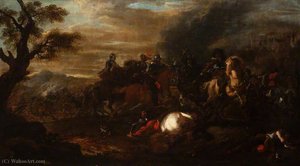
Courtois rapidly established himself as the preeminent battle painter in Rome during the mid-17th century. His canvases weren’t merely depictions of warfare; they were dramatic narratives, often contrasting Christian and Muslim forces in vividly rendered cavalry engagements. He possessed an exceptional ability to capture movement, energy, and the sheer pandemonium of combat. His compositions are characterized by a low horizon line, which intensifies the sense of scale and immerses the viewer within the fray. The figures—soldiers, horses, weaponry—are meticulously detailed, reflecting his earlier military training. He skillfully employed chiaroscuro to heighten the drama, contrasting areas of light and shadow to emphasize key moments of action and create a palpable atmosphere of tension. While many artists focused on heroic generals or grand strategies, Courtois often centered his attention on the individual soldier, portraying both the valor and the brutality of war with unflinching realism. His works appealed to a broad clientele—nobility, military officials, and art collectors—who sought dynamic depictions of conflict that celebrated martial prowess and historical events.
Later Life, Religious Devotion, and Enduring Legacy
Despite his success as a battle painter, Courtois underwent a profound spiritual transformation later in life, becoming a Jesuit in 1672. This decision didn’t lead to an abandonment of art; rather, he continued painting while embracing his new religious vocation. His artistic output during this period reflects a subtle shift towards more contemplative themes, though battle scenes remained central to his practice. He died in Rome in 1676, leaving behind a substantial body of work that significantly influenced subsequent generations of battle painters. While often overshadowed by other prominent artists of the Baroque era due to his relative isolation from mainstream Italian art circles and his origins outside the major artistic centers, Courtois’s impact is undeniable. His dynamic compositions, meticulous detail, and unflinching portrayal of warfare established him as a leading figure in military art history. His works continue to captivate viewers with their energy, drama, and historical significance, offering a compelling glimpse into the world of 17th-century conflict and the artistry that sought to capture its essence.
Influences and Lasting Impact
- Pieter van Laer (Bamboccio): Influenced Courtois’s realistic approach and focus on everyday life, though Courtois adapted this style to his own subject matter of battle scenes.
- Guido Reni & Francesco Albani: Provided technical training in composition and figure painting during his time in Bologna.
- His Military Experience: The three years spent as a Spanish soldier were crucial, providing firsthand knowledge of battle tactics, weaponry, and the atmosphere of conflict.
- Michelangelo Cerquozzi: A leading Italian battle painter whose work Courtois both admired and surpassed in terms of dynamism and detail.
Courtois’s legacy extends beyond his individual paintings. He established a recognizable format for battle scenes—the small-scale, intensely detailed composition—that was widely imitated by other artists throughout the 18th century. His emphasis on realism and dramatic narrative influenced generations of military painters, shaping how warfare was depicted in art for decades to come. His works serve as valuable historical documents, offering insights into the weaponry, tactics, and costumes of the period. Furthermore, his ability to capture the human drama of conflict—the valor, brutality, and chaos—continues to resonate with viewers today, solidifying his place as a significant figure in art history.


 1660
1660 14.0 x 20.0 cm
 Academy of Fine Arts Vienna
 Read More


 Switch to Print


 For artworks or reproductions larger than 105 cm (approximately 41 inches) on any side, the frame will be shipped as a kit, disassembled. This method ensures safe delivery and prevents damage during transport.