


 Preview
 Send
Send Share
Share
 Details
 Guide
Guide

 Download
 Similars
 X-Ray
X-Ray Diaporama
 Q&A
Q&A Stats
StatsMinerva

- 212.0 x 150.0 cm


 Read More
Get a print-ready file that goes far beyond the web preview. Every digital image we sell comes from a high-resolution master in our stock database — usually 5,000 to 15,000 pixels wide — so you can print large, crop tightly, or reproduce fine detail with confidence.
No file leaves our studio untouched. A digital expert checks the colors against the original painting and corrects them if needed, then improves clarity and detail with professional retouching tools — always staying faithful to the artist's brushwork and style. The result is an image that looks like the painting, not like a filtered scan.
You approve before you're done: our expert sends the image by e-mail within 72 hours for your review. Not satisfied? Ask for improvements or corrections, or request a refund if the quality falls short.
This is the quality relied on by publishers, design studios, galleries and print shops.
Digital Image
Download a high-resolution file for personal display, printing, and creative projects. ( Switch to Print Buy Hand Made Painting)
Included in Every Digital Image Order
Expert Digital Delivery, Guaranteed
When you choose AllPaintingsStore.com, you're not just getting an image - you're receiving a professionally enhanced digital artwork, crafted with precision and backed by a satisfaction guarantee. Here's everything that comes with your order, automatically:

Fast Email Delivery
Your high-resolution digital image file will be emailed to you within 72 hours of ordering - ready for immediate use.

AI-Enhanced Digital File
Your artwork is professionally optimized using advanced AI tools and manual editing, ensuring maximum detail, clarity, and color accuracy.

Free Lifetime Re-Delivery
Accidentally deleted or lost your file? No worries - we'll resend it to you anytime, free of charge.

No Import Fees - Ever
Enjoy your artwork instantly with zero customs, duties, or delivery fees - digital downloads are always tax-free.

Color Accuracy Guarantee
We ensure your digital image reflects the original colors as closely as possible using professional tools and color management.

100-Day Satisfaction Guarantee
If you're not satisfied with your digital image, we'll revise it or refund 100% within 100 days - no questions asked.

100% Money-Back Guarantee
Not satisfied? Get a full refund within 100 days of receiving your digital file - no questions asked.

Bulk Order Discounts
Buy 3 images, save 10% - Buy 5, save 15% - Buy 10+, save 20%. Great for creative projects, galleries, and agencies.
A Study in Ink and Shadow
The paper holds a single figure, frozen in a moment of classical poise. Minerva, the Roman goddess of wisdom and strategic warfare, emerges from the white space through a precise web of pen and ink. Her weight shifts onto one leg in a naturalistic contrapposto, creating a subtle curve that breathes life into the monochrome sketch. A helmet rests upon her head, its rigid lines suggesting metal, while the drapery of her garments falls in heavy, rhythmic folds. Fine hatching and cross-hashing create depth, carving out the anatomy of her torso and the soft texture of cloth.
The composition remains centered and stripped of distraction. There is no landscape here, only the goddess and the void. A round object, perhaps a shield or a mirror, rests against her side, held by an arm that anchors her to the frame. The lines are meticulous, tracing the contours of her form with the disciplined accuracy of the Neoclassical tradition.
The Weight of Virtue
Created between 1776 and 1777, this preparatory study reflects a period of intense intellectual change in France. The choice of Minerva is deliberate, embodying the era's preoccupation with reason and civic duty. Her attributes carry silent meanings: the helmet signifies authority, the spear speaks of defense, and the patterned shield represents vigilance. These elements transform a simple sketch into a meditation on strength and moral fortitude.
The technique relies on the mastery of light and shadow without the use of color. Through varying densities of ink, the artist achieves a sense of three-dimensional volume. The lighting is even and diffused, casting no harsh shadows but allowing subtle gradations to define the goddess's face and limbs. It is a quiet observation of form, captured before the larger vision was realized.
A single, steady line defines the edge of her world.
Questions & Answers
From which era does "Minerva" date?
"Minerva" by Jacques-Louis David dates from the Early-Modern period. The period gives the historical context of the work.
What are the date and style of "Minerva" by Jacques-Louis David?
"Minerva" by Jacques-Louis David is dated 1776 and belongs to Neoclassicism.
Which color stands out most in "Minerva"?
The color that stands out most in "Minerva" is white (#e6e8e8). The dominant color is useful when matching an artwork to an interior.
Related Artworks


Artist Biography
The Life and Art of Jacques-Louis David
Born in Paris, France, on August 30, 1748, Jacques-Louis David emerged during a period of profound political and aesthetic transformation. He became the principal exponent of the late 18th-century Neoclassical style, a movement that sought to replace the decorative whimsy of the Rococo with a sense of order and moral clarity. His career was defined by an ability to navigate the most turbulent shifts in French history, moving from the structured hierarchies of the Ancien Régime to the radicalism of the Revolution and the imperial grandeur of the Napoleonic era.
As the preeminent painter of his era, David did more than capture the likenesses of his subjects; he provided a visual language for the changing ideals of his nation. His work often focused on historical and classical themes, utilizing rigorous contours and a disciplined approach to composition. This commitment to clarity helped establish Neoclassicism as the dominant artistic force in France. His canvases were frequently large in scale, designed to command attention and convey the gravity of the scenes they depicted.
His output was vast and varied, ranging from intense historical dramas to formal portraiture. Some of his notable subjects include:
- The Oath of the Horatii (1784)
- The Death of Socrates (1787)
- The Death of Marat (1793)
- Madame Récamier (about 1800)
Early Life, Family and Training
Born into the merchant-and-artisan middle class of Paris, Jacques-Louis David’s early years were marked by a sudden, sharp disruption. When he was nine, his father was killed in a duel, leaving the young boy to be raised by well-off architect uncles. During his formal schooling, he proved to be an indifferent student, his mind frequently wandering from his lessons toward the act of drawing. This early preference for the pencil and charcoal suggested a temperament better suited to the studio than the classroom.
His path toward professional mastery began under the guidance of François Boucher, a painter of the Rococo style. While Boucher provided his initial apprenticeship, David eventually sought a different direction, moving toward the instruction of Joseph-Marie Vien. As a professor at the Royal Academy of Painting and Sculpture, Vien offered a more classical approach that would eventually define David's aesthetic. This period of study was not a swift ascent; it was a process of trial and error. He faced the frustration of three failed attempts to secure the prestigious Prix de Rome, a setback that tested his resolve. He finally achieved the prize in 1774, a victory that would fundamentally alter the course of his career.
The Rise of Neoclassicism and Italian Study
The trajectory of David’s development shifted decisively in 1775 when he traveled to Italy alongside his teacher, Joseph Vien. This period of study provided the necessary distance from the decorative tendencies of the French court, allowing him to confront the weight of antiquity directly. In the shadow of Rome, he turned his attention toward the 17th-century masters, absorbing the structured compositions of Poussin and the dramatic lighting of Caravaggio. He also studied the works of the Carracci, finding in their approach a balance of form and naturalism that would inform his own developing hand.
During these years, David was introduced to Raphael Mengs, a figure who advocated for a rigorous, disciplined study of classical sources. This intellectual encounter helped steer the young painter away from the lingering whimsy of the Rococo. His focus moved toward a more austere and morally driven neoclassicism, a style that favored clarity and order over ornamentation. The experience in Italy did not merely refine his technique; it provided the philosophical foundation for a career dedicated to the pursuit of civic virtue and historical gravity.
- Antiochus and Stratonica (1774)
Artistic Role During the French Revolution
The political upheaval of 1789 found David deeply embedded in the shifting currents of French society. He was an active supporter of the revolution, moving beyond the quietude of the studio to engage directly with the radical forces reshaping the nation. As a member of the Jacobin group, his commitment to the cause was both ideological and personal. He maintained a close friendship with Maximilien Robespierre, a connection that placed him at the very center of the era's most intense political machinations.
His influence extended into the administrative heart of the new republic, where he served as the artistic director. In this capacity, he helped shape the visual language of a movement that sought to replace old hierarchies with new, civic-minded ideals. His work during these years often functioned as a mirror to the fervor of the streets, capturing the gravity of martyrdom and the weight of republican duty. He did not merely paint the revolution; he helped direct its public image.
- The Death of Marat (1793)
- The Lictors Returning to Brutus the Bodies of his Sons (1789)
Patronage and Service to Napoleon
The political tides that had once fueled David’s revolutionary fervor eventually settled into the structured grandeur of the Empire. As Napoleon Bonaparte rose to power, the artist transitioned from a partisan of the Republic to the official court painter of the new regime. This shift was formalized in 1804, when he was appointed First Painter to the Emperor. His role was to provide a visual language for Napoleon’s authority, translating military triumphs and imperial dignity into a grand, public scale.
This period of service brought about a subtle evolution in his aesthetic. The austere, sometimes severe clarity of his earlier Neoclassical works softened, giving way to an Empire style. His palette grew more complex, incorporating warm Venetian colors that lent a sense of richness to his compositions. He moved away from the starkness of his revolutionary years, instead embracing a more opulent visual vocabulary that suited the ceremonial needs of the imperial court.
- Napoleon Crossing the Alps (1801-1805)
- The Coronation of Napoleon (1807)
Technique and Neoclassical Style
David’s brushwork rejected the swirling, decorative excesses of the Rococo in favor of a disciplined, structural clarity. His compositions relied upon rigorous contours and sculpted forms that gave his figures a sense of permanence, as if they were carved from marble rather than rendered in oil. This precision was matched by a preference for polished surfaces, where the hand of the artist often vanished behind a seamless, finished appearance. He sought to capture the essence of antiquity through a visual language of order and restraint.
Light and shadow functioned as primary tools of drama in his studio. He employed a stark, dramatic use of tenebrism, a technique that utilized heavy contrasts to pull subjects out of the darkness. This approach, combined with a Caravaggesque realism, allowed him to ground his historical and mythological scenes in a palpable, physical reality. Rather than relying on a riot of color, he often utilized a restrained palette dominated by earthy tones, which focused the viewer's attention on the moral weight of the scene rather than mere ornamentation.
- The Oath of the Horatii (1784)
- The Death of Socrates (1787)
- The Death of Marat (1793)
- Portrait of Madame Récamier (1800)
Key Works and Masterpieces
The trajectory of David's career is marked by a capacity to translate the political and moral currents of France into rigid, sculptural forms. In 1784, he completed The Oath of the Horatii, a work that signaled a departure from the decorative whimsy of the previous era. By replacing soft curves with sharp, linear precision, he provided a visual language for civic duty. This sense of moral gravity continued in 1787 with The Death of Socrates, where he rendered the philosopher's final moments with a calm, disciplined clarity that emphasized intellectual conviction over chaotic emotion.
As the Revolution turned violent, David’s brush became a tool for documenting the immediate and the tragic. His 1793 depiction of The Death of Marat transformed a political assassination into a scene of profound, quiet stillness. The pale, slumped body of the journalist, resting against a makeshift desk, stripped away the noise of the Terror to focus on a singular, haunting reality. This ability to capture the weight of a moment defined his role as the era's visual chronicler.
The shift from revolutionary fervor to imperial grandeur saw David turning his attention to the man who would reshape Europe. Between 1801 and 1805, he painted Napoleon Crossing the Alps, presenting the leader as a figure of mythic strength. This was followed by the immense 1807 canvas, The Coronation of Napoleon, which documented the opulence of the imperial ceremony. Even in his more intimate portraiture, such as the 1800 depiction of Madame Récamier, his commitment to structured composition and formal dignity remained constant.
- The Death of Socrates (1787)
- The Death of Marat (1793)
- Madame Récamier (1800)
- Napoleon Crossing the Alps (1801-1805)
- The Coronation of Napoleon (1807)
Circle, Pupils and Artistic Influence
The studio of Jacques-Louis David functioned as a vital center for the transmission of Neoclassical principles, attracting a diverse group of students who would go on to shape the nineteenth century. Among his most prominent pupils was Jean-Auguste-Dominique Ingres, who would eventually emerge as a formidable force in his own right. The lineage of David’s instruction also included Antoine-Jean Gros and François Gérard, both of whom navigated the shifting tastes of the era while carrying the weight of his rigorous training. Even Jérôme-Martin Langlois found his way into this disciplined environment, absorbing the technical precision required by the prevailing aesthetic.
This pedagogical reach extended far beyond the immediate classroom. The formal structures and expressive distortions David employed in his compositions left a mark that resonated through subsequent generations. His influence reached into the radical shifts of the modern era, finding unexpected echoes in the work of Henri Matisse and Pablo Picasso. While his direct pupils often sought to refine or even rebel against his strict adherence to classical order, the fundamental emphasis on draftsmanship and structural clarity remained a constant thread in the evolution of French art.
Exile and Death in Brussels
The political tides that once carried him to the heights of imperial favor eventually turned against him. Following the fall of Napoleon, the shifting landscape of France left little room for the former court painter. In 1816, David was sent into exile in Brussels, a move that signaled the end of his direct influence over the French state. He did not retreat into silence, however. In this Belgian city, he maintained his professional rigor, continuing to paint and instruct students until his final days.
His presence in Brussels remained a constant through the final decade of his life. He lived through the transition of European power, a witness to the very history he had once helped to document on canvas. On December 29, 1825, his life reached its conclusion. He died in Brussels, far from the Parisian salons and the imperial courts that had defined his most active years.
A monument marks the site of his rest. In the Brussels Cemetery, an obelisk stands as a memorial to the man who had once been the visual architect of an era. This stone marker serves as a quiet conclusion to a career that spanned the most turbulent transformations of the French state.
Where to See the Works Today
The physical presence of David’s oeuvre is scattered across the major repositories of European and international art. The Louvre Museum in Paris remains the primary guardian of his output, housing a significant portion of his most influential canvases. In New York, the Metropolitan Museum of Art maintains several of his pieces, allowing for a study of his precision far from the streets of France. His reach extends into the East as well, with the Pushkin State Museum in Moscow holding a portrait of Ingres, a work that reflects the complex connections between David and his most famous pupil.
In the south of France, the Musée Fabre in Montpellier offers a different perspective on his development. Within its walls, one can find Hector, a work from 1778 that captures a more formative, dramatic naturalism. This piece provides a window into the artist's earlier stylistic tendencies before his full embrace of the austere clarity that would define his later years. To see his work in these various settings is to trace the geographic spread of a style that once dictated the visual language of an entire era.
- The Death of Socrates, 1787
- The Oath of the Horatii, 1784
- The Death of Marat, 1793
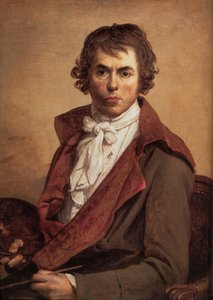
Jacques-Louis David
1748 - 1800 , France
Quick Facts
- Artistic Movement Or Style: Neoclassicism
- Artists Or Movements Influenced By This Artist:
- Jean-Auguste-Dominique Ingres
- Henri Matisse
- Pablo Picasso
- Artists Who Influenced This Artist:
- François Boucher
- Joseph-Marie Vien
- Full Name: Jacques-Louis David
- Nationality: French
- Notable Artworks:
- Oath of the Horatii
- The Death of Marat
- Napoleon Crossing the Alps
- The Coronation of Napoleon
- The Death of Socrates
- Place Of Birth: Paris, France
- Date Of Birth: 1748
- Date Of Death: 1800