Money-Back Guarantee · 100 days Free Worldwide Delivery
449,587artworks 30,613artists 4,660museums 32languages
Currency
    Language
      Atelier · Est. 2015 · Paris, France
      AllPaintingsStore
      allpaintingsstore.com
      Catalogue entry

      St bernard

      Acrylic On Canvas.

      Fig. 1. Jacques-Louis David, St bernard. Shown as the reproduction you are specifying: , .

      § 1Catalogue data

      § 2Abstract

      Collectible Description

      Artist Biography

      Jacques-Louis David (1748-1825): Leading French Neoclassical painter of the Revolution & Napoleonic eras. Known for 'Oath of the Horatii,' his art embodies heroism, drama & classical ideals.

      § 3Commentary

      A Portrait of Resolve: David’s Vision of Napoleon at the St. Bernard Pass

      Jacques-Louis David's “Napoleon at the Great St. Bernard” transcends mere depiction; it embodies a pivotal moment in European history and speaks volumes about the artist’s unwavering commitment to Neoclassical ideals. Painted in 1801, shortly after Napoleon’s triumphant return from Egypt—a victory that solidified his position as Emperor—this monumental canvas captures not just an event but also the spirit of ambition and defiance that characterized David's era. The scene portrays Napoleon Bonaparte astride a magnificent white horse, traversing the treacherous St. Bernard Pass during his daring Alpine expedition to Italy in 1800. He is accompanied by Marshal Ney and General Sebastiani, symbolizing military leadership and strategic prowess.
      • Style & Technique: David’s masterful command of Neoclassicism is evident in every brushstroke. The composition adheres rigorously to classical principles—symmetry, balance, and idealized form—reflecting the influence of ancient Greek sculpture and Roman portraiture. He employed a meticulous glazing technique, layering thin washes of color over a preparatory underpainting to achieve remarkable luminosity and depth. This painstaking process ensured that the textures of the horse’s coat and Napoleon's uniform were rendered with breathtaking realism.
      • Historical Context: The painting is inextricably linked to Napoleon’s ambition to establish himself as a figure worthy of Roman grandeur. David deliberately chose this dramatic landscape—a symbol of hardship and perseverance—to convey Napoleon’s determination to overcome obstacles and achieve his goals. It served as propaganda for the Emperor, demonstrating courage and leadership amidst adversity.
      Symbolism & Narrative: The horse itself represents strength and nobility, mirroring Napoleon's character. The red blanket draped over the horse is a deliberate allusion to Roman imperial banners—a visual declaration of power and authority. Furthermore, the clock in the background serves as a poignant reminder of time’s relentless march, emphasizing the urgency of Napoleon’s mission and highlighting the importance of decisive action. David skillfully utilizes chiaroscuro – dramatic contrasts between light and dark – to heighten the emotional impact of the scene, drawing the viewer's gaze directly to Napoleon’s resolute expression.
      • Emotional Impact: “Napoleon at the Great St. Bernard” evokes a profound sense of grandeur and heroism. David’s portrayal captures not only Napoleon’s physical presence but also his inner conviction—a belief in his own destiny and an unwavering commitment to achieving victory. The painting inspires admiration for leadership, courage, and resilience.
      • Interior Design Considerations: Reproductions of this artwork can inject a powerful dose of neoclassical elegance into any interior space. Its monumental scale commands attention, while its rich colors and masterful technique create a visually stimulating experience. Consider framing it in a stately frame to maximize its impact—a testament to artistic achievement and Napoleonic ambition.
      Concluding Remarks: Jacques-Louis David’s “Napoleon at the Great St. Bernard” remains an enduring symbol of triumph over adversity, embodying the ideals of Neoclassicism and celebrating the spirit of leadership. Its meticulous execution and evocative narrative continue to captivate audiences today, cementing its place as one of the most iconic artworks of the Napoleonic era—a masterpiece that speaks across time about ambition, perseverance, and the transformative power of art.

      Questions & Answers

      What is the perceived brightness of "St bernard" by Jacques-Louis David?

      In terms of perceived brightness, "St bernard" by Jacques-Louis David is balanced.

      Where does "St bernard" fall in Jacques-Louis David's career?

      "St bernard" belongs to the Napoleonic Glory of Jacques-Louis David's career. This classification relates the work to the artist's development.

      What mood and emotion come together in "St bernard"?

      In "St bernard", a dramatic mood accompanies a powerful emotion.
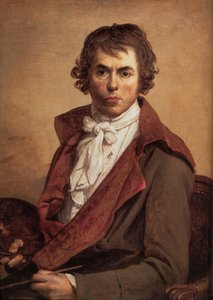
      § 4The artist

      Jacques-Louis David

      Jacques-Louis David

      1748 - 1800, France

      Quick Facts

      • Artistic Movement Or Style: Neoclassicism
      • Artists Or Movements Influenced By This Artist:
        • Jean-Auguste-Dominique Ingres
        • Antoine-Jean Gros
        • François Gérard
        • Anne-Louis Girodet
        • Jérôme-Martin Langlois
      • Artists Who Influenced This Artist:
        • François Boucher
        • Joseph-Marie Vien
        • Poussin
        • Caravaggio
        • Annibale Carracci
      • Full Name: Jacques-Louis David
      • Nationality: French
      • Notable Artworks:
        • Oath of the Horatii
        • The Death of Marat
        • Napoleon Crossing the Alps
        • The Coronation of Napoleon
      • Place Of Birth: Paris, France
      • Date Of Birth: 1748
      • Date Of Death: 1800

      Artist Biography

      A Brushstroke Across Revolution: The Life and Art of Jacques-Louis David

      Jacques-Louis David, born in Paris in 1748, was more than just a painter; he was a visual chronicler of an era defined by upheaval, idealism, and the relentless pursuit of new orders. His life mirrored the dramatic shifts unfolding across France – from the waning opulence of the Rococo to the austere clarity of Neoclassicism, and ultimately, through the tumultuous years of revolution and Napoleonic glory. A childhood marked by the early loss of his father and a facial impediment that initially hindered his speech seemed only to sharpen his observational skills and fuel an unwavering dedication to artistic mastery. Though initially apprenticed to François Boucher, David quickly found himself drawn to the more morally resonant work of Joseph-Marie Vien, whose emphasis on history painting and classical subjects resonated with a burgeoning sense of purpose within the young artist. His early attempts to win the prestigious Prix de Rome were fraught with frustration, yet these repeated setbacks only intensified his resolve, forging a relentless perfectionism that would characterize his entire career.

      The Birth of Neoclassical Drama

      David’s artistic evolution wasn't merely a stylistic shift; it was a philosophical statement. He rejected the frivolous ornamentation and playful themes of the Rococo, embracing instead the clarity, order, and moral seriousness inherent in classical antiquity. This commitment was profoundly influenced by archaeological discoveries at Pompeii and Herculaneum, which unveiled a world of Roman art and architecture previously lost to time. His breakthrough came with “Oath of the Horatii” (1784), a painting that transcended mere artistic skill to become an emblem of civic virtue and patriotic sacrifice. The stark composition, dramatic lighting, and precise draftsmanship were revolutionary, signaling a decisive break from the past. It wasn’t simply *what* he painted but *how* – a deliberate construction designed to evoke powerful emotional responses and inspire contemplation on themes of duty, honor, and self-sacrifice. This work didn't just announce a new style; it foreshadowed the ideological currents that would soon sweep across France.

      Revolution and Remembrance: Art as Political Weapon

      As the French Revolution erupted in 1789, David was not merely an observer but an active participant. A fervent supporter of the revolutionary cause and a close associate of Maximilien Robespierre, he saw art as a powerful tool for shaping public opinion and immortalizing the ideals of the new republic. His paintings during this period became potent symbols of revolutionary martyrdom and republican fervor. Perhaps his most iconic work from this era is “The Death of Marat” (1793), a hauntingly realistic depiction of the assassinated journalist, transformed into a secular saint. The painting’s stark simplicity – the pale body, the makeshift desk, the poignant letter clutched in Marat's hand – elevates the scene to a level of profound emotional resonance. David served on the Committee of Public Safety during the Reign of Terror, even signing Robespierre’s death warrant, demonstrating his deep entanglement with the political machinations of the time.

      From Revolution to Empire: Serving Napoleon

      The fall of Robespierre marked another turning point in David's career. With remarkable adaptability, he navigated the shifting political landscape and aligned himself with Napoleon Bonaparte, becoming the First Consul’s official court painter. This new patronage ushered in a period of grand-scale commissions designed to glorify Napoleon’s victories and achievements. “Napoleon Crossing the Alps” (1801-1805) is perhaps the most famous example – a masterful piece of propaganda that presents Napoleon as a heroic, almost mythical figure conquering both nature and adversity. “The Coronation of Napoleon” (1807), an immense canvas capturing the opulence and grandeur of the imperial ceremony, further cemented David’s position as the preeminent artist of the Napoleonic era. During this time, his palette subtly shifted, incorporating warmer Venetian colors while maintaining the precision and clarity that defined his style.

      Exile, Legacy, and Enduring Influence

      The Bourbon Restoration in 1814 brought renewed peril for David, whose association with the fallen Napoleon made him a target of persecution. He chose exile in Brussels in 1816, where he continued to paint and teach until his death on December 29, 1825. Even in exile, his influence remained profound. He trained numerous pupils, including Jean-Auguste-Dominique Ingres, who would become one of the most important neoclassical painters of the 19th century. David’s emphasis on draftsmanship, composition, and historical accuracy left an indelible mark on French art. His legacy extends beyond mere imitation; his expressive distortions of form and space even foreshadowed the innovations of later artists like Henri Matisse and Pablo Picasso. Jacques-Louis David was not simply a painter of his time; he *defined* it, capturing its spirit of revolution, ambition, and enduring ideals on canvas for generations to come.
      • Major Achievements: Established Neoclassicism as the dominant style in French painting.
      • Historical Significance: Created iconic images that captured the spirit of the French Revolution and the Napoleonic era.
      • Influence: Trained a generation of influential artists who carried on his legacy.

      § 5Comparanda

      § 6Questions

      Quick Facts

      • Influences: Ancient Greek sculpture"; "Roman portraiture
      • Artistic style: Classical realism
      • Notable elements or techniques: Dramatic lighting; Monumental scale
      • Title: St bernard
      • Medium: Oil on canvas

      Art Quiz

      There is only one correct answer for each question.

      Question 1:
      What is the primary subject depicted in Jacques-Louis David’s painting?
      Question 2:
      The image description mentions a clock. What does this element contribute to the overall atmosphere and narrative of the artwork?
      Question 3:
      David's painting exemplifies which artistic movement?
      Question 4:
      According to the biographical information, what was David’s initial artistic training like?
      Question 5:
      What historical event is commemorated in this artwork?

      § 7Further reading

      Cite this entry

      AllPaintingsStore.com, “Jacques-Louis David, St bernard”, https://allpaintingsstore.com/en/art/jacques-louis-david-st-bernard-9GZGLQ-en/ArtistReproduction/ (accessed 1 October 2026).

      § 8The reproduction

      Hand Made Oil Reproduction

      Hand-painted oil on canvas in your size and frame, made to order by our artists. ( Switch to Print Switch to Digital Image)

      It is specified on the order sheet in the margin; the present state of that sheet reads as follows.

      St bernard

      Reproduction Medium

      Reproduction Size

      -

      Elite Senior Artist

      More detail, finesse, and extra production time

      -

      Reproduction Frame

      -

      -

      For artworks or reproductions larger than 105 cm (approximately 41 inches) on any side, the frame will be shipped as a kit, disassembled. This method ensures safe delivery and prevents damage during transport.

      Professional assembly required - this is not a DIY product.
      The kit must be assembled and the canvas stretched by an experienced professional framer, using wood glue (not supplied), a canvas stretching plier and clamps to hold the bars square while the glue dries. Incorrect assembly or uneven canvas tension can permanently damage the artwork and is not covered by our warranty.

      • All solid wood bars are included, precisely cut to size.

      • Assembled with the screws provided, plus wood glue for the corner joints, which is not supplied and must be sourced by your framer.

      • Professional tools are required and not included: a canvas stretching plier (tensioner) and clamps to hold the bars square while the glue dries.

      Important:
      The corner joints require wood glue, the bars must be held with clamps until the glue is fully dry, and tightening the canvas on the assembled frame requires a canvas stretching plier. None of these are included in the kit. Please arrange an experienced professional framer before ordering this size.

      Nameplate

      -

      -

      Protective Varnish

      Glossy Varnish (enhances colors, protects against light/moisture)

      -

      Customize My Artwork

      Examples of what can be changed: Replace face with customer photo; Add pet (e.g., replace cat with dog); Include hidden message in background; Change background landscape or elements.

      -

      Urgent

      Worldwide Delivery () in 3/4 weeks instead of standard 5 weeks. (29 October). No compromise on quality.

      -

      Express Shipping

      Worldwide Delivery () in 5 weeks. (5 November).

      Included

      Total Price

      $ 258

      Included with every order

      • Free Worldwide Express Shipping
      • High-Quality Linen Canvas
      • Full Shipping Insurance
      • Customs Tax Refund Guarantee
      • True Color Matching Guarantee
      • 100-Day Return Policy (Defects Only)
      • 100% Money-Back Guarantee
      • Bulk Discount Offer
      Order sheet