Money-Back Guarantee · 100 days Free Worldwide Delivery
646,446artworks 53,409artists 5,406museums 32languages
Catalogue entry

Bathing Hut

Oil. Royal Museum of Fine Arts Antwerp.

Fig. 1. James Ensor, Bathing Hut. Shown as the reproduction you are specifying: , .

§ 1Catalogue data

§ 2Abstract

Collectible Description

An atmosphere of impending doom permeates this Expressionist masterpiece by James Ensor, where muted blues and textured brushstrokes capture a coastal scene ripe for contemplation and your private collection.

Artist Biography

Belgian Expressionist known for grotesque carnival masks and chaotic, brightly colored processions of skeletons and religious figures.

§ 3Commentary

A Study in Coastal Solitude

Step closer and observe the quiet tension held within this seaside scene. At first glance, one might see only a simple coastal village, yet there is an unmistakable weight to the atmosphere. The composition centers on a small white house resting upon the sand, its presence marked by a sense of isolation. Near the shore, a boat sits quietly, while an empty wheelbarrow rests in the foreground, adding a touch of stillness to the landscape. The sky above is heavy with clouds and shades of blue, suggesting that a storm may be gathering just beyond the horizon. It is a moment caught in transition, where the tranquility of the beach meets an underlying sense of unease.

The palette is restrained, relying on muted blues and greys to build this mood of impending change. This choice of color avoids any bright distractions, focusing instead on the subtle shifts in light and shadow that define the coastal air. There is a certain flatness to the perspective here, which brings the elements of the scene closer together, creating a space that feels somewhat enclosed despite being outdoors.

The Texture of Expression

The physical presence of the paint is quite significant when you look at the surface. Ensor utilized oil paint to create thick, textured brushstrokes that lend a sense of movement to the work. You can see the materiality of the medium in the way the light catches the ridges of the paint, particularly in the depiction of the weathered shingles on the roof of the hut. These tactile details ground the painting in a certain reality, even as the overall mood leans toward the psychological.

This technique moves away from mere observation and toward an expression of internal feeling. The heavy application of paint mirrors the artist's interest in physicality and the raw energy of the scene. By emphasizing the texture of the shingles and the weight of the clouds, the work communicates a sense of gravity. It is a deliberate departure from more traditional, smooth finishes, opting instead for a surface that feels as restless as the sea itself.

Symbolism and the Unseen

There is much to consider beneath the surface of this landscape. The solitary nature of the hut can be read as a reflection of isolation, standing vulnerable against the vastness of the sky. Even the empty wheelbarrow carries a weight of meaning, perhaps suggesting a sense of stagnation or the end of a period of activity. These small, quiet details invite us to look for deeper truths hidden within the scenery.

The muted tones of the sky do more than just set a weather pattern; they evoke a feeling of melancholy and foreshadowing. In this way, the painting functions as an exploration of what lies beneath appearances. The artist uses the familiar elements of a beach setting to touch upon themes of mortality and decay, suggesting that even in a moment of apparent peace, there is a deeper, more turbulent reality at work.

Questions & Answers

What subjects appear in "Bathing Hut" by James Ensor?

The themes present in "Bathing Hut" by James Ensor include beach scene, stormy sky, white house, wheelbarrow, boat, landscape painting, expressionism, quiet atmosphere. Together they summarize the artwork's subject matter.

Is "Bathing Hut" by James Ensor a portrait, landscape or square composition?

"Bathing Hut" by James Ensor is a landscape composition. The proportions are worth checking before choosing a print size.

Where is "Bathing Hut" suggested to be displayed, considering its palette?

Considering its neutrals colors, "Bathing Hut" is suggested for a living room.
§ 4The artist

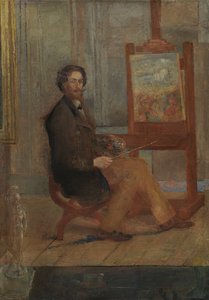
James Ensor

James Ensor

1860 - 1949, Belgium

Quick facts about James Ensor

  • Artistic Movement Or Style:
    • Symbolism
    • Expressionism
  • Artists Or Movements Influenced By This Artist:
    • Expressionism
    • Surrealism
  • Artists Who Influenced This Artist:
    • Pieter Bruegel the Elder
    • Francisco Goya
    • James Abbott McNeill Whistler
  • Full Name: James Sidney Edouard Ensor
  • Nationality: Belgian
  • Notable Artworks:
    • Christ's Entry into Brussels
    • The Man of Sorrows
    • The Oyster Eater
    • Tribulations of Saint Anthony
    • Skeletons Fighting over a Hanged Man
  • Place Of Birth: Ostend, Belgium
  • Date Of Birth: 1860
  • Date Of Death: 1949

Artist Biography

Early Life, Family and Artistic Training

James Ensor was born on April 13, 1860, in Ostend, Belgium. His identity was shaped by a specific cultural intersection: his father, James Frederic Ensor, was born in Brussels to English parents, while his mother, Maria Catherina Haegheman, was Belgian. This dual heritage provided a foundation for a perspective that often sat outside the narrow confines of local tradition. Growing up, the artist lived within the walls of a souvenir shop operated by his parents in Ostend. This environment was not merely a place of residence but a repository of the strange and the ornamental. The shop was filled with shells, carnival masks, and peculiar objects that provided a visual vocabulary for his later work.

His formal education in art was a process of trial and error. Before entering the structured environment of the academy, he began his artistic training under two local painters. This early instruction provided the technical groundwork that he would later manipulate and distort. From 1877 to 1880, he attended the Académie Royale des Beaux-Arts in Brussels. Even within these academic walls, his interests remained distinct from the rigid expectations of the institution. He was not a student of the status quo; he was a student of the objects that surrounded him in Ostend.

The Evolution of His Artistic Style

Ensor’s early output lacked the psychological friction that defines his mature work. In pieces like Russian Music (1881) and The Drunkards (1883), he worked within a somber, realistic framework. These compositions relied on muted tones and traditional depictions of everyday life. They show an artist still tethered to the gravity of realism before his visual language underwent a radical shift. He eventually abandoned this restraint, opting instead for a palette that brightened significantly as his subject matter grew increasingly bizarre.

The shift toward the grotesque was driven by a specific fascination with the mask. He was drawn to the plastic forms and the intense colors of the carnival masks found in his family's souvenir shop. These objects were not mere props; they became central to his aesthetic. He integrated them into his still lifes to introduce a theatrical quality, using them to disrupt the domesticity of the scene. This move toward the irrational allowed him to move beyond simple representation into a space of psychological tension.

Key Works and Major Themes

Ensor’s preoccupation with the mask and the grotesque provides a direct link to the psychological tensions of the modern era. In The Scandalized Masks (1883), he established an early interest in the power of disguise, using the carnival motif to strip away social pretenses. This fascination with the theatrical and the unsettling was not a mere stylistic choice but a method of exploring identity. His 1882 work The Oyster Eater demonstrates a different facet of his ability to handle light and color, depicting his sister Mitche in a scene that challenged the conservative sensibilities of the Antwerp Salon. The painting’s rejection by the establishment highlights the friction between his vision and the rigid norms of the time.

The artist’s shift toward more aggressive, expressive forms is most evident in his monumental compositions. Christ's Entry Into Brussels (1888-1889) functions as a forerunner of twentieth-century Expressionism, utilizing a chaotic, brightly-colored procession of grotesque figures to parody modern society. This sense of existential struggle is furthered in The Man of Sorrows (1891), an oil painting that combines the suffering of Christ with the jarring imagery of a Japanese Noh theatre mask. Such works reveal a man using religious and allegorical themes to express a profound frustration with human behavior and societal indifference.

Mortality and the absurdity of existence remain central to his output. Skeletons Fighting over a Hanged Man (1891) uses skeletal figures to confront the viewer with the reality of decay and death. These recurring themes of sin, temptation, and the fragility of appearances ensure his work remains a potent subject for study. His ability to synthesize these dark, often uncomfortable truths into a coherent visual language is what defines his contribution to the transition toward modernism.

Where to See His Works Today

Ensor’s presence in major international collections confirms his lasting impact on the development of modernism. In Antwerp, the Royal Museum of Fine Arts holds two significant works: The Man of Sorrows and The Oyster Eater. These pieces demonstrate the technical range of an artist who could move from religious tension to domestic scenes. His influence extends across the Atlantic, where the Museum of Modern Art in New York City preserves Tribulations of Saint Anthony. This work remains a primary example of his shift toward the bizarre and the psychological.

The reach of his imagery is global. The Getty Center in Los Angeles houses Entry of Christ into Brussels, a massive composition that captures his most aggressive social critiques. Meanwhile, the Kimbell Art Museum in Fort Worth maintains Skeletons Warming Themselves. These scattered locations ensure that his visual language, defined by its refusal to adhere to academic norms, remains accessible to a diverse audience of scholars and observers.

§ 5Comparanda

§ 6Questions

Quick Facts

  • Subject or theme: Beach scene
  • Movement: Expressionism
  • Medium: Oil on canvas
  • Notable elements or techniques: Distorted forms, vivid colors

Art Quiz

There is only one correct answer for each question.

Question 1:
What artistic movement is James Ensor’s Bathing Hut primarily associated with?
Question 2:
The painting depicts a beach scene featuring what prominent elements?
Question 3:
James Ensor’s use of oil paint contributes to the artwork's aesthetic by allowing for:
Question 4:
According to the description, what atmosphere does the cloudy blue sky create in Bathing Hut?
Question 5:
Which museum houses a collection of modernist art that includes works influenced by James Ensor?

§ 7Cite this entry

AllPaintingsStore.com, “James Ensor, Bathing Hut”, https://allpaintingsstore.com/en/art/james-ensor-bathing-hut-8BWRPA-en/ (accessed 27 October 2026).

§ 8The reproduction

Hand Made Oil Reproduction

Hand-painted oil on canvas in your size and frame, made to order by our artists. ( Switch to Print Switch to Digital Image)

It is specified on the order sheet in the margin; the present state of that sheet reads as follows.

Bathing Hut

Reproduction Medium

Reproduction Size

-

Elite Senior Artist

More detail, finesse, and extra production time

-

Reproduction Frame

-

-

For artworks or reproductions larger than 105 cm (approximately 41 inches) on any side, the frame will be shipped as a kit, disassembled. This method ensures safe delivery and prevents damage during transport.

Professional assembly required - this is not a DIY product.
The kit must be assembled and the canvas stretched by an experienced professional framer, using wood glue (not supplied), a canvas stretching plier and clamps to hold the bars square while the glue dries. Incorrect assembly or uneven canvas tension can permanently damage the artwork and is not covered by our warranty.

  • All solid wood bars are included, precisely cut to size.

  • Assembled with the screws provided, plus wood glue for the corner joints, which is not supplied and must be sourced by your framer.

  • Professional tools are required and not included: a canvas stretching plier (tensioner) and clamps to hold the bars square while the glue dries.

Important:
The corner joints require wood glue, the bars must be held with clamps until the glue is fully dry, and tightening the canvas on the assembled frame requires a canvas stretching plier. None of these are included in the kit. Please arrange an experienced professional framer before ordering this size.

Nameplate

-

-

Protective Varnish

Glossy Varnish (enhances colors, protects against light/moisture)

-

Customize My Artwork

Examples of what can be changed: Replace face with customer photo; Add pet (e.g., replace cat with dog); Include hidden message in background; Change background landscape or elements.

-

Urgent

Worldwide Delivery () in 3/4 weeks instead of standard 5 weeks. (24 November). No compromise on quality.

-

Express Shipping

Worldwide Delivery () in 5 weeks. (1 December).

Included

Total Price

$ 258

Included with every order

  • Free Worldwide Express Shipping
  • High-Quality Linen Canvas
  • Full Shipping Insurance
  • Customs Tax Refund Guarantee
  • True Color Matching Guarantee
  • 100-Day Return Policy (Defects Only)
  • 100% Money-Back Guarantee
  • Bulk Discount Offer
Order sheet