- Home

- Oil Painting Reproduction
- Jan Asselijn
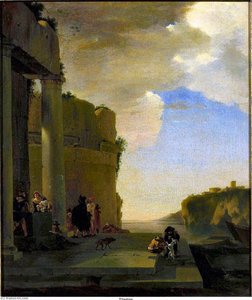
- Hunting Company out of Rome

 Buy print
 Send
Send Share
Share
 Details

 Download
 Similars
 X-Ray
X-Ray Diaporama
Hunting Company out of Rome


 Read More
Hand Made Oil Reproduction
Hand-painted oil on canvas in your size and frame, made to order by our artists.




P118B $10

P118H $10

P118W $10

P438Z $10

P508JH $12

P508YH $12

P805H $10

P805Z $10

P919BZ $10

P919G $10

P919XJ $10

P959ZH $10

P968JZ $12

W106C $8

W218G $10

W218JH $8

W218Y $10

W307PJ $10

W316G $10

W316PJ $8

W316Y $10

W398PJ $8

W4111J $10

W500HY $15

W500JH $15

W692G $12

W849H $8

W940BG $15

W953PJ $8




Pick from our preset sizes that match the artwork's original proportions.

You may enter your own dimensions to fit a specific frame or space. If your selected size does not match the original image's proportions, we will either crop the artwork or extend the painting with additional hand-painted elements. A digital mockup will be sent for your approval before production begins.
Please note that the on-screen preview does not reflect the actual cropping or extension. Only the mockup will accurately show the final composition.
While custom sizes are available, we recommend selecting a dimension from the predefined list to preserve the original proportions.
After order, AllPaintingsStore.com team will email client for instructions and provide a mockup preview
Worldwide Delivery () in 3/4 weeks instead of standard 5 weeks. (16 July). No compromise on quality.

Free Worldwide Express Shipping

High-Quality Linen Canvas

Full Shipping Insurance

Customs Tax Refund Guarantee

True Color Matching Guarantee

60-Day Return Policy (Defects Only)

100% Money-Back Guarantee

Bulk Discount Offer
 Glass option is only available in size under 110 CM

Hunting Company out of Rome
Reproduction Medium
Reproduction Size
-


Total Price
-
Artwork Description
Hunting Company Out of Rome
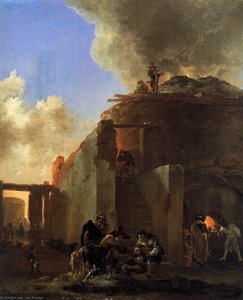
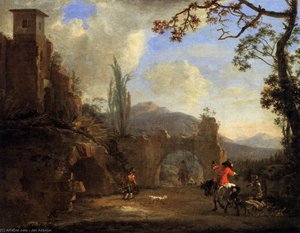
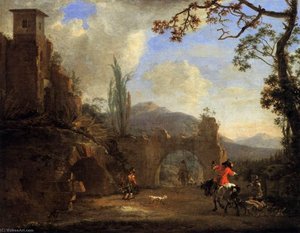
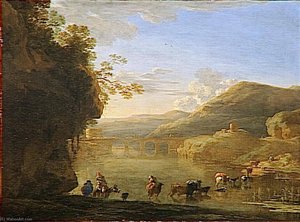
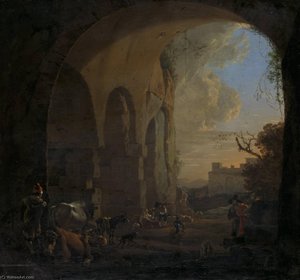
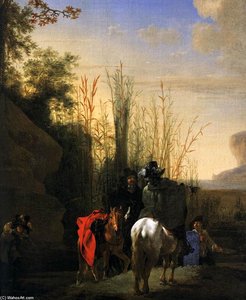
Jan Asselijn’s “Hunting Company Out of Rome,” completed in 1652, stands as a quintessential emblem of the Dutch Golden Age landscape tradition—a testament to both meticulous observation and profound artistic interpretation. Painted during a period marked by burgeoning scientific curiosity alongside an undeniable fascination with beauty and grandeur, this monumental canvas captures a dynamic tableau of aristocratic pursuit amidst the serene expanse of the Italian countryside. A Window into Baroque Vision Asselijn’s stylistic allegiance firmly rooted in the Baroque aesthetic—influenced heavily by artists like Rembrandt and Rubens—manifests itself in dramatic chiaroscuro lighting that sculpts the figures and foliage alike. The artist skillfully employs tonal gradations to convey depth and atmosphere, transporting viewers into a scene brimming with palpable energy. Unlike earlier landscape depictions prioritizing topographical accuracy, Asselijn prioritizes conveying emotion; the composition pulsates with movement as hunters stride purposefully across the meadow, their rifles poised for action against a backdrop of dappled sunlight filtering through ancient oaks. Technique & Material Considerations Executed on canvas using oil paint—a medium favored during this era for its luminosity and ability to achieve nuanced textures—the painting demonstrates Asselijn’s mastery of layering techniques. Careful blending creates an illusion of softness and realism, particularly evident in the depiction of the horses’ coats and the delicate petals of wildflowers scattered across the meadow. The artist's meticulous attention to detail extends beyond mere representation; subtle variations in color and brushstroke contribute to a sense of immediacy and authenticity—as if one could step into the very moment captured on canvas. Symbolism & Contextual Significance Beyond its aesthetic merits, “Hunting Company Out of Rome” carries symbolic weight reflecting the broader cultural preoccupations of the time. Hunting was not merely a pastime for the nobility but also imbued with ritualistic significance—representing courage, discipline, and dominion over nature. The inclusion of dogs underscores the importance of companionship and loyalty within aristocratic society. Furthermore, the setting itself—the Italian countryside—was viewed as an idealized realm embodying harmony and beauty—a deliberate contrast to the turbulent political landscape of Europe dominated by religious conflict and dynastic rivalries. Asselijn’s depiction serves as a visual meditation on these themes, inviting contemplation about humanity's relationship with the natural world and its aspirations for order and grandeur. Emotional Resonance & Legacy The painting’s enduring appeal lies in its ability to evoke feelings of tranquility mingled with excitement—a captivating blend that speaks to the human desire for both beauty and adventure. Asselijn’s masterful rendering captures not only the visual splendor of the scene but also its underlying psychological depth. “Hunting Company Out of Rome” remains a cornerstone of Dutch landscape painting, inspiring generations of artists and continuing to fascinate viewers today with its timeless elegance and evocative portrayal of aristocratic life amidst the sublime grandeur of Italy.Related Artworks


Artist Biography
A Life Forged in Landscape: The World of Jan Asselijn
Born Jean Asselin in the French port city of Dieppe around 1610, Jan Asselijn’s journey was one shaped by religious upheaval and artistic exploration. His family, Huguenots fleeing persecution, relocated to Amsterdam in 1621, a vibrant hub of commerce and burgeoning artistic talent during the Dutch Golden Age. This relocation proved pivotal, immersing young Jean into a world where landscape painting was rapidly evolving beyond traditional depictions toward more atmospheric and emotionally resonant scenes. He initially trained with Jan Martszen the Younger, honing his skills in battle pieces before discovering his true calling – capturing the beauty and drama of both natural landscapes and animal life. Asselijn’s early exposure to the Dutch light and expansive skies would become a defining characteristic of his work, though it was a sojourn to Italy that truly solidified his artistic vision.The Italianate Embrace & The Bentvueghels
Like many ambitious Northern European painters of the era, Asselijn sought refinement in Italy, likely arriving sometime after 1635. It was there he fully embraced the *Italianate* style – a genre characterized by sun-drenched vistas, classical ruins, and pastoral scenes imbued with a sense of romanticism. He joined the ranks of the *Bentvueghels*, a colorful society of Dutch and Flemish artists working in Rome. These “Birds of a Feather” were known for their unconventional behavior, satirical nicknames, and dedication to painting directly from life – rejecting the constraints of studio work. Within this boisterous community, Asselijn earned the moniker "Krabbetje" (little crab) due to a physical disability affecting his hand, yet he thrived creatively. He absorbed the influence of artists like Pieter van Laer (Bamboccio), whose depictions of Roman peasant life and landscapes resonated deeply with Asselijn’s own developing style. This period was crucial in shaping his ability to convey atmosphere, light, and a sense of narrative within his compositions.Mastering Light & Symbolism: Key Works
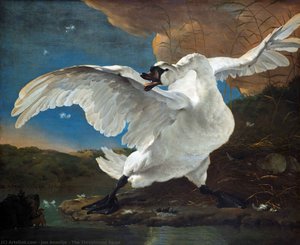
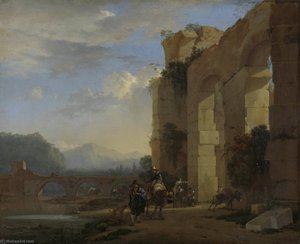
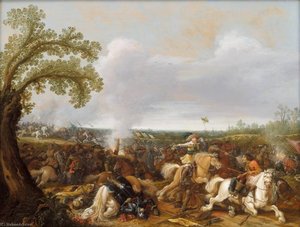
Asselijn returned to Amsterdam with a refined technique and a distinctive voice. His paintings are characterized by a clarity of execution and a masterful handling of light – qualities that quickly gained him recognition. While he produced historical and battle scenes, it was his landscapes and animal paintings that truly set him apart. The Threatened Swan, painted in the 1640s, remains his most celebrated work. More than just a depiction of avian defense, this painting became a powerful symbol of Dutch national resistance against external threats. The fiercely protective swan, aggressively warding off intruders near its nest, resonated with contemporary anxieties and was even interpreted as an allegory for Johan de Witt, a prominent Dutch statesman. Intriguingly, later owners added symbolic inscriptions to the canvas – “Holland” on one of the eggs and “Enemy of the state” beside the menacing dog – further cementing its political undertones. Other notable works include Cavalry Attack at Sunset, showcasing his earlier training in battle scenes with dramatic flair, and depictions of rural life like Drovers with Cattle under an Arch of the Colosseum in Rome, which beautifully blend Italianate landscapes with animal studies. The Breach of the Saint Anthony’s Dike near Amsterdam demonstrates his ability to capture a moment of national crisis, reflecting the ever-present threat of water and the ingenuity required for Dutch land reclamation.Influence & Legacy: A Lasting Impression
Jan Asselijn's impact extended beyond his own prolific output. He was admired by contemporaries like Rembrandt, who even created etchings of the artist at work – though notably, these etchings obscure Asselijn’s hands, perhaps a sensitive acknowledgement of his physical challenge. He also served as a mentor to Frederik de Moucheron, another prominent Dutch landscape painter who further popularized the Italianate style. Asselijn's innovative approach to light and atmosphere influenced a generation of artists, paving the way for greater naturalism and emotional depth in landscape painting. His works are now held in prestigious collections such as the Rijksmuseum in Amsterdam, ensuring his legacy endures as a significant figure within the Dutch Golden Age. He died relatively young, in 1652, but left behind a body of work that continues to captivate viewers with its beauty, drama, and subtle layers of meaning.
Jan Asselijn
1610 - 1652 , France
Quick Facts
- Artistic Movement Or Style: Italianate landscape
- Artists Or Movements Influenced By This Artist: ['Frederick de Moucheron']
- Artists Who Influenced This Artist:
- Esaias van de Velde
- Bamboccio
- Rembrandt
- Date Of Birth: 1610
- Date Of Death: 1652
- Full Name: Jan Asselijn
- Nationality: Dutch
- Notable Artworks:
- The Threatened Swan
- Hangout in Italy
- Cavalry Charge at Sunset
- Place Of Birth: Dieppe, France
Related Articles

Masterpieces of the 17th Century: Art, History & Decor Inspiration | AllPaintingsStore
Journey through 17th century art with masterpieces by Rembrandt, Vermeer & Caravaggio. Explore Baroque paintings, Dutch Golden Age techniques & timeless beauty. Find museum-quality reproductions and elevate your home decor on AllPaintingsStore.com.

Bridging Centuries: Digital Visualization & Classical Oil Painting Techniques in Contemporary Art Commissioning
Discover the art of commissioning bespoke oil paintings blending classical techniques with modern digital precision. Expert artists, personalized service & museum-quality results. Invest in a timeless masterpiece today.
Golden Age Reflections: Dutch Baroque Painting & Cultural Innovation
Explore the Dutch Golden Age of painting! Discover key artists like Vermeer & ter Borch, their innovative techniques, and the rich cultural context behind these Baroque masterpieces. Learn about collecting & appreciating this iconic art period.

John Frederick Lewis: Orientalism, Detail & Genre Painting in 19th-Century British Art
Explore the captivating Orientalist paintings of John Frederick Lewis! Discover his mastery of detail, genre scenes & influence on 19th-century British art. Learn about his life, techniques & legacy at AllPaintingsStore.

Genre Painting: A Window into Daily Life & Societal Values of the Dutch Golden Age
Explore the captivating world of Dutch Golden Age genre painting! Discover realistic depictions of daily life, masterful artists like Ostade & Metsu, and hidden symbolism. Learn about this influential art movement with AllPaintingsStore.