

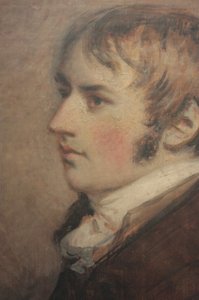
1810. Oil On Canvas, 15.0 x 24.0 cm.

§ 1Catalogue data

- 15.0 x 24.0 cm


§ 2Abstract
Collectible Description
Discover John Constable's 'East Bergholt Rectory,' a Romantic masterpiece capturing a serene sunset over Suffolk fields. Admire the light, composition & human presence in this iconic landscape painting.
 Read More
Artist Biography
A Romantic landscape painter famous for The Hay Wain. Explore his emotive scenes of the English countryside now.
§ 3Commentary
A Sunset’s Embrace: John Constable's *East Bergholt Rectory*
John Constable’s 1810 painting, *East Bergholt Rectory*, isn’t merely a depiction of a rural landscape; it’s a profound meditation on light, atmosphere, and the quiet beauty of the English countryside. This intimate canvas, measuring just 15 x 24 centimeters, captures a fleeting moment – a sunset over the fields surrounding Constable's beloved home in East Bergholt, Suffolk. More than a simple record of a scene, it’s an embodiment of the Romantic sensibility, revealing Constable’s extraordinary ability to translate feeling onto canvas and his deep connection with the land that shaped his artistic vision.
The painting immediately draws the eye to the dramatic sky, rendered in a masterful blend of warm ochres, fiery oranges, and delicate pinks. These aren't simply colors; they’re imbued with an almost palpable sense of warmth and tranquility. Constable skillfully employs broken brushstrokes – tiny, individual marks of paint – to create a shimmering effect, mimicking the way light dances across the clouds. This technique, characteristic of his mature style, lends the sky an incredible luminosity and depth, suggesting both the vastness of the heavens and the intimate scale of the scene below.
Composition and Human Presence
The composition is remarkably balanced, anchored by the central sunset but subtly enlivened by the presence of two figures standing in the foreground. These individuals – their identities lost to time – are not grand heroes or dramatic subjects; they’re ordinary people, seemingly absorbed in a simple moment of contemplation. Their placement isn't haphazard; they serve as a vital counterpoint to the grandeur of nature, reminding us of humanity’s place within this vast landscape. They invite the viewer to share in their quiet appreciation, fostering a sense of connection and shared experience.
The trees scattered throughout the scene are depicted with meticulous detail – each branch, leaf, and shadow rendered with remarkable precision. Constable wasn't simply copying what he saw; he was actively interpreting it, imbuing the landscape with his own emotional response. The varying distances of the trees create a powerful sense of depth, drawing the eye into the distance and suggesting an endless expanse of countryside. The use of light and shadow is particularly noteworthy, enhancing the three-dimensionality of the trees and creating a truly immersive experience for the viewer.
Romanticism and Suffolk’s Influence
*East Bergholt Rectory* stands as a quintessential example of John Constable's Romantic style. Born in East Bergholt, Constable’s artistic identity was inextricably linked to his native Suffolk. The rolling hills, meandering rivers, and ever-changing light of the region provided an endless source of inspiration for his work. He wasn’t interested in grand historical narratives or heroic figures; instead, he focused on capturing the intimate details of everyday life and the profound beauty of the natural world.
Constable's approach was revolutionary for its time. He rejected the idealized landscapes favored by earlier generations of artists, opting instead to portray nature as it truly appeared – with all its imperfections and subtle nuances. This commitment to realism, combined with his intense emotional response, helped to establish him as one of the most important landscape painters in British history. His work profoundly influenced artists like De Witt Clinton Boutelle, a key figure in the Hudson River School movement, demonstrating Constable’s lasting impact on the development of landscape painting.
A Timeless Reflection
*East Bergholt Rectory* is more than just a beautiful painting; it's a testament to the power of observation and the enduring appeal of nature. The serene atmosphere, the evocative light, and the subtle presence of humanity combine to create an image that continues to resonate with viewers today. Reproductions of this iconic work offer a unique opportunity to bring Constable’s vision into your home, allowing you to experience the tranquility and beauty of the Suffolk countryside whenever you desire. It's a piece that speaks to our deepest connection with the natural world – a reminder to slow down, appreciate the simple things, and find solace in the embrace of a perfect sunset.
Questions & Answers
How many people view "East Bergholt Rectory"?
Statistics about "East Bergholt Rectory" by John Constable are on the artwork's Stats page: monthly visits of the artwork, visits of the artist's works, and country and language breakdowns of recent visitors.
How do movement and era meet in "East Bergholt Rectory" by John Constable?
"East Bergholt Rectory" belongs to the Romanticism movement, and its creator worked in the 19th-Century era.
Who made "East Bergholt Rectory", and when?
The author of "East Bergholt Rectory" is John Constable, and the work is dated 1810.


 Switch to Print


 For artworks or reproductions larger than 105 cm (approximately 41 inches) on any side, the frame will be shipped as a kit, disassembled. This method ensures safe delivery and prevents damage during transport.


