


 Preview
 Send
Send Share
Share
 Details

 Download
 Similars
 X-Ray
X-Ray Diaporama
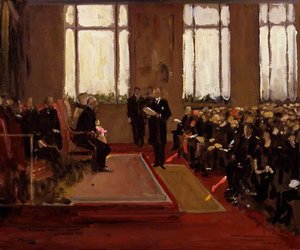
Albert Mansbridge
 Academic Portraiture
 1947
1947 90.0 x 70.0 cm
 Read More
Giclée / Art Print
Museum-quality giclée or canvas print with fast production and flexible finish options. ( Buy Hand Made Painting Buy Image)




































Pick from our preset sizes that match the artwork's original proportions.

You may enter your own dimensions to fit a specific frame or space. If your selected size does not match the original image's proportions, we will either crop the artwork or extend the image with a mirrored or solid-fill edge. A digital mockup will be sent for your approval before production begins.
Please note that the on-screen preview does not reflect the actual cropping or extension. Only the mockup will accurately show the final composition.
While custom sizes are available, we recommend selecting a dimension from the predefined list to preserve the original proportions.
Worldwide Delivery () in 2 weeks instead of standard 4/5 weeks. (15 August)

Free Worldwide Express Shipping

High-Quality Linen Canvas

Full Shipping Insurance

Customs Tax Refund Guarantee

True Color Matching Guarantee

60-Day Return Policy (Defects Only)

100% Money-Back Guarantee

Bulk Discount Offer
 Glass option is only available in size under 110 CM

Albert Mansbridge
Giclée / Art Print
Reproduction Size
-


Total Price
$ 65
Related Artworks




Artist Biography
John Mansbridge: A Pioneer of British War Art and Architectural Vision
John Mansbridge (1901–1981) stands as a significant figure in twentieth-century British art, recognized primarily for his wartime commissions and his influential role at Goldsmiths College. He wasn’t merely an artist; he was a teacher who instilled a passion for visual culture within generations of students and whose meticulous architectural studies continue to inspire admiration.Early Life and Education
Born in 1901, Mansbridge's artistic journey began with formative years spent at Manchester Grammar School, followed by enrollment at Slade School of Fine Art in London under the tutelage of Henry Tonks—a connection that profoundly shaped his aesthetic sensibilities. Tonks’ emphasis on observation and tonal painting instilled a dedication to capturing the essence of subjects through nuanced shading and color palettes, principles Mansbridge would carry throughout his career. His father, Albert Mansbridge, was instrumental in establishing the Workers Educational Association (WEA), fostering an environment that championed artistic engagement alongside social responsibility.Early Career: Posters and Decorative Arts
Before dedicating himself to monumental commissions, Mansbridge honed his skills designing posters for the Underground Electric Railways Company of London and the London Passenger Transport Board from 1927 to 1935. These projects showcased his mastery of graphic design—particularly Art Deco influences—demonstrating an ability to synthesize visual appeal with communicative intent. He skillfully utilized geometric forms, bold colors, and stylized imagery to convey messages effectively.World War II Service and Artistic Legacy
Mansbridge’s artistic career took a decisive turn during World War II when he applied unsuccessfully for a full-time commission from the War Artists Advisory Committee (WAAC). However, he was promptly recruited by the Air Ministry as a war artist, embarking on a mission to document the realities of aerial combat. He traveled extensively across Britain, capturing portraits of RAF pilots and crew—works that exemplify his meticulous realism and sensitivity to human emotion. Notably, several of these paintings were featured in “Britain at War,” an exhibition held at MoMA in New York, cementing Mansbridge’s place within the broader context of wartime art history. Furthermore, he contributed to camouflage design efforts and undertook expeditions to India and Burma, broadening his artistic horizons and documenting diverse cultural landscapes.Academic Influence and Architectural Exploration
Mansbridge's commitment extended beyond painting; he became a founding member of the Blackheath Art Society in 1947, alongside Graham Sutherland—a partnership that fostered intellectual exchange and championed artistic excellence. He lectured on art history and architecture for the extra-mural department of University of London, disseminating knowledge and inspiring students with his scholarly approach. His magnum opus, “Graphic History of Architecture” (1967), published by Viking Press, demonstrated a fascination with architectural forms and their relationship to human experience—a project lauded for its clarity and visual impact. He continued to produce posters for London Transport and mural panels for the Blue Funnel Line shipping company, solidifying his reputation as a versatile artist adept at conveying narratives through diverse mediums.Recognition and Enduring Significance
Mansbridge’s paintings reside in prestigious institutions like the British Council and the National Portrait Gallery (London), testament to their artistic merit and historical importance. His work embodies the spirit of a generation grappling with profound social and political upheaval—yet retains an enduring beauty rooted in careful observation and masterful technique. He remains a celebrated figure, remembered not only for his wartime contributions but also for his lasting influence on British art education and architectural scholarship.
Quick Facts
- Artistic Movement Or Style: Realism
- Artists Or Movements Influenced By This Artist: ['Graham Sutherland']
- Artists Who Influenced This Artist: ['Henry Tonks']
- Date Of Death: 1981
- Full Name: John Mansbridge
- Nationality: British
- Notable Artworks:
- An Air Gunner in a Gun Turret Sergeant G. Holmes, DFM
- Sir John Collings Squire
- Place Of Birth: London, England
Related Articles
John Singer Sargent's 25 Masterpieces: Portraits & Beyond | AllPaintingsStore
Explore 25 iconic John Singer Sargent paintings – from dazzling portraits to Impressionist landscapes. Discover the stories behind Madame X, El Jaleo & more! Find museum-quality art reproductions and elevate your home decor with AllPaintingsStore.com.

John Constable's Masterpieces: Explore 25 Iconic Landscapes for Your Home
Journey through John Constable's 25 most celebrated landscapes. Explore Romanticism, Dedham Vale & his masterful use of light in iconic paintings like 'Hay Wain'. Find museum-quality art reproductions and elevate your home decor on AllPaintingsStore.com.

Oil on Canvas: A Historical & Technical Exploration of a Timeless Artistic Medium
Explore the rich history & enduring techniques of oil painting on canvas. Discover the science behind its longevity, conservation practices, and contemporary relevance. Expert insights for art enthusiasts.

The Enduring Legacy of Oil on Canvas: Technique, History & Aesthetic Impact
Explore the rich history & techniques of oil painting – from Renaissance masters to Impressionism. Discover pigments, layering methods, and why this timeless medium endures. Expert insights for artists & art enthusiasts.

The Enduring Power of Painting: A Historical & Contemporary Exploration of Form and Emotion
Explore the rich history & enduring techniques of oil painting with AllPaintingsStore. Discover masterpieces, learn about art collecting, and find authentic handmade reproductions crafted by skilled artists.





