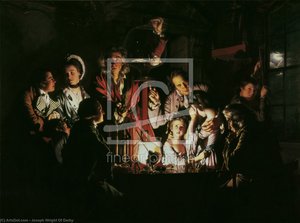
1789. Acrylic On Canvas, 76.0 x 64.0 cm. Yale Center for British Art.

§ 1Catalogue data

- 76.0 x 64.0 cm


§ 2Abstract
Collectible Description
Witness the dramatic portrait of Dr. Richard Wright by Joseph Wright! This captivating oil painting captures a man's intensity, reflecting the era’s innovation and artistry. Explore its rich history & details.
 Read More
Artist Biography
Explore the captivating works of Joseph Wright of Derby (1734-1797), a pioneer of Industrial Revolution art. Known for dramatic chiaroscuro, moonlight landscapes & philosophical scenes.
§ 3Commentary
A Portrait of Disquiet: Dr. Richard Wright by Joseph Wright
Joseph Wright’s “Dr. Richard Wright,” painted in 1789, is more than simply a likeness; it's a carefully constructed tableau that speaks volumes about the anxieties and intellectual currents swirling around England at the close of the 18th century. This intimate portrait, measuring 76 x 64 cm, immediately draws the eye to its subject – a man distinguished by his white hair, meticulously styled wig, and an expression of palpable displeasure. The dark background isn’t merely a backdrop; it actively amplifies the sitter's mood, creating a sense of contained tension that resonates with the viewer.
- The Man Himself: Dr. Richard Wright was a prominent physician and surgeon in Derby, a figure deeply involved in the burgeoning medical practices of his time. His colonial attire – a deliberate choice – situates him firmly within the historical context of 18th-century England, hinting at the era’s fascination with classical antiquity and its influence on fashion and social standing.
- Wright's Revolutionary Vision: Wright was a pivotal figure in British art, often considered the first artist to truly engage with the Industrial Revolution. While many artists of his time focused on grand historical scenes or aristocratic portraits, Wright’s work increasingly explored themes of scientific discovery, philosophical inquiry, and the dramatic impact of technological change – all powerfully evident here.
Technique and Style: A Study in Dramatic Light
Wright's masterful technique is immediately apparent. He employs a dramatic chiaroscuro—a bold contrast between light and dark—to sculpt Dr. Wright’s features and imbue the scene with an almost theatrical quality. The meticulous rendering of the wig, the subtle details of his clothing, and the careful attention to texture all contribute to the painting's remarkable realism. Wright’s brushwork is loose yet controlled, creating a sense of movement and immediacy that draws the viewer into the subject’s emotional state. This technique was influenced by Caravaggio and Rembrandt, demonstrating Wright’s deep understanding of classical artistic principles.
- Oil on Canvas: The painting is executed in oil paint on canvas, a standard medium for portraiture at the time, allowing for rich color saturation and detailed rendering.
- Chiaroscuro Mastery: Wright’s skillful use of light and shadow creates depth, volume, and dramatically emphasizes Dr. Wright's expression.
Symbolism and Historical Context
“Dr. Richard Wright” transcends a simple portrait; it’s a reflection of the intellectual ferment of the late 18th century. The subject’s demeanor – his furrowed brow, pursed lips – suggests a man grappling with complex ideas or perhaps frustrated by the limitations of contemporary medicine. The wig itself, a symbol of status and learning, underscores Wright's profession and social standing. Painted in 1789, just before the French Revolution, the painting subtly hints at the growing unrest and questioning of established authority that would soon engulf Europe.
Emotional Impact and Collector’s Value
This reproduction captures not only a likeness but also the very essence of Joseph Wright's artistic vision. “Dr. Richard Wright” is a compelling study in human emotion, rendered with technical brilliance and imbued with historical significance. A hand-painted reproduction offers an unparalleled opportunity to own a piece of art history – a window into the mind of one of England’s most innovative artists and a poignant reflection on the anxieties and aspirations of his time. Its size (76 x 64 cm) makes it suitable for a variety of interior spaces, from formal studies to more contemporary living areas.
Questions & Answers
What color harmony does "Dr. Richard Wright" by Joseph Wright of Derby display?
The colors of "Dr. Richard Wright" by Joseph Wright of Derby show a unified palette harmony. Harmony describes how the colors relate to each other.
What is the art-historical place of "Dr. Richard Wright" by Joseph Wright of Derby?
The art-historical classification of "Dr. Richard Wright" by Joseph Wright of Derby is Industrial Revolution Art, in the 19th-Century period.
Is "Dr. Richard Wright" by Joseph Wright of Derby a bright or a dark artwork?
Overall, "Dr. Richard Wright" is recorded as deep_shadow. Perceived brightness describes how light or dark the work appears.


 Switch to Print


 For artworks or reproductions larger than 105 cm (approximately 41 inches) on any side, the frame will be shipped as a kit, disassembled. This method ensures safe delivery and prevents damage during transport.