A Life Immersed in Color: The World of Kenneth Noland
Kenneth Clifton Noland, a name synonymous with the vibrant energy of Color Field painting and a pivotal figure in the Washington Color School, dedicated his life to distilling art down to its most essential elements – color, form, and spatial relationships. Born in Asheville, North Carolina, in 1924, Noland’s journey was one of constant exploration and innovation, evolving from early engagements with Abstract Expressionism to a groundbreaking embrace of shaped canvases that redefined the boundaries of abstract painting. His work wasn't merely about what he *painted*, but how he revealed color itself, allowing it to breathe and resonate within carefully considered compositions.
Early Influences and Artistic Formation
Noland’s artistic inclinations were nurtured from a young age, growing up in a household where music and art held value. This early exposure laid the foundation for his lifelong pursuit of aesthetic expression. His formal training began after serving in the U.S. Air Force during World War II, utilizing the G.I. Bill to attend Black Mountain College – an institution renowned as a crucible of artistic experimentation. It was here that Noland encountered transformative influences. Instructors like Ilya Bolotowsky introduced him to the principles of Neo-plasticism and the work of Piet Mondrian, while Josef Albers instilled in him a deep understanding of Bauhaus theory and the profound impact of color perception. These foundational lessons would become cornerstones of his artistic philosophy.
A subsequent period studying sculpture with Ossip Zadkine in Paris further broadened Noland’s horizons, marking his first solo exhibition and exposing him to the European art scene. However, it was a pivotal encounter back in America that truly set him on the path toward his signature style. In 1953, Clement Greenberg introduced Noland – along with Morris Louis – to Helen Frankenthaler's revolutionary “soak-stain” technique. This method, involving applying thinned paint directly onto unprimed canvas, proved a watershed moment, liberating color from the constraints of traditional brushwork and allowing it to become an integral part of the fabric itself.
The Evolution of Style: Circles, Chevrons, and Shaped Canvases
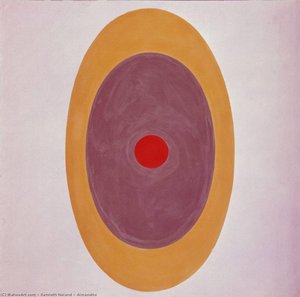
Noland and Louis enthusiastically embraced Frankenthaler’s technique, embarking on a shared exploration of color field painting. Noland's early works during this period are characterized by striking concentric circles – often referred to as “targets.” These weren’t simply depictions of targets; they were investigations into the relationship between image and canvas edge, utilizing unexpected and bold color combinations to create visual tension and optical effects. Beginning (1958) stands as a prime example of this phase, showcasing his mastery of color interaction and spatial dynamics.
Around 1958, Noland began to diverge from Louis’s artistic trajectory, venturing into explorations with chevrons and stripes. This marked a shift towards more structured compositions while retaining the emphasis on pure color. However, it was his pioneering use of shaped canvases that truly cemented his place in art history. Initially experimenting with diamonds or chevrons, Noland progressively evolved toward highly irregular forms, emphasizing the canvas edges not as boundaries but as integral structural elements – actively participating in the overall composition and challenging traditional notions of pictorial space.
Recognition and Lasting Legacy
Noland’s innovative work garnered significant recognition throughout his career. He was prominently featured in Clement Greenberg’s influential 1964 exhibition, Post-Painterly Abstraction, which solidified Color Field painting as a major force in the contemporary art world. That same year, he occupied half of the American pavilion at the Venice Biennale, demonstrating international acclaim. Major retrospective exhibitions followed, including one at the Solomon R. Guggenheim Museum in 1977 that traveled to other prestigious institutions like the Hirshhorn Museum and Sculpture Garden and the Toledo Museum of Art. Further exhibitions internationally, including a showing at the Tate in London in 2006, continued to celebrate his contributions.
Throughout the 1970s and 80s, Noland relentlessly refined his shaped canvas approach, creating increasingly complex structures with sophisticated color control. He remained committed to pushing the boundaries of abstraction, inspiring generations of artists. Kenneth Noland passed away in 2010, leaving behind a legacy as a central figure in Color Field painting, a leader of the Washington Color School, and an innovator who fundamentally expanded the possibilities of abstract art. His work continues to resonate today, reminding us of the power of color to evoke emotion, challenge perception, and redefine our understanding of space.
A Lasting Impact
- Noland’s influence extends beyond his immediate contemporaries, inspiring artists exploring abstraction, color theory, and spatial relationships even now.
- His pioneering use of shaped canvases challenged conventional notions of painting, opening up new avenues for artistic expression.
- As a key figure in the Washington Color School, he helped establish a distinct American voice within the broader context of abstract art.


 Color Field Painting
 1963
1963 175.0 x 175.0 cm
 Read more


![Abstract Composition [triptych] — Vaclav Vytlacil, Abstract Expressionism](/media/artworks/images-thumb/08/3c/083c0675045645fd42d4e6c6d63f1ced.jpg)


 Switch to Print


 For artworks or reproductions larger than 105 cm (approximately 41 inches) on any side, the frame will be shipped as a kit, disassembled. This method ensures safe delivery and prevents damage during transport.