Money-Back Guarantee · 100 days Free Worldwide Delivery
449,587artworks 30,613artists 4,660museums 32languages
Currency
    Language
      Atelier · Est. 2015 · Paris, France
      AllPaintingsStore
      allpaintingsstore.com
      Catalogue entry

      St Jerome

      1480. Oil On Panel, 103.0 x 75.0 cm. Vatican Pinacoteca.

      Fig. 1. Leonardo da Vinci, St Jerome, 1480. Shown as the reproduction you are specifying: , .

      § 1Catalogue data

      § 2Abstract

      Collectible Description

      Leonardo da Vinci's unfinished 'St Jerome' showcases his innovative techniques and profound exploration of solitude & contemplation. A Renaissance masterpiece!

      Artist Biography

      Renaissance master Leonardo da Vinci created the Mona Lisa. Discover his legendary paintings and scientific genius today.

      § 3Commentary

      St Jerome: A Glimpse into Leonardo da Vinci's Soul

      Leonardo da Vinci’s “St Jerome in the Wilderness,” painted around 1480, is more than just a religious depiction; it's a profound exploration of human spirituality and an intriguing window into the artist's own psyche. Housed within the Pinacoteca Vaticana, this unfinished masterpiece offers a unique perspective on da Vinci’s artistic process and his evolving style during the High Renaissance.

      Composition and Technique: A Study in Sfumato

      The painting portrays St. Jerome, the renowned theologian and translator of the Bible, seated amidst a desolate landscape. He is depicted as an aged hermit, deeply engrossed in contemplation. Da Vinci masterfully employs sfumato, his signature technique of blurring lines and softening transitions to create a hazy, atmospheric effect. This lends a dreamlike quality to the scene, enhancing the sense of solitude and introspection. The composition is drafted in monochrome onto the primed wooden panel, showcasing da Vinci’s experimental approach. The use of light and shadow emphasizes Jerome's aged features and the ruggedness of his surroundings. Noticeable are the anatomical studies evident in the rendering of Jerome's neck muscles – a testament to Da Vinci’s scientific curiosity and meticulous observation.

      Historical Context: Renaissance Spirituality and Artistic Innovation

      The Italian Renaissance was a period of immense intellectual and artistic flourishing, marked by a renewed interest in classical learning and humanism. Da Vinci, as one of the era's leading figures, embodied this spirit of inquiry. The choice of St. Jerome as a subject reflects the religious fervor of the time, but also allows for exploration of themes like solitude, penance, and intellectual pursuit. Da Vinci’s departure from traditional depictions of St. Jerome – often portrayed in opulent settings – to a stark wilderness setting is significant. It highlights his desire to portray the inner life of the saint rather than external grandeur. The painting's unfinished state provides valuable insight into da Vinci’s working methods, revealing layers of sketches and underpainting that would typically be concealed in a completed work.

      Symbolism: Lions, Rocks, and Spiritual Struggle

      The painting is rich with symbolic meaning. St. Jerome is accompanied by a lion, representing both his power over the animal kingdom (legend states he tamed a lion) and a symbol of Christ's strength. The rock he clutches signifies penance and self-mortification – a key aspect of Jerome’s spiritual journey. The distant church faintly sketched in the background hints at Jerome’s aspiration for salvation and his connection to the divine. The barren landscape itself symbolizes the harshness of the desert, representing the challenges and sacrifices inherent in a life dedicated to religious devotion. Even the saint's posture—hunched and weary—speaks volumes about the burdens of spiritual struggle.

      Emotional Impact: A Window into Da Vinci’s Inner World

      “St Jerome in the Wilderness” evokes a profound sense of melancholy and introspection. The painting is not merely a depiction of a saint; it's an exploration of human vulnerability, faith, and the search for meaning. Some art historians suggest that the work reflects da Vinci’s own personal struggles and anxieties, particularly following accusations of sodomy in his youth. Regardless of its biographical context, the painting resonates with viewers through its raw emotional honesty and Da Vinci’s unparalleled ability to capture the complexities of the human spirit.

      Questions & Answers

      How is "St Jerome" by Leonardo da Vinci proportioned, and how big is it?

      The format of "St Jerome" is portrait, and the original measures 103 x 75 cm. Both are useful when planning a reproduction.

      How much light do the colors of "St Jerome" appear to reflect?

      The colors of "St Jerome" show a soft shadow luminance.

      From which era does "St Jerome" date?

      "St Jerome" belongs to the Renaissance era.
      § 4The artist

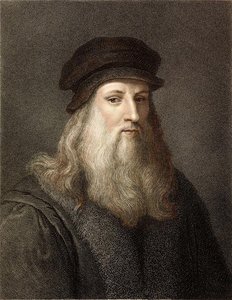
      Leonardo da Vinci

      Leonardo da Vinci

      1452 - 1519, Italy

      Quick facts about Leonardo da Vinci

      • Artistic Movement Or Style: Renaissance
      • Artists Or Movements Influenced By This Artist: ['Western art']
      • Artists Who Influenced This Artist: ['Andrea del Verrocchio']
      • Full Name: Lionardo di ser Piero da Vinci
      • Nationality: Italian
      • Notable Artworks:
        • Mona Lisa
        • The Last Supper
        • Virgin of the Rocks
        • Annunciation
      • Place Of Birth: Vinci, Italy
      • Date Of Birth: 1452
      • Date Of Death: 1519

      Artist Biography

      The Boy from Vinci

      In the quiet hills near the village of Vinci, a child named Lionardo di ser Piero da Vinci entered a world that would never truly contain his restless mind. Born to a Florentine notary and a peasant woman, his very beginnings were marked by an unconventional path, as his illegitimacy meant he was not destined to follow in his father's legal footsteps. Instead, this freedom allowed him to wander into the workshop of Andrea del Verrocchio in Florence. It was here, amidst the scent of oils and the dust of marble, that a young apprentice learned that seeing was the highest form of understanding. He did not merely study the brush; he studied the way light clings to a curved surface and how shadow dissolves the edges of a limb.

      His early years in Florence were defined by this intense observation. He absorbed the technical rigors of metalworking, carpentry, and drawing, building a foundation that merged the physical with the cerebral. While others sought only to replicate what they saw, he sought to understand the mechanics behind it. This period of growth was not marked by a sudden burst of fame, but by a slow, methodical accumulation of knowledge that would later allow him to bridge the gap between the artist's eye and the scientist's inquiry.

      The Milanese Years and the Pursuit of Motion

      When the winds of political change blew toward Milan, Leonardo followed the service of Ludovico Sforza. This move transformed him from a talented painter into a multifaceted presence within the ducal court. He arrived not merely as an artist, but as an engineer and designer, tasked with creating fortifications and even theatrical stage sets. It was during this long residency in Milan that he began to grapple with the profound drama of human interaction. In the refectory of Santa Maria delle Grazie, he applied his observations of psychology to a large-scale fresco, capturing the precise, heavy moment of betrayal within a group of apostles.

      His mind during these years wandered far beyond the walls of the monastery. He filled notebooks with sketches of flying machines, advanced weaponry, and hydraulic systems, driven by a desire to map the hidden laws of nature. Yet, his ambitions often outpaced his ability to finish. A great equestrian statue, intended to honor the Sforza family, remained a dream of clay that was eventually shattered by invading French forces. This pattern of unfinished greatness followed him; he was a man who often found more satisfaction in the discovery of a principle than in the completion of a canvas.

      The Final Light in France

      A return to Florence brought with it a period of profound refinement. It was here that he worked on the portrait of a woman whose subtle, enigmatic expression would later haunt the halls of history. Through his use of sfumato, a technique where colors and tones blend so softly that they appear like smoke, he removed the harsh outlines of the world, creating an atmosphere that felt alive with breath and movement. His anatomical studies grew more precise during this time as well, fueled by his habit of dissecting cadavers to map the intricate architecture of bone and muscle.

      In his final years, under the invitation of King Francis I, Leonardo moved to the Château du Clos Lucé in France. Even as age perhaps slowed his hand, his intellect remained sharp, focused on the study of optics, geology, and botany. He died in 1519, leaving behind a legacy that was never truly finished, much like his many drawings. His life remains a singular example of what can be achieved when the boundaries between art and science are erased, proving that to truly see the world, one must be willing to study every shadow and every muscle within it.

      § 5Comparanda

      § 6Questions

      Quick Facts

      • Year: 1480
      • Influences: Classical Art
      • Dimensions: 103 x 75 cm
      • Notable elements or techniques:
        • Sfumato technique
        • Anatomical detail
      • Title: St Jerome
      • Location: Pinacoteca Vaticana

      Art Quiz

      There is only one correct answer for each question.

      Question 1:
      Who is the artist of "St Jerome"?
      Question 2:
      In what city and country is the painting currently housed?
      Question 3:
      Approximately when was "St Jerome" created?
      Question 4:
      What is notable about the painting's state when it was rediscovered?
      Question 5:
      What technique is prominently displayed in the painting, characterized by subtle gradations of light and shadow?

      § 7Cite this entry

      AllPaintingsStore.com, “Leonardo da Vinci, St Jerome (1480)”, https://allpaintingsstore.com/en/art/leonardo-da-vinci-st-jerome-8XZPCR-en/ArtistReproduction/ (accessed 2 October 2026).

      § 8The reproduction

      Hand Made Oil Reproduction

      Hand-painted oil on canvas in your size and frame, made to order by our artists. ( Switch to Print Switch to Digital Image)

      It is specified on the order sheet in the margin; the present state of that sheet reads as follows.

      St Jerome

      Reproduction Medium

      Reproduction Size

      -

      Elite Senior Artist

      More detail, finesse, and extra production time

      -

      Reproduction Frame

      -

      -

      For artworks or reproductions larger than 105 cm (approximately 41 inches) on any side, the frame will be shipped as a kit, disassembled. This method ensures safe delivery and prevents damage during transport.

      Professional assembly required - this is not a DIY product.
      The kit must be assembled and the canvas stretched by an experienced professional framer, using wood glue (not supplied), a canvas stretching plier and clamps to hold the bars square while the glue dries. Incorrect assembly or uneven canvas tension can permanently damage the artwork and is not covered by our warranty.

      • All solid wood bars are included, precisely cut to size.

      • Assembled with the screws provided, plus wood glue for the corner joints, which is not supplied and must be sourced by your framer.

      • Professional tools are required and not included: a canvas stretching plier (tensioner) and clamps to hold the bars square while the glue dries.

      Important:
      The corner joints require wood glue, the bars must be held with clamps until the glue is fully dry, and tightening the canvas on the assembled frame requires a canvas stretching plier. None of these are included in the kit. Please arrange an experienced professional framer before ordering this size.

      Nameplate

      -

      -

      Protective Varnish

      Glossy Varnish (enhances colors, protects against light/moisture)

      -

      Customize My Artwork

      Examples of what can be changed: Replace face with customer photo; Add pet (e.g., replace cat with dog); Include hidden message in background; Change background landscape or elements.

      -

      Urgent

      Worldwide Delivery () in 3/4 weeks instead of standard 5 weeks. (31 October). No compromise on quality.

      -

      Express Shipping

      Worldwide Delivery () in 5 weeks. (7 November).

      Included

      Total Price

      $ 258

      Included with every order

      • Free Worldwide Express Shipping
      • High-Quality Linen Canvas
      • Full Shipping Insurance
      • Customs Tax Refund Guarantee
      • True Color Matching Guarantee
      • 100-Day Return Policy (Defects Only)
      • 100% Money-Back Guarantee
      • Bulk Discount Offer
      Order sheet