Money-Back Guarantee · 100 days Free Worldwide Delivery
449,587artworks 30,613artists 4,660museums 32languages
Catalogue entry

Spatial Concept

1962. Mixed Media.

Fig. 1. Lucio Fontana, Spatial Concept, 1962. Shown as the reproduction you are specifying: , .

§ 1Catalogue data

§ 2Abstract

Collectible Description

A luminous white circle bisects a pale pink canvas in Lucio Fontana's 1962 Spatial Concept, an iconic masterpiece of the Spatialism movement that invites you to explore the profound depths of abstract dimension.

Artist Biography

Explore the revolutionary art of Lucio Fontana (1899-1968), founder of Spatialism! Discover his iconic slashed canvases & pioneering abstract sculptures that redefined modern art.

§ 3Commentary

A Portal to the Infinite: The Radical Vision of Lucio Fontana

In the landscape of twentieth-century abstraction, few gestures are as visceral or as transformative as Lucio Fontana’s “Spatial Concept.” Created in 1962, this masterpiece serves as a profound testament to the artist's role as a pioneer of the Spatialist movement. At first glance, the viewer is met with a serene, pale pink expanse, a soft field that seems to recede into an ethereal distance. Yet, this tranquility is interrupted by a luminous white circle, a celestial orb that appears not merely painted upon the surface, but emerging from it. The composition is further animated by smaller circular forms connected by delicate, precise lines, creating a visual rhythm that suggests a cosmic or microscopic blueprint. It is a work that refuses to remain static; it breathes, it pulses, and it invites the eye to wander through a dimension that exists beyond the physical limits of the canvas.

The brilliance of this piece lies in its defiance of traditional boundaries. Fontana was not interested in the mere imitation of reality; he sought to dismantle the very concept of the two-dimensional plane. Through his revolutionary technique, he moved beyond the brushstroke to engage with the physical integrity of the medium itself. By utilizing perforations and incisions, Fontana disrupted the surface, creating actual voids that allow light and shadow to interact with the artwork in real-time. This method transforms the painting from a window into a sculptural object, where the "space" mentioned in the title is not an illusion created by perspective, but a tangible, physical reality. For the collector or interior designer, this creates a dynamic focal point that changes character depending on the lighting and the angle of observation, offering a sophisticated layer of depth to any curated space.

The Alchemy of Spatialism and Modernity

To understand the emotional weight of “Spatial Concept,” one must look to the historical crucible in which it was forged. Emerging from the post-war intellectual fervor of Milan, Fontana’s work was a reaction against the exhausted traditions of academic art. He sought to synthesize color, sound, and movement into a new language capable of expressing the complexities of the atomic age. The symbolism within this specific work—the interplay between the solid pigment and the void—speaks to the human desire to explore the unknown. The white circles act as beacons of clarity amidst the soft pink haze, representing a search for order and mathematical truth within the vastness of the universe.

For those seeking to integrate such a profound piece into a contemporary interior, "Spatial Concept" offers an unparalleled sense of intellectual luxury. It is a work that commands respect through its minimalism yet rewards intimacy through its subtle textures. Whether placed in a minimalist gallery setting or as a sophisticated anchor in a modern living space, the painting evokes a sense of quiet contemplation and forward-thinking elegance. Owning a high-quality reproduction of this work allows one to possess a fragment of art history—a piece that does not just decorate a wall, but expands the very walls themselves, inviting the infinite into the home.

Questions & Answers

What is "Spatial Concept" made with, and in which style?

In "Spatial Concept", the mixed media technique meets the Spatial Minimalism movement.

What color leads the composition of "Spatial Concept" by Lucio Fontana?

putty (#dfb8be) is the leading color of "Spatial Concept" by Lucio Fontana.

Can I examine "Spatial Concept" in more detail?

"Spatial Concept" can be examined layer by layer on the artwork's X-Ray page, a viewer inspired by a conservator's light bench with eleven optical readings of the image.
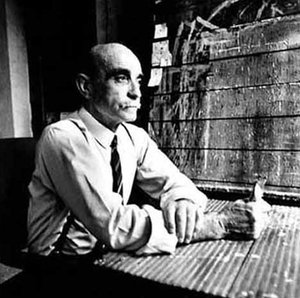
§ 4The artist

Lucio Fontana

Lucio Fontana

1899 - 1968, Argentina

Quick facts about Lucio Fontana

  • Artistic Movement Or Style: Spatialism
  • Artists Or Movements Influenced By This Artist:
    • Zero
    • Nouveau Réalisme
    • Minimalism
  • Artists Who Influenced This Artist:
    • Jan Grzegorz Stanisławski
    • Vincent van Gogh
    • Pieter Bruegel the Elder
  • Date Of Birth: 1899
  • Date Of Death: 1968
  • Full Name: Lucio Fontana
  • Nationality: Argentine-Italian
  • Notable Artworks:
    • Concetto Spaziale, Attese
    • Spatial Concept
    • Soffitto Spaziale
  • Place Of Birth: Rosario, Argentina

Artist Biography

A Life Forged in Spatialism

Lucio Fontana, a name synonymous with radical innovation in 20th-century art, was born into a world poised between tradition and modernity. His journey began not in Italy, the nation he would come to define within the artistic landscape, but in Rosario, Argentina, in 1899. The son of an Italian sculptor, Luigi Fontana, young Lucio inherited a craftsman’s sensibility alongside a burgeoning artistic vision. This early exposure to form and material proved foundational, even as his life became a series of geographical and stylistic explorations. Returning to Italy with his family, he absorbed the rich cultural heritage of Europe, studying at the Brera Academy in Milan and immersing himself in the avant-garde movements that were beginning to challenge established norms. However, the pull of his origins remained strong; multiple returns to Argentina punctuated his career, shaping his perspective and fueling a desire to transcend conventional artistic boundaries. Fontana’s early work reflected this duality – initially rooted in figurative sculpture and painting, it gradually evolved towards abstraction, hinting at the revolutionary path he was destined to forge.

Breaking the Canvas: The Birth of Spatialism

The devastation of World War II proved a catalyst for Fontana's most groundbreaking artistic endeavor. Witnessing the destruction and upheaval firsthand, he felt compelled to redefine art’s purpose in a world irrevocably altered. This led to the formulation of *Spatialism*, a movement that sought not merely to represent space but to incorporate it as an integral element of the artwork itself. Fontana believed traditional painting was limited by its two-dimensionality, confining art within a static plane. He envisioned a new form of expression that would break down these barriers, acknowledging the infinite depth and potential of space beyond the canvas. This wasn’t simply about creating illusions of depth; it was about physically opening up the artwork to reveal what lay *beyond*. Beginning in the late 1940s, Fontana began his now-iconic series of slashed and punctured canvases – the *Concetti Spaziali* (Spatial Concepts). These weren't acts of destruction but rather deliberate interventions, revealing a void that symbolized the vastness of the cosmos. The slashes, often executed with a razor blade, were precise and purposeful, transforming the canvas into a window onto another dimension. He wasn’t destroying the painting; he was liberating it from its limitations.

Influences and Artistic Kinship

Fontana's artistic development wasn’t born in isolation. He engaged with a diverse range of influences, absorbing and transforming them into his unique visual language. The expressive power of Vincent van Gogh resonated deeply within him, particularly the emotional intensity conveyed through brushwork. He also admired the satirical edge of Pieter Bruegel the Elder, finding inspiration in the older master’s ability to critique societal flaws. However, a pivotal encounter with the work of Polish artist Jan Grzegorz Stanisławski proved particularly transformative. Stanisławski's exploration of light and color within his 'Mullein' series profoundly impacted Fontana’s approach to abstraction and spatial representation. Furthermore, his participation in groups like *Abstraction-Création* in Paris exposed him to a broader network of avant-garde artists, fostering an exchange of ideas that fueled his experimentation. While distinctively original, Fontana’s work also shares affinities with other post-war movements such as Zero and Nouveau Réalisme, all striving to redefine the boundaries of art and challenge conventional perceptions.

Beyond the Slash: A Legacy of Dimensionality

While the slashed canvases remain his most recognizable achievement, Fontana's exploration of space extended beyond this singular technique. He created *hole paintings*, meticulously piercing the canvas to create actual openings that further emphasized spatial depth. He also ventured into sculpture, producing works that echoed the themes of volume and void found in his two-dimensional pieces. His *Soffitto Spaziale* (Spatial Ceiling) installations were particularly ambitious, transforming entire environments into immersive experiences designed to evoke a sense of infinite space. These large-scale creations enveloped viewers, blurring the lines between art and architecture, painting and sculpture. Fontana’s impact on subsequent generations of artists is undeniable. He paved the way for movements like Minimalism, encouraging a reductionist aesthetic focused on form and materiality. His emphasis on process and conceptual intent also anticipated aspects of Arte Povera, which embraced unconventional materials and challenged traditional notions of artistic value.

A Lasting Resonance

Lucio Fontana’s death in Comabbio, Italy, in 1968, marked the end of a remarkable career but not the end of his influence. Today, his works are held in prestigious museum collections worldwide – from The Metropolitan Museum of Art to the Ballarat Fine Art Gallery in Australia – testament to his enduring legacy. He remains a pivotal figure in post-war abstract art, celebrated for his courage to challenge conventions and redefine the very essence of artistic expression. Fontana didn’t simply paint *on* canvas; he engaged with space itself, creating works that invite viewers to contemplate the infinite possibilities beyond the visible world. His legacy is not merely a collection of slashed canvases but a profound invitation to perceive reality in new and expansive ways. He demonstrated that art could be more than representation—it could be an exploration of existence itself.

§ 5Comparanda

§ 6Questions

Quick Facts

  • Medium: Oil on Canvas
  • Year: 1962
  • Subject or theme: Space exploration
  • Movement: Spatialism
  • Notable elements or techniques: Slashed canvases; punctures; incisions

Art Quiz

There is only one correct answer for each question.

Question 1:
What artistic movement is Lucio Fontana primarily associated with?
Question 2:
Where was Lucio Fontana born?
Question 3:
What is the dominant visual element of Fontana’s ‘Spatial Concept’ paintings?
Question 4:
Fontana's early sculptures prioritized:
Question 5:
The image depicts a painting characterized by what distinctive feature?

§ 7Cite this entry

AllPaintingsStore.com, “Lucio Fontana, Spatial Concept (1962)”, https://allpaintingsstore.com/en/art/lucio-fontana-spatial-concept-D4A4MZ-en/ArtistReproduction/ (accessed 3 October 2026).

§ 8The reproduction

Hand Made Oil Reproduction

Hand-painted oil on canvas in your size and frame, made to order by our artists. ( Switch to Print Switch to Digital Image)

It is specified on the order sheet in the margin; the present state of that sheet reads as follows.

Spatial Concept

Reproduction Medium

Reproduction Size

-

Elite Senior Artist

More detail, finesse, and extra production time

-

Reproduction Frame

-

-

For artworks or reproductions larger than 105 cm (approximately 41 inches) on any side, the frame will be shipped as a kit, disassembled. This method ensures safe delivery and prevents damage during transport.

Professional assembly required - this is not a DIY product.
The kit must be assembled and the canvas stretched by an experienced professional framer, using wood glue (not supplied), a canvas stretching plier and clamps to hold the bars square while the glue dries. Incorrect assembly or uneven canvas tension can permanently damage the artwork and is not covered by our warranty.

  • All solid wood bars are included, precisely cut to size.

  • Assembled with the screws provided, plus wood glue for the corner joints, which is not supplied and must be sourced by your framer.

  • Professional tools are required and not included: a canvas stretching plier (tensioner) and clamps to hold the bars square while the glue dries.

Important:
The corner joints require wood glue, the bars must be held with clamps until the glue is fully dry, and tightening the canvas on the assembled frame requires a canvas stretching plier. None of these are included in the kit. Please arrange an experienced professional framer before ordering this size.

Nameplate

-

-

Protective Varnish

Glossy Varnish (enhances colors, protects against light/moisture)

-

Customize My Artwork

Examples of what can be changed: Replace face with customer photo; Add pet (e.g., replace cat with dog); Include hidden message in background; Change background landscape or elements.

-

Urgent

Worldwide Delivery () in 3/4 weeks instead of standard 5 weeks. (31 October). No compromise on quality.

-

Express Shipping

Worldwide Delivery () in 5 weeks. (7 November).

Included

Total Price

$ 258

Included with every order

  • Free Worldwide Express Shipping
  • High-Quality Linen Canvas
  • Full Shipping Insurance
  • Customs Tax Refund Guarantee
  • True Color Matching Guarantee
  • 100-Day Return Policy (Defects Only)
  • 100% Money-Back Guarantee
  • Bulk Discount Offer
Order sheet