

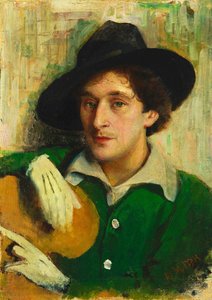
1914. Acrylic, 72.0 x 47.0 cm.

§ 1Catalogue data

- 72.0 x 47.0 cm


This Artwork Is Under Copyright Protection
The artwork displayed on this page is protected by copyright law, which means we cannot legally create or sell an identical reproduction. This protection is enforced under international agreements such as the Berne Convention and by national laws, including those outlined by the U.S. Copyright Law - Title 17.
As a respectful and legal alternative, we offer custom, hand-painted artworks inspired by the original. Our skilled and professional artists carefully study the original's style, mood, and artistic essence to create a new, unique piece that evokes the same feeling - while remaining an original creation in its own right.
This method fully complies with copyright regulations because it does not involve copying or duplicating the protected artwork. Instead, it is a creative reinterpretation - a new painting that is influenced by the original but not identical to it.
 Read more
§ 2Abstract
Collectible Description
Marc Chagall’s mesmerizing ‘Self Portrait with Easel,’ painted in 1914, captures the artist's contemplative gaze and embodies Surrealist style—a dreamlike depiction of a Jewish painter amidst vibrant colors and symbolic imagery. Explore this iconic masterpiece and bring its enchanting vision home.
Artist Biography
Explore the vibrant world of Marc Chagall (1887-1985), a Russian-French master known for his dreamlike paintings, Jewish folklore themes, and stunning stained glass art. Discover his legacy!
§ 3Commentary
A Window Into Chagall’s Soul: Exploring “Self Portrait with Easel”
Marc Chagall's "Self Portrait with Easel," painted in 1914, isn’t simply a depiction of an artist contemplating his craft; it’s a profound meditation on identity, memory, and the elusive nature of dreams—themes that would dominate Chagall’s oeuvre throughout his prolific career. Created during a period of significant artistic experimentation, this painting exemplifies the burgeoning Expressionist movement while simultaneously retaining the distinctive visual language of Chagall's formative years. The canvas captures a moment of quiet introspection, yet it vibrates with an underlying energy born from recollections of Vitebsk and imbued with fantastical elements characteristic of his artistic vision.- Subject Matter: The portrait presents Chagall himself seated at a table adorned with a cigarette holder, cup, and bowl—objects that serve as tangible anchors to the artist’s everyday life. However, his gaze is directed outwards, towards an imagined horizon, suggesting a preoccupation with broader existential questions.
- Style & Technique: Chagall's signature style – characterized by flattened perspectives, distorted figures, and vibrant color palettes—is evident throughout “Self Portrait.” He employs loose brushstrokes and bold hues to convey emotion rather than precise representation. The use of color is particularly striking; blues and greens dominate the background, evoking memories of Vitebsk’s landscapes, while reds and yellows punctuate the composition with flashes of warmth and vibrancy.
Historical Context: Vitebsk and the Expressionist Spirit
Painted in 1914, just before the outbreak of World War I, “Self Portrait” reflects the anxieties and uncertainties of its time. Vitebsk, Chagall’s hometown, was a crossroads of cultures—Russian Orthodox Christianity alongside Jewish tradition—a setting that profoundly influenced his artistic sensibility. The Expressionist movement, which sought to convey subjective experience and emotional intensity through distorted forms and exaggerated colors, gained momentum during this period. Chagall's work aligns seamlessly with these stylistic trends, rejecting academic conventions in favor of a more visceral response to the world around him.- Symbolism: The easel itself symbolizes artistic creation and contemplation, but it’s also imbued with a deeper significance—representing Chagall's unwavering belief in imagination as a means of accessing truth. The cigarette holder is a subtle nod to Chagall’s Jewish heritage and perhaps hints at the artist’s own anxieties about the impending conflict.
- Emotional Impact: “Self Portrait” communicates a sense of melancholy mixed with determination. Chagall's gaze conveys both vulnerability and resilience, inviting viewers to contemplate their own relationship to memory and dreams. The painting’s luminous colors contribute to its emotional resonance, transporting the viewer into Chagall’s inner world.
A Legacy of Dreamlike Vision
“Self Portrait with Easel” stands as a cornerstone of Chagall's artistic legacy—a testament to his ability to transform personal experience into universal symbols. It exemplifies the artist’s enduring fascination with folklore, mythology, and the subconscious mind. More than just a portrait, it is an invitation to embark on a journey into Chagall’s imaginative universe, where figures float effortlessly amidst fantastical landscapes and colors dance in defiance of reality. Its influence can be seen throughout his subsequent works—from biblical narratives to lyrical depictions of Jewish life—solidifying Chagall's place as one of the most celebrated artists of the 20th century.Questions & Answers
What kind of piece is "Self Portrait with Easel"?
In the catalog, "Self Portrait with Easel" by Marc Chagall is filed as wall art. The category helps find similar works.
Where can I buy a hand-painted reproduction of "Self Portrait with Easel" by Marc Chagall?
You can order a hand-painted reproduction of "Self Portrait with Easel" by Marc Chagall directly on its Hand-Painted Reproduction page: a hand-painted oil reproduction on linen canvas, made to order.
Which color stands out most in "Self Portrait with Easel"?
espresso (#46372f) is the leading color of "Self Portrait with Easel" by Marc Chagall.


 Switch to Print


 For artworks or reproductions larger than 105 cm (approximately 41 inches) on any side, the frame will be shipped as a kit, disassembled. This method ensures safe delivery and prevents damage during transport.


