Money-Back Guarantee · 100 days Free Worldwide Delivery
449,587artworks 30,613artists 4,660museums 32languages
Catalogue entry

The walk

1973. Oil On Canvas.

Fig. 1. Marc Chagall, The walk, 1973. Shown as the reproduction you are specifying: , .

§ 1Catalogue data

§ 2Abstract

Collectible Description

Marc Chagall’s ‘The Walk,’ painted in 1973, captures a dreamlike scene of two figures intertwined against a backdrop of whimsical buildings and a symbolic clock—a testament to Chagall's distinctive style and Jewish folklore heritage. Explore this captivating artwork and bring its vibrant beauty into your home.

Artist Biography

Explore the vibrant world of Marc Chagall (1887-1985), a Russian-French master known for his dreamlike paintings, Jewish folklore themes, and stunning stained glass art. Discover his legacy!

§ 3Commentary

A Dreamscape in Motion: The Soul of Marc Chagall’s “The Walk”

To encounter Marc Chagall’s 1973 masterpiece, “The Walk,” is to step through a veil separating the tangible world from the ethereal realm of memory. This evocative work does not merely depict a scene; it orchestrates a visual symphony where gravity feels optional and color speaks the language of the subconscious. At its heart, the painting presents two figures locked in a tender embrace, strolling before a structure that feels both grounded in reality and suspended in a dream. The man, distinguished by his hat, and the woman, with her arms wrapped around him, serve as the emotional anchor for a composition that defies the rigid boundaries of traditional portraiture. Through their intertwined forms, Chagall invites us to witness a moment of profound intimacy that transcends time.

The technique employed in this late-career triumph is a testament to Chagall’s mastery of Surrealist Reverie. Eschewing the cold precision of academic realism, the artist utilizes loose, spontaneous brushstrokes that imbue the canvas with a palpable sense of life and movement. The application of paint is rich and textured, utilizing thick impasto to create a physical depth that catches the light, much like the layered textures of a half-remembered dream. This tactile quality is complemented by a palette of vibrant, luminous hues—deep blues, radiant yellows, and soft pastels—that evoke the nostalgic landscapes of his beloved Vitebsk. The colors do not simply sit upon the surface; they seem to glow from within, casting an otherworldly light over the scattered figures and the enigmatic clock that watches over the scene.

A Tapestry of Heritage and Resilience

Beyond its aesthetic splendor, “The Walk” is deeply rooted in the tumultuous historical landscape of the 20th century. Created during a period following the immense upheavals of World War II and the complexities of Soviet rule, the painting serves as a sanctuary of cultural identity. Chagall, a poet of the brush, weaves elements of his Hasidic Jewish upbringing and Belarusian folklore into the very fabric of the composition. The presence of smaller, wandering figures and the whimsical arrangement of the background elements suggest a world populated by spirits and legends. This layering of history and myth allows the artwork to function as more than a mere decoration; it is a profound exploration of how personal heritage survives even amidst the shadows of political and social strife.

For the discerning collector or interior designer, “The Walk” offers an unparalleled opportunity to introduce a sense of narrative depth and emotional warmth into a space. The painting’s ability to balance vibrant energy with a contemplative, melancholic beauty makes it a versatile centerpiece for any sophisticated environment. Whether placed in a sunlit gallery or a quiet study, the artwork acts as a window into a universe where love, memory, and imagination dance in eternal motion. Owning a high-quality reproduction of this piece means more than possessing a beautiful image; it means hosting a fragment of a dream, a timeless testament to the enduring power of the human spirit to find beauty in the midst of change.

Questions & Answers

Are there works similar to "The walk"?

Works similar to "The walk" are listed on the artwork's Similars page.

For whom is "The walk" by Marc Chagall a good gift?

"The walk" by Marc Chagall is recommended as a gift for anniversary, especially for focal. A reproduction of the artwork can be given as a present.

Where can I find a guide to "The walk"?

A Guide page is available for "The walk" by Marc Chagall: a printable factsheet about the artwork, designed for students and classroom use.
§ 4The artist

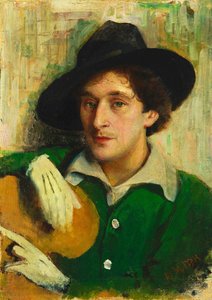
Marc Chagall

Marc Chagall

1887 - 1985, Belarus

Quick facts about Marc Chagall

  • Artistic Movement Or Style:
    • Cubism
    • Symbolism
    • Fauvism
  • Artists Or Movements Influenced By This Artist: ['Surrealists']
  • Artists Who Influenced This Artist: ['Léon Bakst']
  • Full Name: Marc Chagall
  • Nationality: Russian-French
  • Notable Artworks:
    • I and the Village
    • Over Vitebsk
    • White Crucifixion
    • Jacob's Dream
  • Place Of Birth: Liovana, Belarus
  • Date Of Birth: 1887
  • Date Of Death: 1985

Artist Biography

A Life Painted in Dreams: The World of Marc Chagall

Marc Chagall, born Moishe Shagal in 1887 in the small Belarussian town of Liozna near Vitebsk, wasn’t merely a painter; he was a poet of color, a weaver of dreams, and a chronicler of memory. His life, spanning nearly a century, mirrored the tumultuous currents of the 20th century, yet his art remained steadfastly rooted in a deeply personal vision—one infused with the folklore of his Hasidic Jewish upbringing and an unwavering belief in the power of imagination. Vitebsk itself was more than just a birthplace; it became the emotional core of his artistic universe, a recurring motif populated by flying figures, whimsical animals, and the vibrant hues of remembered landscapes. The town’s unique blend of cultures—Russian Orthodox churches alongside bustling Jewish marketplaces—forged an aesthetic sensibility that would defy easy categorization throughout his long career. Though he sought formal training first with a local sign painter and later in St. Petersburg under Léon Bakst, and then in Paris at the Académie de la Grande Chaumière, Chagall never fully embraced any single artistic movement. He absorbed elements of Cubism, Symbolism, and Fauvism, but always filtered them through his own intensely personal lens, creating a style that was uniquely, unmistakably Chagall.

Forging a Unique Visual Language

Chagall’s early works already hinted at the distinctive language he would develop. Paintings like I and the Village (1911) are not simply depictions of place; they are explorations of identity, memory, and the relationship between the individual and community. The village isn't rendered realistically but as a fragmented collection of recollections, imbued with symbolic meaning. This ability to transmute personal experience into universal themes became a hallmark of his art. His palette was bold and expressive, often employing vibrant, non-naturalistic colors to convey emotion rather than literal representation. Figures float and dance across the canvas, defying gravity and logic, creating a dreamlike atmosphere that invites viewers into his inner world. This stylistic approach wasn’t accidental; it stemmed from a desire to move beyond mere imitation of reality and capture the essence of feeling, the weight of memory, and the power of folklore. The Russian Revolution brought Chagall back to Vitebsk, where he became involved in cultural initiatives, establishing an art school that briefly flourished before succumbing to the restrictions imposed by the new regime. This period was marked by both creative energy and political disillusionment, a tension that would continue to shape his artistic trajectory.

A Life Between Worlds: Paris, New York, and Beyond

Eventually, Chagall left Russia for good, settling in France in 1923. This marked the beginning of a period of international recognition and prolific creativity. Works like Over Vitebsk (1920-1922) demonstrate his continued engagement with his childhood memories, while paintings inspired by biblical stories—such as Jacob’s Dream—reveal a growing interest in religious themes. The outbreak of World War II forced him to flee occupied France for the United States, where he spent seven years in New York City. This period was marked by profound emotional upheaval and artistic experimentation. He found solace in his art, creating powerful works that reflected the anxieties and uncertainties of the time. White Crucifixion (1938), a haunting depiction of suffering and persecution, stands as a testament to this era. After the war, Chagall returned to France, where he continued to paint and create until his death in 1985 at the age of 97.

Legacy and Enduring Influence

In his later years, Marc Chagall received numerous prestigious commissions, including the ceiling of the Paris Opera (1964), a breathtaking explosion of color and form that celebrated musical masterpieces, and stunning stained glass windows for the Hadassah Hebrew University Medical Center synagogue in Jerusalem. These large-scale projects allowed him to translate his artistic vision into architectural spaces, creating immersive environments that continue to inspire awe and wonder. Chagall’s influence on subsequent generations of artists is undeniable. His lyrical quality, emotional depth, and imaginative power resonated with Surrealists and other movements that embraced fantasy and symbolism. He bridged the gap between European modernism and Jewish cultural identity, becoming known as “the quintessential Jewish artist of the twentieth century.” His ability to synthesize personal experience, folklore, and universal themes continues to resonate with audiences worldwide. His work reminds us of the power of art to transcend boundaries, to connect us to our shared humanity, and to illuminate the beauty and mystery of life.

A Lasting Impression

Marc Chagall’s legacy extends beyond his paintings and stained glass; it resides in the enduring power of his vision—a vision that celebrates love, memory, and the boundless possibilities of the human imagination. He left behind a body of work that is both deeply personal and universally accessible, inviting viewers to lose themselves in a world painted with dreams and illuminated by hope. The Musée Marc Chagall in Nice stands as a testament to his enduring influence, housing an extensive collection of his works and offering visitors a glimpse into the heart and soul of this extraordinary artist. His art continues to inspire, challenge, and move us, ensuring that his vibrant and imaginative spirit will live on for generations to come.

§ 5Comparanda

§ 6Questions

Quick Facts

  • Medium: Oil on canvas
  • Title: The walk
  • Notable elements or techniques: Clock motif
  • Location: Private Collection
  • Influences: Biblical imagery

§ 7Cite this entry

AllPaintingsStore.com, “Marc Chagall, The walk (1973)”, https://allpaintingsstore.com/en/art/marc-chagall-the-walk-8XYH64-en/ArtistReproduction/ (accessed 3 October 2026).

§ 8The reproduction

Hand Made Oil Reproduction

Hand-painted oil on canvas in your size and frame, made to order by our artists. ( Switch to Print Switch to Digital Image)

It is specified on the order sheet in the margin; the present state of that sheet reads as follows.

The walk

Reproduction Medium

Reproduction Size

-

Elite Senior Artist

More detail, finesse, and extra production time

-

Reproduction Frame

-

-

For artworks or reproductions larger than 105 cm (approximately 41 inches) on any side, the frame will be shipped as a kit, disassembled. This method ensures safe delivery and prevents damage during transport.

Professional assembly required - this is not a DIY product.
The kit must be assembled and the canvas stretched by an experienced professional framer, using wood glue (not supplied), a canvas stretching plier and clamps to hold the bars square while the glue dries. Incorrect assembly or uneven canvas tension can permanently damage the artwork and is not covered by our warranty.

  • All solid wood bars are included, precisely cut to size.

  • Assembled with the screws provided, plus wood glue for the corner joints, which is not supplied and must be sourced by your framer.

  • Professional tools are required and not included: a canvas stretching plier (tensioner) and clamps to hold the bars square while the glue dries.

Important:
The corner joints require wood glue, the bars must be held with clamps until the glue is fully dry, and tightening the canvas on the assembled frame requires a canvas stretching plier. None of these are included in the kit. Please arrange an experienced professional framer before ordering this size.

Nameplate

-

-

Protective Varnish

Glossy Varnish (enhances colors, protects against light/moisture)

-

Customize My Artwork

Examples of what can be changed: Replace face with customer photo; Add pet (e.g., replace cat with dog); Include hidden message in background; Change background landscape or elements.

-

Urgent

Worldwide Delivery () in 3/4 weeks instead of standard 5 weeks. (31 October). No compromise on quality.

-

Express Shipping

Worldwide Delivery () in 5 weeks. (7 November).

Included

Total Price

$ 258

Included with every order

  • Free Worldwide Express Shipping
  • High-Quality Linen Canvas
  • Full Shipping Insurance
  • Customs Tax Refund Guarantee
  • True Color Matching Guarantee
  • 100-Day Return Policy (Defects Only)
  • 100% Money-Back Guarantee
  • Bulk Discount Offer
Order sheet