


 Preview
 Send
Send Share
Share
 Details
 Guide
Guide

 Download
 Similars
 X-Ray
X-Ray Diaporama
 Q&A
Q&A Stats
StatsTwo Nudes


 Read More
The artwork displayed on this page is protected by copyright law, which means we cannot legally create or sell an identical reproduction. This protection is enforced under international agreements such as the Berne Convention and by national laws, including those outlined by the U.S. Copyright Law - Title 17.
This method fully complies with copyright regulations because it does not involve copying or duplicating the protected artwork. Instead, it is a creative reinterpretation - a new painting that is influenced by the original but not identical to it.
Giclée / Art Print
Museum-quality giclée or canvas print with fast production and flexible finish options. ( Buy Hand Made Painting Switch to Digital Image)




P118B $10

P118H $10

P118W $10

P438Z $10

P508JH $12

P508YH $12

P805H $10

P805Z $10

P919BZ $10

P919G $10

P919XJ $10

P959ZH $10

P968JZ $12

W106C $8

W218G $10

W218JH $8

W218Y $10

W307PJ $10

W316G $10

W316PJ $8

W316Y $10

W398PJ $8

W4111J $10

W500HY $15

W500JH $15

W692G $12

W849H $8

W940BG $15

W953PJ $8




Pick from our preset sizes that match the artwork's original proportions.

Type the width and the height you need, to fit your frame or your wall. A print can only be cut, never made bigger than the picture, so a size with a different shape loses a part of the image. We send you a digital mockup to approve before we print anything. The picture shown on this page does not show the real cut — only the mockup does.
Worldwide Delivery () in 2 weeks instead of standard 4/5 weeks. (31 October)

Free Worldwide Express Shipping

High-Quality Linen Canvas

Full Shipping Insurance

Customs Tax Refund Guarantee

True Color Matching Guarantee

100-Day Return Policy (Defects Only)

100% Money-Back Guarantee

Bulk Discount Offer
 Glass option is only available in size under 110 CM

Two Nudes
Giclée / Art Print
Reproduction Size
-


Total Price
$ 65
The Intimate Echoes of Duchamp's "Two Nudes"
To stand before Marcel Duchamp’s "Two Nudes" is not merely to observe two figures in a sun-dappled wood; it is to step into a moment suspended between intimacy and philosophical inquiry. Painted around 1910, this post-impressionist piece captures a scene of quiet communion. The composition centers on two naked women situated within a lush, wooded setting, their forms intertwined with the surrounding nature. One figure gazes toward her companion, an act of visual exchange that immediately draws the viewer into the delicate emotional space between them. It is a portrait steeped in unspoken narratives, where the gentle weight of shared presence hangs palpably in the air.
A Study in Post-Impressionist Sensuality
Technically, the work showcases Duchamp’s early mastery while hinting at the revolutionary spirit that would define his later career. The post-impressionist style allows for a rich interplay of color and visible brushwork, giving the foliage and skin tones a vibrant, almost palpable texture. Notice how the artist has incorporated potted plants scattered throughout the woods; these elements are not mere decoration but integral parts of the scene's atmosphere, grounding the ethereal quality of the nudes in tangible nature. The balance achieved by placing both figures occupying roughly equal visual weight creates a harmonious yet subtly charged equilibrium across the canvas.
Symbolism and the Gaze
The most compelling aspect of "Two Nudes" lies within its symbolism, particularly through the act of looking. The directed gaze between the two women transforms the painting from a simple depiction into a psychological study. It invites us to question the nature of observation—who is watching whom, and what meaning do they derive from that shared look? In art history, the nude form has always been a vehicle for exploring humanity, vulnerability, and connection. Here, Duchamp elevates this tradition by embedding it within an atmosphere so charged with mutual awareness that the viewer becomes complicit in the secret unfolding between the subjects.
Bringing the Woods Home: Decorating with Art
For those seeking to infuse a space with the sophisticated melancholy of early modernism, a reproduction of "Two Nudes" offers unparalleled depth. Its blend of natural subject matter and intellectual undertones makes it a remarkable centerpiece for any room—be it a salon designed for quiet contemplation or a master suite yearning for artistic gravitas. The rich tones and organic composition work beautifully against both minimalist and richly decorated interiors, acting as a focal point that sparks conversation. Owning this piece is acquiring not just an image, but a dialogue with the pioneering spirit of modern art itself.
Questions & Answers
Where can I find a guide to "Two Nudes"?
The guide to "Two Nudes" is the artwork's Guide page - a printable factsheet showing the artwork with its caption, credit line and identity table (artist, dates, medium, original size, collection).
Who is the artist behind "Two Nudes"?
"Two Nudes" was created by Marcel Duchamp. The information on this page describes Marcel Duchamp's original work.
Where does "Two Nudes" by Marcel Duchamp sit in art history?
"Two Nudes" by Marcel Duchamp belongs to the Post-Impressionism movement, within the Modern period. Together they give the work its place in art history.
Related Artworks


Artist Biography
A Revolutionary Spirit: The Life and Art of Marcel Duchamp
Marcel Duchamp, born Henri-Robert-Marcel Duchamp in 1887 in Blainville-Crevon, Normandy, was more than an artist; he was a philosophical provocateur who fundamentally altered the course of modern art. His early life, though seemingly conventional – nurtured within a family that appreciated artistic expression with both brothers pursuing successful careers as artists – hinted at the iconoclasm to come. Duchamp initially pursued formal training, mastering traditional techniques and experimenting with post-impressionist styles. However, this academic foundation served not as an end in itself, but as a springboard for questioning the very nature of art, its purpose, and its definition. He wasn’t content merely to depict the world; he sought to challenge how we perceive it, and what constitutes artistic value. This restless intellectual curiosity would become the defining characteristic of his prolific career.From Cubism to Dada: A Rejection of Convention
Duchamp's artistic journey was marked by a constant evolution, a deliberate shedding of established norms. His initial engagement with Cubism, evident in works like *Portrait of Chess Players* (1911), demonstrated an interest in fragmented forms and multiple perspectives – a departure from traditional representation. Yet, he quickly moved beyond purely aesthetic concerns, recognizing that simply rearranging visual elements wasn’t enough to address the deeper questions swirling within him. The horrors of World War I fueled this discontent, leading Duchamp to embrace Dadaism, a movement born out of disillusionment and a rejection of logic, reason, and traditional artistic values. It was within the Dadaist framework that Duchamp truly began to dismantle conventional notions of art. He wasn’t interested in creating beautiful objects; he wanted to provoke thought, challenge assumptions, and expose the arbitrariness of aesthetic judgment. This period saw the birth of his most radical innovation: the ‘readymade’.The Readymades and the Subversion of Art
The introduction of readymades – ordinary manufactured objects selected and presented as art – was Duchamp’s most significant contribution to the 20th century. These weren't simply found objects; they were deliberate acts of artistic subversion. By taking an everyday item, like a urinal (*Fountain*, 1917), signing it “R. Mutt,” and submitting it to an art exhibition, Duchamp challenged the very definition of artistic skill and authorship. Was it the artist’s hand that created the work, or was it the artist's *idea*? This question became central to his practice and laid the groundwork for Conceptual Art. Other notable readymades like *L.H.O.O.Q.* (1919), a postcard reproduction of the Mona Lisa defaced with a mustache and goatee, were playful yet pointed critiques of art history and established cultural icons. These works weren’t meant to be admired for their aesthetic qualities; they were intended to provoke debate and force viewers to reconsider their preconceived notions about what constitutes art. Duchamp believed that art should reside in the mind, not merely in the eye.Legacy and Enduring Influence
Marcel Duchamp's impact on subsequent generations of artists is immeasurable. He fundamentally altered our understanding of art, paving the way for movements like Conceptual Art, Minimalism, Pop Art, and countless others. His emphasis on the artist’s idea – the concept behind the work – over its aesthetic qualities continues to inspire artists today.- Cubism: Early exploration of fractured forms and spatial representation.
- Dadaism: Rejection of logic, reason, and traditional artistic values in response to World War I.
- Conceptual Art: Emphasis on the idea behind the artwork rather than its aesthetic qualities.
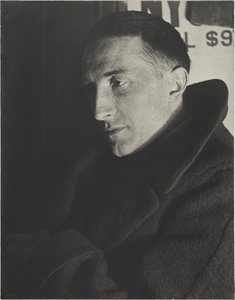
Marcel Duchamp
1887 - 1968 , France
Quick Facts
- Artistic Movement Or Style:
- Cubism
- Dadaism
- Conceptual Art
- Artists Or Movements Influenced By This Artist:
- Conceptual Art
- Minimalism
- Pop Art
- Artists Who Influenced This Artist:
- Cézanne
- Picasso
- Braque
- Full Name: Henri-Robert-Marcel Duchamp
- Nationality: French American
- Notable Artworks:
- Fountain
- Bicycle Wheel
- The Large Glass
- Place Of Birth: Blainville-sur-Mer, France
- Date Of Birth: 1887
- Date Of Death: 1968
Related Articles

Post-Impressionism Guide: Bold Colors and Expressive Masterpieces for Professional Hotel Decorators
Elevate hospitality interiors with Post-Impressionist masterpieces. A professional guide for hotel designers on selecting bold, expressive oil reproductions and large-scale murals to create impactful, high-end guest experiences through expert art procurement.


