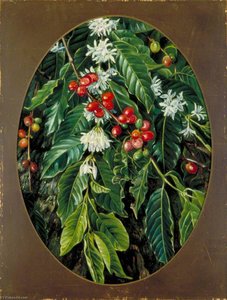
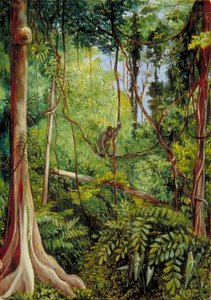
1876. Acrylic On Canvas, 29.0 x 51.0 cm. Marianne North Gallery.

§ 1Catalogue data

- 29.0 x 51.0 cm


§ 2Abstract
Collectible Description
Marianne North’s masterpiece, ‘Old Banyan Trees at Buitenzorg,’ showcases a serene Indonesian forest scene featuring towering banyan trees and tranquil benches. Created in 1876, this painting exemplifies North's dedication to documenting the natural world with exceptional accuracy.
 Read More
Artist Biography
Discover Marianne North (1830-1890), a Victorian explorer & botanical artist who painted exotic flora worldwide. Her gallery at Kew Gardens showcases over 800 vibrant paintings – a testament to her adventurous spirit!
§ 3Commentary
Marianne North's Vision of Tranquility: Exploring ‘Old Banyan Trees at Buitenzorg’
Marianne North (1830–1890) wasn’t merely a painter; she was an explorer, botanist, and a fearless champion of scientific observation blended with artistic passion. Her legacy resides in over 800 meticulously crafted watercolor paintings—a breathtaking testament to her unwavering dedication to documenting the extraordinary flora of distant lands. Among these masterpieces stands ‘Old Banyan Trees at Buitenzorg,’ a serene depiction capturing not just trees, but an entire ethos of wonder and reverence for the natural world.
- Subject Matter: The painting focuses on a grove of ancient banyan trees nestled within the Royal Botanic Gardens, Kew—a location chosen specifically by North to celebrate the beauty and resilience of Southeast Asian ecosystems.
- Style: North’s style is distinctly Romantic, prioritizing expressive color palettes and loose brushstrokes that convey atmosphere rather than photographic realism. This approach aligns perfectly with the Victorian fascination for capturing sublime landscapes.
- Technique: Employing wet-on-wet watercolor technique—a method favored by North—she achieved luminous washes of pigment that subtly blend together, creating an ethereal quality reminiscent of Impressionism but rooted in detailed botanical observation.
A Window into Victorian Scientific Exploration
‘Old Banyan Trees at Buitenzorg’ emerged from a period marked by groundbreaking scientific discoveries—particularly Darwin's theory of evolution—which profoundly reshaped Western understanding of the natural world. North’s artistic endeavors weren’t simply aesthetically pleasing; they served as crucial conduits for disseminating knowledge about plant species and habitats to a wider audience. Her meticulous renderings documented plants previously unknown to European science, furthering botanical research and bolstering the importance of conservation.
- Historical Context: Painted in 1876 during Queen Victoria’s reign—a time of imperial expansion and burgeoning scientific curiosity—the artwork reflects the Victorian preoccupation with classifying and cataloging the natural world.
- Symbolism: The banyan tree itself carries significant symbolic weight, representing longevity, strength, and interconnectedness—themes central to Victorian spiritual thought. Its sprawling roots symbolize resilience in the face of adversity, mirroring North’s own unwavering spirit of adventure.
Capturing Emotion Through Color and Light
Beyond its scientific merit, ‘Old Banyan Trees at Buitenzorg’ possesses a palpable emotional resonance. North skillfully utilized color—particularly shades of emerald green and amber—to evoke feelings of tranquility and contemplation. The diffused light filtering through the canopy creates an atmosphere of dappled shade—a visual metaphor for the subtle beauty found within undisturbed natural environments.
- Emotional Impact: Viewing this painting inspires a sense of awe and appreciation for the grandeur of botanical artistry combined with scientific rigor.
- Interior Design Considerations: Its calming palette and evocative composition make ‘Old Banyan Trees at Buitenzorg’ an ideal choice for enhancing interior spaces—bringing a touch of Victorian elegance and natural serenity into contemporary homes.
A Legacy Preserved in Watercolor
Marianne North's dedication to botanical illustration continues to inspire artists and collectors alike. Reproductions of ‘Old Banyan Trees at Buitenzorg’ offer an opportunity to experience the beauty and intellectual depth of Victorian scientific exploration—a timeless reminder that art can illuminate both the wonders of the natural world and the transformative power of observation.
Questions & Answers
From which country does the Victorian Botanical Painting work "Banyan Trees at Buitenzorg, Java" come?
"Banyan Trees at Buitenzorg, Java" was created by Marianne North, born in United Kingdom, within the Victorian Botanical Painting movement. The artist's origin links the work to Victorian Botanical Painting as practiced by artists from United Kingdom.
At what size is "Banyan Trees at Buitenzorg, Java" recommended to be printed?
A large reproduction is suggested for "Banyan Trees at Buitenzorg, Java" by Marianne North. Size can be adjusted while keeping the proportions.
Is "Banyan Trees at Buitenzorg, Java" by Marianne North in the public domain, and why?
"Banyan Trees at Buitenzorg, Java" by Marianne North is in the public domain - its copyright has expired. Copyright duration runs from the artist's death, which occurred in 1890.



 Switch to Print


 For artworks or reproductions larger than 105 cm (approximately 41 inches) on any side, the frame will be shipped as a kit, disassembled. This method ensures safe delivery and prevents damage during transport.