

Acrylic On Canvas.
§ 1Catalogue data


This Artwork Is Under Copyright Protection
The artwork displayed on this page is protected by copyright law, which means we cannot legally create or sell an identical reproduction. This protection is enforced under international agreements such as the Berne Convention and by national laws, including those outlined by the U.S. Copyright Law - Title 17.
As a respectful and legal alternative, we offer custom, hand-painted artworks inspired by the original. Our skilled and professional artists carefully study the original's style, mood, and artistic essence to create a new, unique piece that evokes the same feeling - while remaining an original creation in its own right.
This method fully complies with copyright regulations because it does not involve copying or duplicating the protected artwork. Instead, it is a creative reinterpretation - a new painting that is influenced by the original but not identical to it.
 Read more
§ 2Abstract
Collectible Description
Explore Mark Rothko’s Untitled 126 – a minimalist masterpiece of stacked frames & subtle tonal variations. Abstract Expressionism at its finest! #Rothko #AbstractArt
Artist Biography
Mark Rothko mastered Color Field painting with the Seagram Murals. Discover the emotional power of his iconic abstract works today.
§ 3Commentary
The Essence of Minimalism: An Exploration of Color and Form
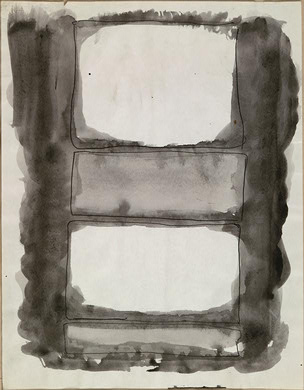
Mark Rothko's "Untitled 126" isn't a painting that shouts for attention; it’s an invitation to pause, to breathe, and to contemplate. Born in 1903 amidst the turbulent backdrop of Tsarist Russia and later navigating the complexities of American assimilation, Rothko’s life profoundly shaped his artistic vision – a relentless pursuit of emotional resonance through pure color. This particular work, created around 1968, exemplifies his mature style: a masterful distillation of abstract expressionism, reduced to its most elemental components. The piece presents three rectangular frames stacked vertically, each containing a vast expanse of white space punctuated by subtle tonal variations. These aren’t merely blank canvases; they are carefully orchestrated fields of color – delicate washes of pink, green, and red that seem to bleed into one another, creating an illusion of depth and shadow without the need for traditional perspective.
The influence of watercolor and ink is palpable in the loose, fluid lines and uneven application of paint. Rothko deliberately eschewed precise representation, opting instead for a gestural approach – a sense of movement and spontaneity captured on the canvas. The deliberate lack of sharp edges and defined forms contributes to the painting’s ethereal quality, inviting viewers to lose themselves within its chromatic depths. It's a testament to his belief that color itself could evoke profound emotional responses, bypassing the need for narrative or recognizable imagery.
Technique and Materials: A Dance with Wet-on-Wet
The painting’s remarkable texture is achieved through a technique known as “wet-on-wet,” where colors are applied to a still-damp surface, allowing them to blend and merge organically. This process results in soft edges, hazy transitions, and an overall sense of atmospheric depth. Rothko utilized watercolor paper, likely diluted with water to achieve the desired transparency and luminosity. The irregular edges of the frames further enhance this informal aesthetic, suggesting a deliberate rejection of rigid boundaries and a celebration of imperfection. The subtle shifts in tone – the almost imperceptible gradients within each rectangular field – are achieved through meticulous layering and blending, creating an illusion of movement and light that seems to emanate from within the painting itself.
Rothko’s Legacy: Existentialism and the Search for Meaning
Understanding Rothko requires acknowledging his deeply personal journey. His early life in Latvia, marked by displacement and loss – including the death of his father – instilled a profound sensitivity to human suffering. This experience resonated throughout his oeuvre, informing his exploration of existential themes such as mortality, trauma, and the search for meaning. "Untitled 126," while devoid of explicit symbolism, embodies this underlying emotional current. The painting’s quiet contemplation invites viewers to confront their own anxieties about existence, offering a space for introspection and perhaps even a sense of solace. It's not a painting that provides answers; rather, it poses questions – prompting us to consider our place in the universe and the nature of human experience.
A Reproduction Worthy of Display: Bringing Rothko’s Vision Home
AllPaintingsStore offers meticulously crafted hand-painted reproductions of "Untitled 126," allowing you to bring this iconic work into your own space. Our skilled artisans replicate Rothko's unique technique with the utmost care, capturing not only the colors and forms but also the subtle textures and atmospheric depth that define the painting’s power. Whether displayed in a minimalist gallery or a serene living room, this reproduction serves as a constant reminder of Rothko’s profound exploration of color, form, and emotion – a timeless testament to the enduring beauty of abstract art. Consider it an investment not just in a piece of art, but in a moment of quiet contemplation.
Questions & Answers
Is Mark Rothko, creator of "Untitled 126", known under other names?
Mark Rothko is also known as Marcus Rothkowitz, Markus Yakovlevich Rothkowitz.
What is the recommended use of a print of "Untitled 126"?
The recommended use of a print of "Untitled 126" is reflective.
How much light do the colors of "Untitled 126" appear to reflect?
The colors of "Untitled 126" show a bright balance luminance.


 Switch to Print


 For artworks or reproductions larger than 105 cm (approximately 41 inches) on any side, the frame will be shipped as a kit, disassembled. This method ensures safe delivery and prevents damage during transport.


