


 Preview
 Send
Send Share
Share
 Details
 Guide
Guide

 Download
 Similars
 X-Ray
X-Ray Diaporama
 Q&A
Q&A Stats
StatsDavid


 Read More
Giclée / Art Print
Museum-quality giclée or canvas print with fast production and flexible finish options. ( Buy Hand Made Painting Switch to Digital Image)




P118B $10

P118H $10

P118W $10

P438Z $10

P508JH $12

P508YH $12

P805H $10

P805Z $10

P919BZ $10

P919G $10

P919XJ $10

P959ZH $10

P968JZ $12

W106C $8

W218G $10

W218JH $8

W218Y $10

W307PJ $10

W316G $10

W316PJ $8

W316Y $10

W398PJ $8

W4111J $10

W500HY $15

W500JH $15

W692G $12

W849H $8

W940BG $15

W953PJ $8




Pick from our preset sizes that match the artwork's original proportions.

Type the width and the height you need, to fit your frame or your wall. A print can only be cut, never made bigger than the picture, so a size with a different shape loses a part of the image. We send you a digital mockup to approve before we print anything. The picture shown on this page does not show the real cut — only the mockup does.
Worldwide Delivery () in 2 weeks instead of standard 4/5 weeks. (31 October)

Free Worldwide Express Shipping

High-Quality Linen Canvas

Full Shipping Insurance

Customs Tax Refund Guarantee

True Color Matching Guarantee

100-Day Return Policy (Defects Only)

100% Money-Back Guarantee

Bulk Discount Offer
 Glass option is only available in size under 110 CM

David
Giclée / Art Print
Reproduction Size
-


Total Price
$ 65
A Colossus of the Renaissance: Michelangelo’s David
Michelangelo’s *David*, sculpted between 1501 and 1504, is arguably the most recognizable sculpture in the world – a breathtaking embodiment of High Renaissance ideals. Standing at an imposing 5.17 meters (17 feet) tall, this marble masterpiece transcends mere representation; it *is* power, beauty, and human potential realized in stone. Originally intended for Florence Cathedral as part of a series depicting Old Testament prophets, its placement before the Palazzo della Signoria – the seat of Florentine government – transformed it into a potent symbol of civic pride and republican values. Today, it resides within the protective walls of the Galleria dell'Accademia in Florence, continuing to inspire awe in countless visitors.Subject & Historical Context
The sculpture depicts David, the biblical hero who famously slew Goliath. However, Michelangelo’s interpretation diverges from earlier depictions which typically showed David *after* his victory, often with Goliath’s severed head at his feet. Instead, Michelangelo captures David in a moment of intense concentration *before* battle – a psychological portrait brimming with contained energy and resolve. This choice was deliberate. Florence, a small republic surrounded by powerful rivals and the looming threat of the Medici family's return, identified strongly with David’s underdog status and his courageous defense of liberty. The statue became an emblem of Florentine independence and strength in the face of adversity.Style & Technique
*David* is a quintessential example of High Renaissance sculpture. Michelangelo masterfully employed *contrapposto*, a classical technique where the weight of the body is shifted to one leg, creating a naturalistic S-curve and imbuing the figure with dynamic potential. His anatomical accuracy is astonishing – every muscle, vein, and tendon meticulously rendered in marble. This dedication to realism wasn’t merely about imitation; it was about celebrating the beauty and perfection of the human form, reflecting Renaissance Humanist philosophy. The surface polish is remarkable, creating a luminous quality that seems to bring the stone to life. Michelangelo's skill lay not only in carving but also in *revealing* the figure already present within the block of marble – as he himself described it.Symbolism & Emotional Impact
Beyond its political connotations, *David* is rich with symbolic meaning. His nudity alludes to classical ideals of heroism and vulnerability. The sling draped over his shoulder and the stone held in his right hand are subtle yet powerful indicators of his impending action. But perhaps most striking is David’s gaze – focused, determined, and slightly apprehensive. This expression conveys not just physical strength but also intellectual and moral courage. The sculpture evokes a profound emotional response: admiration for its beauty, respect for its power, and contemplation of the human condition.A Legacy in Stone
Michelangelo’s *David* has been endlessly replicated throughout history – in plaster, fiberglass, even snow! However, none can truly capture the majesty and emotional depth of the original. Its influence on subsequent generations of artists is immeasurable. For those seeking to bring a touch of Renaissance grandeur into their spaces, a meticulously crafted reproduction offers an opportunity to own a piece of art history. At AllPaintingsStore, our skilled artisans create handmade oil painting reproductions that faithfully capture the essence and beauty of Michelangelo’s masterpiece, ensuring a lasting tribute to this iconic work. Key Features:- Sculpted from a single block of Carrara marble.
- Exemplifies High Renaissance ideals of humanism and anatomical accuracy.
- Originally commissioned for Florence Cathedral, later became a symbol of Florentine Republic.
- Now housed in the Galleria dell'Accademia, Florence.
Questions & Answers
Is "David" free of copyright?
"David" by Michelangelo Buonarroti is in the public domain - its copyright has expired. This status governs how the image of the work may be reproduced.
Which room is "David" by Michelangelo Buonarroti recommended for?
"David" by Michelangelo Buonarroti is recommended for a living room. This suggestion is based on the work's subject, colors and mood.
What does "David" share with the rest of Michelangelo Buonarroti's output?
"David" shares with Michelangelo Buonarroti's other works its Renaissance style and the recorded themes: classical ideals, humanism, florentine liberty, civic pride, biblical narrative, david's triumph", "michelangelo's mastery, sculptural peak".
Related Artworks


Artist Biography
The Hands of Caprese
In the hills of Caprese, a boy learned the weight of stone and the grit of marble dust. Born in 1475, Michelangelo di Lodovico Buonarroti Simoni spent his early years near Settignano, where his father owned a quarry. The smell of damp earth and the sound of hammers against rock were part of his childhood. He did not start with brushes but with the chisel. His apprenticeship under Domenico Ghirlandaio in Florence brought him into contact with the city's growing interest in the human form, yet it was the Medici gardens that truly shaped his eyes. There, among the ancient Greek and Roman fragments, he studied how light falls across muscle and bone.
His work began to take shape through a deep study of anatomy. He looked at the way a limb carries weight and how skin stretches over a joint. This focus on the physical reality of the body became his primary language. By the time he reached Rome in 1496, he was already carving figures that possessed a heavy, palpable presence. The Pietà, completed in 1499, shows this early ability to make marble appear as soft as flesh, even as it carries the weight of a dead man.
The Weight of the Sistine Ceiling
The task of the Sistine Chapel ceiling was not something he sought. He saw himself as a sculptor, someone who pulls life out of stone rather than spreading pigment on plaster. Yet, for four years, he worked in the high reaches of the chapel, painting over 300 figures from the Book of Genesis. The physical toll was visible in his daily life. He spent hours in difficult positions, his body strained by the reach and the heavy application of fresco technique. In panels like The Creation of Adam, the tension is found in the small gap between two fingers, a moment of near-contact that holds the viewer's attention through pure composition.
As time passed, his style moved away from the balanced ideals of the High Renaissance toward something more restless. His later works, such as The Last Judgment on the altar wall, show a shift toward Mannerism. The figures became more elongated and the compositions more crowded and dramatic. This change reflected a shifting spiritual climate in Rome. He continued to work with an intensity that many found overwhelming, often leaving projects unfinished as his mind moved toward new architectural or sculptural problems.
Architecture and Final Years
In his later decades, Michelangelo turned much of his attention to the structure of buildings. At age 71, he took over the work on St. Peter's Basilica, altering the plans to create a more massive, imposing design. He also designed the Laurentian Library, where his use of architectural elements broke from tradition, creating a sense of movement within the stone itself. His work on the Piazza del Campidoglio in Rome showed how he could organize a public space using symmetry and classical motifs to guide the eye through the square.
He died in Rome in 1564, leaving behind a legacy written in marble, fresco, and stone. His life was defined by several key roles:
- Sculptor: Carving works like David from single blocks of Carrara marble.
- Painter: Executing the vast narrative cycles of the Sistine Chapel.
- Architect: Redesigning the foundations of St. Peter's Basilica and the Laurentian Library.
- Poet: Expressing his inner thoughts through verse.
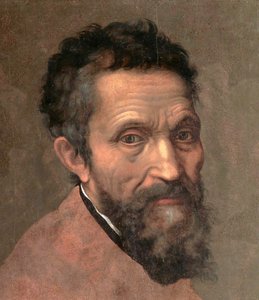
Michelangelo Buonarroti
1475 - 1564 , Italy
Quick Facts
- Artistic Movement Or Style:
- High Renaissance
- Mannerism
- Artists Or Movements Influenced By This Artist: ['Mannerism']
- Artists Who Influenced This Artist:
- Domenico Ghirlandaio
- Donatello
- Masaccio
- Full Name: Michelangelo di Lodovico Buonarroti Simoni
- Nationality: Italian
- Notable Artworks:
- Pietà
- David
- The Creation of Adam
- The Last Judgment
- Moses
- Place Of Birth: Caprese Michelangelo, Italy
- Date Of Birth: 1475
- Date Of Death: 1564
Related Articles

Masterpieces of Michelangelo: The Top 25 Greatest Works of the Renaissance Legend
Explore 25 iconic Michelangelo masterpieces from the Renaissance. Discover museum-quality art legends on AllPaintingsStore.com.

The Enduring Allure of Marble in Art History: From Classical Sculpture to Modern Abstraction
Explore the captivating history of marble sculpture from ancient Greece to modern art. Discover renowned artists like Canova & Michelangelo, carving techniques, and investment insights at AllPaintingsStore.

Timeless Elegance: A Complete Guide to the Sublime Beauty and Artistry of Marble Sculpture
Discover the sublime beauty of marble art through an expert exploration of Renaissance and Neoclassical masterpieces. From the delicate textures of Carpeaux to the grandeur of Sansovino, immerse yourself in a guide to timeless elegance and sculptural perfection.

Bronze Sculptures That Defined Art History | AllPaintingsStore
Journey through art history with our Top 10 bronze sculptures! Explore masterpieces by Rodin, Michelangelo & more. Discover stories behind iconic statues and find museum-quality reproductions for your home decor at AllPaintingsStore.com.

Bronze Age to Modern Masters: 10 Sculptures That Redefined Art | AllPaintingsStore
Journey through art history with 10 legendary bronze sculptures – from Michelangelo's David to Rodin’s Thinker. Explore the stories, techniques & timeless beauty of these masterpieces. Find museum-quality reproductions & elevate your home decor on AllPaintingsStore.com.


