Money-Back Guarantee · 100 days Free Worldwide Delivery
449,587artworks 30,613artists 4,660museums 32languages
Currency
    Language
      Atelier · Est. 2015 · Paris, France
      AllPaintingsStore
      allpaintingsstore.com
      Catalogue entry

      Three Standing Men (recto)

      1494. Acrylic On Canvas, 292.0 x 200.0 cm. Graphische Sammlung Albertina.

      Fig. 1. Michelangelo Buonarroti, Three Standing Men (recto), 1494. Shown as the reproduction you are specifying: , .

      § 1Catalogue data

      § 2Abstract

      Collectible Description

      Michelangelo Buonarroti's 'Three Standing Men (recto)' is a masterful pen drawing housed at the Graphische Sammlung Albertina, showcasing his skill and capturing human emotion.

      Artist Biography

      High Renaissance master of the Sistine Chapel. Discover his legendary sculptures and frescoes today.

      § 3Commentary

      A Silent Conversation: Unveiling Michelangelo’s ‘Three Standing Men’

      Michelangelo Buonarroti, a titan of the High Renaissance, possessed an unparalleled ability to distill human experience onto canvas and stone. Among his vast oeuvre, the drawing known as ‘Three Standing Men (recto)’ – currently residing within the esteemed Graphische Sammlung Albertina in Vienna – offers a poignant glimpse into this extraordinary talent. Executed with remarkable precision in pen on paper in 1494, this work transcends mere representation; it’s a study of posture, emotion, and the subtle language of the human form, revealing a profound depth rarely achieved in drawing.

      The image presents three figures standing close together, each imbued with distinct gestures and expressions. The man on the left, his hands clasped before him in a gesture of contemplation or perhaps prayer, immediately draws the eye. Across from him, the second figure, seemingly gazing downwards, evokes a sense of introspection or melancholy. And finally, the third man, lost in distant thought, embodies a quiet solitude – a powerful depiction of individual experience within a shared space. These aren’t merely portraits; they are carefully constructed studies in human psychology, demonstrating Michelangelo's acute observation and his ability to capture fleeting moments of inner life.

      The Renaissance Master at Work: Technique and Medium

      ‘Three Standing Men (recto)’ is a testament to Michelangelo’s mastery of the pen. The drawing showcases an astonishing level of detail, achieved through meticulous shading and line work. Notice how he renders the texture of clothing, the subtle contours of faces, and the weight of each figure's stance. The use of pen allows for incredible control – a delicate balance between precision and expressive fluidity. This particular medium was favored by Michelangelo during this period, offering him the versatility to create both detailed studies and preliminary sketches for larger works. The drawing’s monochrome palette further emphasizes the figures themselves, stripping away extraneous detail and focusing attention on their forms and expressions.

      A Window into a World: Historical Context and the Graphische Sammlung Albertina

      Created in 1494, ‘Three Standing Men (recto)’ exists within a pivotal moment of artistic innovation. The Renaissance was flourishing across Italy, fueled by renewed interest in classical antiquity and a burgeoning spirit of humanism. Michelangelo, deeply influenced by this era, sought to capture the essence of humanity – its beauty, its struggles, and its inherent complexity. The Graphische Sammlung Albertina, itself a treasure trove of prints and drawings, provides an invaluable context for appreciating this work. This institution’s collection represents centuries of artistic production, offering a comprehensive view of printmaking techniques and showcasing the works of masters like Michelangelo alongside contemporary artists.

      Beyond the Lines: Symbolism and Emotional Resonance

      While seemingly simple in composition, ‘Three Standing Men (recto)’ is rich with symbolic potential. The figures’ postures invite interpretation – are they engaged in a private conversation? Are they reflecting on their lives? Or perhaps they represent different facets of human nature itself? Michelangelo's genius lies not just in his technical skill but also in his ability to evoke emotion and stimulate the viewer's imagination. This drawing, like so many of his works, invites us to contemplate the mysteries of the human condition and the enduring power of art to capture our deepest thoughts and feelings. For those seeking a high-quality reproduction, AllPaintingsStore offers meticulously crafted reproductions that faithfully preserve the beauty and nuance of this remarkable masterpiece.

      Questions & Answers

      Can I use augmented reality to see "Three Standing Men (recto)" by Michelangelo Buonarroti in my room?

      The AR Preview page of "Three Standing Men (recto)" by Michelangelo Buonarroti uses augmented reality to show the artwork in your own space, on a compatible device.

      What emotion does "Three Standing Men (recto)" by Michelangelo Buonarroti convey?

      "Three Standing Men (recto)" is associated with a reflective feeling. The emotional tone describes the impression the work gives.

      What was Michelangelo Buonarroti's age when "Three Standing Men (recto)" was created?

      When "Three Standing Men (recto)" was created in 1494, Michelangelo Buonarroti - born in 1475 - was 19 years old.
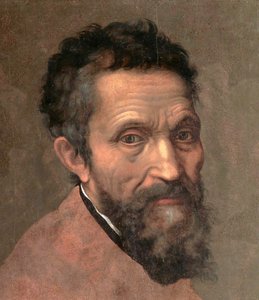
      § 4The artist

      Michelangelo Buonarroti

      Michelangelo Buonarroti

      1475 - 1564, Italy

      Quick facts about Michelangelo Buonarroti

      • Artistic Movement Or Style:
        • High Renaissance
        • Mannerism
      • Artists Or Movements Influenced By This Artist: ['Mannerism']
      • Artists Who Influenced This Artist:
        • Domenico Ghirlandaio
        • Donatello
        • Masaccio
      • Full Name: Michelangelo di Lodovico Buonarroti Simoni
      • Nationality: Italian
      • Notable Artworks:
        • Pietà
        • David
        • The Creation of Adam
        • The Last Judgment
        • Moses
      • Place Of Birth: Caprese Michelangelo, Italy
      • Date Of Birth: 1475
      • Date Of Death: 1564

      Artist Biography

      The Hands of Caprese

      In the hills of Caprese, a boy learned the weight of stone and the grit of marble dust. Born in 1475, Michelangelo di Lodovico Buonarroti Simoni spent his early years near Settignano, where his father owned a quarry. The smell of damp earth and the sound of hammers against rock were part of his childhood. He did not start with brushes but with the chisel. His apprenticeship under Domenico Ghirlandaio in Florence brought him into contact with the city's growing interest in the human form, yet it was the Medici gardens that truly shaped his eyes. There, among the ancient Greek and Roman fragments, he studied how light falls across muscle and bone.

      His work began to take shape through a deep study of anatomy. He looked at the way a limb carries weight and how skin stretches over a joint. This focus on the physical reality of the body became his primary language. By the time he reached Rome in 1496, he was already carving figures that possessed a heavy, palpable presence. The Pietà, completed in 1499, shows this early ability to make marble appear as soft as flesh, even as it carries the weight of a dead man.

      The Weight of the Sistine Ceiling

      The task of the Sistine Chapel ceiling was not something he sought. He saw himself as a sculptor, someone who pulls life out of stone rather than spreading pigment on plaster. Yet, for four years, he worked in the high reaches of the chapel, painting over 300 figures from the Book of Genesis. The physical toll was visible in his daily life. He spent hours in difficult positions, his body strained by the reach and the heavy application of fresco technique. In panels like The Creation of Adam, the tension is found in the small gap between two fingers, a moment of near-contact that holds the viewer's attention through pure composition.

      As time passed, his style moved away from the balanced ideals of the High Renaissance toward something more restless. His later works, such as The Last Judgment on the altar wall, show a shift toward Mannerism. The figures became more elongated and the compositions more crowded and dramatic. This change reflected a shifting spiritual climate in Rome. He continued to work with an intensity that many found overwhelming, often leaving projects unfinished as his mind moved toward new architectural or sculptural problems.

      Architecture and Final Years

      In his later decades, Michelangelo turned much of his attention to the structure of buildings. At age 71, he took over the work on St. Peter's Basilica, altering the plans to create a more massive, imposing design. He also designed the Laurentian Library, where his use of architectural elements broke from tradition, creating a sense of movement within the stone itself. His work on the Piazza del Campidoglio in Rome showed how he could organize a public space using symmetry and classical motifs to guide the eye through the square.

      He died in Rome in 1564, leaving behind a legacy written in marble, fresco, and stone. His life was defined by several key roles:

      • Sculptor: Carving works like David from single blocks of Carrara marble.
      • Painter: Executing the vast narrative cycles of the Sistine Chapel.
      • Architect: Redesigning the foundations of St. Peter's Basilica and the Laurentian Library.
      • Poet: Expressing his inner thoughts through verse.

      § 5Comparanda

      § 6Questions

      Quick Facts

      • Dimensions: 292 x 200 cm
      • Movement: Renaissance
      • Subject or theme: Human anatomy; contemplation
      • Artistic style: High Renaissance
      • Year: 1494
      • Title: Three Standing Men

      § 7Cite this entry

      AllPaintingsStore.com, “Michelangelo Buonarroti, Three Standing Men (recto) (1494)”, https://allpaintingsstore.com/en/art/michelangelo-buonarroti-three-standing-men-recto-8XZRXP-en/ArtistReproduction/ (accessed 2 October 2026).

      § 8The reproduction

      Hand Made Oil Reproduction

      Hand-painted oil on canvas in your size and frame, made to order by our artists. ( Switch to Print Switch to Digital Image)

      It is specified on the order sheet in the margin; the present state of that sheet reads as follows.

      Three Standing Men (recto)

      Reproduction Medium

      Reproduction Size

      -

      Elite Senior Artist

      More detail, finesse, and extra production time

      -

      Reproduction Frame

      -

      -

      For artworks or reproductions larger than 105 cm (approximately 41 inches) on any side, the frame will be shipped as a kit, disassembled. This method ensures safe delivery and prevents damage during transport.

      Professional assembly required - this is not a DIY product.
      The kit must be assembled and the canvas stretched by an experienced professional framer, using wood glue (not supplied), a canvas stretching plier and clamps to hold the bars square while the glue dries. Incorrect assembly or uneven canvas tension can permanently damage the artwork and is not covered by our warranty.

      • All solid wood bars are included, precisely cut to size.

      • Assembled with the screws provided, plus wood glue for the corner joints, which is not supplied and must be sourced by your framer.

      • Professional tools are required and not included: a canvas stretching plier (tensioner) and clamps to hold the bars square while the glue dries.

      Important:
      The corner joints require wood glue, the bars must be held with clamps until the glue is fully dry, and tightening the canvas on the assembled frame requires a canvas stretching plier. None of these are included in the kit. Please arrange an experienced professional framer before ordering this size.

      Nameplate

      -

      -

      Protective Varnish

      Glossy Varnish (enhances colors, protects against light/moisture)

      -

      Customize My Artwork

      Examples of what can be changed: Replace face with customer photo; Add pet (e.g., replace cat with dog); Include hidden message in background; Change background landscape or elements.

      -

      Urgent

      Worldwide Delivery () in 3/4 weeks instead of standard 5 weeks. (31 October). No compromise on quality.

      -

      Express Shipping

      Worldwide Delivery () in 5 weeks. (7 November).

      Included

      Total Price

      $ 258

      Included with every order

      • Free Worldwide Express Shipping
      • High-Quality Linen Canvas
      • Full Shipping Insurance
      • Customs Tax Refund Guarantee
      • True Color Matching Guarantee
      • 100-Day Return Policy (Defects Only)
      • 100% Money-Back Guarantee
      • Bulk Discount Offer
      Order sheet