Money-Back Guarantee · 100 days Free Worldwide Delivery
449,587artworks 30,613artists 4,660museums 32languages
Catalogue entry

[Untitled]

1969. Painting. Japanese American National Museum.

Fig. 1. Miné Okubo, [Untitled], 1969. Shown as the reproduction you are specifying: , .

§ 1Catalogue data

§ 2Abstract

Collectible Description

Explore Miné Okubo's poignant abstract painting 'Untitled,' created during WWII incarceration and reflecting resilience through bold colors and symbolic figures—a powerful testament to artistic expression amidst adversity.

Artist Biography

Miné Okubo was an American artist renowned for her poignant drawings documenting life within Japanese American internment camps during WWII. Her powerful graphic novel, *Citizen 13660*, offers a vital witness account of resilience and injustice.

§ 3Commentary

A Symphony of Crimson and Resilience

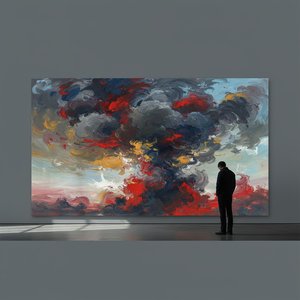
In the vast landscape of twentieth-century American art, few works possess the visceral, haunting power of Miné Okubo’s 1969 masterpiece, "Untitled." At first glance, the viewer is met with an overwhelming surge of color—a dominant, fiery red that saturates the canvas, demanding immediate attention. This is not merely a decorative choice; it is an emotional landscape. The painting serves as a profound testament to the Japanese American experience during the dark era of World War II internment. Through her expressive use of pigment, Okubo transforms a moment of historical trauma into a universal contemplation on identity and survival. For the discerning collector or interior designer, this piece offers more than visual impact; it provides a deep, narrative soul that can anchor a room with both warmth and gravity.

The technique employed in "Untitled" leans heavily into the traditions of Expressionism, where the artist’s internal psyche is laid bare through movement and texture. Okubo eschews the sterile precision of realism, opting instead for loose, energetic brushstrokes that pulse with life. The application of paint often features a thick impasto, creating a tactile surface that mirrors the physical and psychological hardships endured by those in the relocation centers. This textured approach allows light to catch the ridges of the pigment, adding a three-dimensional dynamism to the work. Against this turbulent red sea, the central figures emerge in stark black and white, their monochromatic forms acting as silent witnesses to the surrounding intensity. The contrast is sharp and deliberate, emphasizing the vulnerability of the human spirit when caught in the tides of historical upheaval.

Symbolism and the Echoes of History

To gaze upon "Untitled" is to engage in a dialogue with history. Okubo, a survivor of the Topaz War Relocation Center in Utah, channeled her memories of displacement into this abstract composition. The interplay between the humanoid figures and more fluid, organic shapes—some of which suggest the movement of aquatic life—creates a sense of flux and instability. This fluidity can be interpreted as the loss of groundedness experienced by families uprooted from their homes. The red backdrop, while evocative of passion and the burning desire for freedom, also carries the weight of anger and the blood of a fractured community. It is a color that both protects and consumes.

For those looking to integrate such a powerful work into a curated space, "Untitled" offers an unparalleled opportunity to introduce narrative depth. Whether placed in a modern gallery setting or as a focal point in a sophisticated residential study, the painting invites endless interpretation. It is a piece that rewards long periods of contemplation, offering new layers of meaning with every viewing. As a high-quality reproduction, it captures the raw, emotive essence of Okubo’s original vision, allowing the legacy of her resilience to breathe within contemporary interiors, reminding us all of the enduring power of memory and the indomitable strength of the human heart.

Questions & Answers

What is "[Untitled]" about?

The themes present in "[Untitled]" by Miné Okubo include abstraction, surrealism, fish symbolism, human figure, color palette, black white contrast, resilience. Together they summarize the artwork's subject matter.

Can I use augmented reality to see "[Untitled]" by Miné Okubo in my room?

"[Untitled]" by Miné Okubo can be previewed on your own wall with the artwork's AR Preview page, using augmented reality on a compatible device.

Does "[Untitled]" show strong light-dark contrasts?

"[Untitled]" by Miné Okubo shows a bold contrast between its light and dark areas.

§ 4The artist

Miné Okubo

Miné Okubo

1912 - 2001, United States of America

Quick facts about Miné Okubo

  • Full Name: Miné Okubo
  • Nationality: American
  • Date Of Birth: 1912
  • Date Of Death: 2001
  • Place Of Birth: Riverside, United States of America
  • Notable Artworks:
    • Citizen 13660
    • Interior of Mine and Toku
    • Working at the Topaz Times
  • Artistic Movement Or Style: Social Realism
  • Artists Who Influenced This Artist: ['Käthe Kollwitz']
  • Artists Or Movements Influenced By This Artist: ['Civil Rights Movement']

Artist Biography

A Life Etched in Resilience: The Art of Miné Okubo

Miné Okubo, born in Riverside, California, in 1912, was an artist whose life became inextricably linked to a pivotal and painful chapter in American history. Her story is not simply one of artistic talent, but of profound courage, unwavering observation, and the power of art as witness. From her early encouragement within a family that valued creativity – her mother a skilled calligrapher, her father a scholar – Okubo embarked on a path toward formal training, studying at the University of California, Berkeley, and later venturing to Europe in 1938 to broaden her artistic horizons. This period of study was abruptly curtailed by the looming shadow of World War II, forcing her return to America just as global tensions reached a boiling point. Little could she have known that this homecoming would lead not to continued artistic exploration, but to forced incarceration and an experience that would define both her life and her art.

Bearing Witness: Art Within the Walls

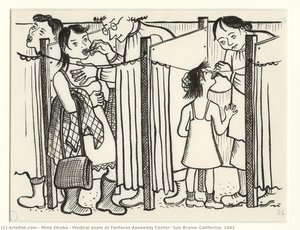
The attack on Pearl Harbor irrevocably altered the course of Okubo’s life, as it did for countless other Japanese Americans. In 1942, she and her brother Benji were uprooted from their home and unjustly confined to the Tanforan Assembly Center, a converted racetrack that served as a temporary holding facility before transfer to the more permanent Topaz War Relocation Center in Utah. It was within these barbed-wire confines, amidst the dust and despair, that Okubo embarked on her most significant artistic undertaking. Driven by an almost compulsive need to document the reality around her, she began creating a remarkable visual record of camp life – over 2,000 drawings and sketches meticulously rendered in pen and ink, watercolor, and charcoal. These weren’t grand historical paintings or idealized portraits; they were raw, honest depictions of daily existence: crowded living quarters, bureaucratic processes, the faces etched with worry and resignation, moments of quiet dignity amidst profound hardship. She captured the mundane details – laundry hanging on lines, children playing in the dust, meals served in mess halls – transforming them into powerful statements about resilience and the erosion of civil liberties. Okubo’s art wasn't merely a personal response; it was an act of defiance, a refusal to be silenced or erased.

Citizen 13660: A Testament to Dehumanization and Hope

Upon her release from Topaz in 1944, Okubo channeled her experiences into a groundbreaking work of art and literature: Citizen 13660. Published in 1946, the book comprised 198 of her drawings accompanied by poignant text. The title itself is deeply symbolic, referencing the number assigned to her within the internment system – a stark reminder of the dehumanizing process she and so many others endured. Citizen 13660 wasn’t simply a chronicle of suffering; it was a nuanced portrayal of human spirit in the face of adversity. Okubo didn't shy away from depicting the indignities and injustices, but she also captured moments of community, humor, and quiet strength. The drawings are characterized by their directness, emotional depth, and masterful use of line and shadow. The book quickly became a seminal work documenting the Japanese American internment experience, offering an unflinching look at a dark chapter in American history that many preferred to ignore.

A Continuing Legacy: Art as Social Commentary

Following the war, Okubo relocated to New York City and continued her artistic career, working as a freelance illustrator for magazines and books, and undertaking mural projects. While she never fully abandoned the themes of social justice and human dignity that had defined her wartime work, her style evolved over time. She explored different mediums and techniques, but always maintained a commitment to realism and honest observation. Okubo’s artistic influences were diverse, drawing inspiration from the Social Realist movement – which emphasized depicting social issues and everyday life with unflinching accuracy – and artists like Käthe Kollwitz, renowned for her powerful depictions of human suffering. Throughout her career, she received numerous awards and recognitions, including grants from the National Endowment for the Arts, acknowledging the significance of her contributions to American art and culture. Miné Okubo passed away in 2001, leaving behind a legacy that continues to resonate today. Her work serves as a potent reminder of the fragility of civil liberties, the importance of vigilance against prejudice and discrimination, and the enduring power of art to bear witness, challenge injustice, and inspire hope. Her drawings are not just historical documents; they are deeply human stories etched in ink and watercolor, demanding that we remember, learn from, and never repeat the mistakes of the past.

§ 5Comparanda

§ 6Questions

Quick Facts

  • Artist: Miné Okubo
  • Movement: Abstract Expressionism
  • Subject or theme: Conceptual art
  • Medium: Painting
  • Notable elements or techniques: Bold brushstrokes, vibrant color palette

Art Quiz

There is only one correct answer for each question.

Question 1:
What is the predominant color in Miné Okubo’s painting?
Question 2:
The artist's signature 'Okubo' indicates that this artwork was created during:
Question 3:
What artistic movement is Miné Okubo’s style most closely associated with?
Question 4:
The painting depicts a figure resembling:
Question 5:
What is the significance of the black and white figures contrasted against the red background?

§ 7Cite this entry

AllPaintingsStore.com, “Miné Okubo, [Untitled] (1969)”, https://allpaintingsstore.com/en/art/mine-okubo-untitled-DD3CVR-en/ArtistReproduction/ (accessed 4 October 2026).

§ 8The reproduction

Hand Made Oil Reproduction

Hand-painted oil on canvas in your size and frame, made to order by our artists. ( Switch to Print Switch to Digital Image)

It is specified on the order sheet in the margin; the present state of that sheet reads as follows.

[Untitled]

Reproduction Medium

Reproduction Size

-

Elite Senior Artist

More detail, finesse, and extra production time

-

Reproduction Frame

-

-

For artworks or reproductions larger than 105 cm (approximately 41 inches) on any side, the frame will be shipped as a kit, disassembled. This method ensures safe delivery and prevents damage during transport.

Professional assembly required - this is not a DIY product.
The kit must be assembled and the canvas stretched by an experienced professional framer, using wood glue (not supplied), a canvas stretching plier and clamps to hold the bars square while the glue dries. Incorrect assembly or uneven canvas tension can permanently damage the artwork and is not covered by our warranty.

  • All solid wood bars are included, precisely cut to size.

  • Assembled with the screws provided, plus wood glue for the corner joints, which is not supplied and must be sourced by your framer.

  • Professional tools are required and not included: a canvas stretching plier (tensioner) and clamps to hold the bars square while the glue dries.

Important:
The corner joints require wood glue, the bars must be held with clamps until the glue is fully dry, and tightening the canvas on the assembled frame requires a canvas stretching plier. None of these are included in the kit. Please arrange an experienced professional framer before ordering this size.

Nameplate

-

-

Protective Varnish

Glossy Varnish (enhances colors, protects against light/moisture)

-

Customize My Artwork

Examples of what can be changed: Replace face with customer photo; Add pet (e.g., replace cat with dog); Include hidden message in background; Change background landscape or elements.

-

Urgent

Worldwide Delivery () in 3/4 weeks instead of standard 5 weeks. (1 November). No compromise on quality.

-

Express Shipping

Worldwide Delivery () in 5 weeks. (8 November).

Included

Total Price

$ 258

Included with every order

  • Free Worldwide Express Shipping
  • High-Quality Linen Canvas
  • Full Shipping Insurance
  • Customs Tax Refund Guarantee
  • True Color Matching Guarantee
  • 100-Day Return Policy (Defects Only)
  • 100% Money-Back Guarantee
  • Bulk Discount Offer
Order sheet