


 Preview
 Send
Send Share
Share
 Details
 Guide
Guide

 Download
 Similars
 X-Ray
X-Ray Diaporama
 Q&A
Q&A Stats
StatsPieta

- 57.0 x 48.0 cm


 Read More
Giclée / Art Print
Museum-quality giclée or canvas print with fast production and flexible finish options. ( Buy Hand Made Painting Switch to Digital Image)




P118B $10

P118H $10

P118W $10

P438Z $10

P508JH $12

P508YH $12

P805H $10

P805Z $10

P919BZ $10

P919G $10

P919XJ $10

P959ZH $10

P968JZ $12

W106C $8

W218G $10

W218JH $8

W218Y $10

W307PJ $10

W316G $10

W316PJ $8

W316Y $10

W398PJ $8

W4111J $10

W500HY $15

W500JH $15

W692G $12

W849H $8

W940BG $15

W953PJ $8




Pick from our preset sizes that match the artwork's original proportions.

Type the width and the height you need, to fit your frame or your wall. A print can only be cut, never made bigger than the picture, so a size with a different shape loses a part of the image. We send you a digital mockup to approve before we print anything. The picture shown on this page does not show the real cut — only the mockup does.
Worldwide Delivery () in 2 weeks instead of standard 4/5 weeks. (20 November)

Free Worldwide Express Shipping

High-Quality Linen Canvas

Full Shipping Insurance

Customs Tax Refund Guarantee

True Color Matching Guarantee

100-Day Return Policy (Defects Only)

100% Money-Back Guarantee

Bulk Discount Offer
 Glass option is only available in size under 110 CM

Pieta
Giclée / Art Print
Reproduction Size
-


Total Price
$ 65
A Sacred Encounter of Sorrow and Grace
In the quiet, heavy atmosphere of Nicolas Poussin’s Pieta, time seems to suspend itself, capturing a moment of profound theological and human weight. The canvas presents us with the heartbreaking intimacy of the Virgin Mary cradling the lifeless body of her son, Jesus. It is not merely a depiction of death, but a testament to the enduring strength of maternal love amidst divine tragedy. Poussin, a master who bridged the gap between the visceral drama of the Baroque and the disciplined clarity of Classicism, imbues this scene with a stillness that invites deep contemplation. Every fold of the heavy drapery and every subtle tilt of a head serves to heighten the emotional resonance, drawing the viewer into a shared experience of grief and reverence.
The Mastery of Light and Form
Technically, the Pieta stands as a triumph of chiaroscuro, where light does not merely illuminate but actively narrates the spiritual struggle within the frame. Poussin employs a sophisticated interplay of shadow and luminescence to sculpt his figures, giving them a palpable, three-dimensional presence that feels almost statuesque. A soft, ethereal glow graces Mary’s countenance and the cascading textures of her garments, creating a striking contrast against the deep, mysterious recesses of the tomb behind them. This deliberate manipulation of light directs our gaze toward the central tragedy, ensuring that the viewer's eye is perpetually drawn back to the intersection of flesh and spirit. Through meticulous tonal gradations, Poussin achieves a sense of depth that transforms a two-dimensional surface into a window onto a sacred event.
A Timeless Addition to the Collector’s Eye
For the discerning collector or interior designer, this work offers more than just historical significance; it provides a focal point of unparalleled dignity. Born in France but shaped by the classical grandeur of Rome, Poussin’s approach to composition emphasizes balance, harmony, and intellectual rigor. This makes the piece uniquely versatile for sophisticated spaces, where its somber elegance can anchor a room with a sense of history and gravitas. Whether viewed as an exploration of 17th-century religious devotion or as a masterpiece of formal composition, the Pieta remains a powerful emblem of the human condition. Owning a reproduction of such a monumental work allows one to bring the quiet, commanding presence of Poussin’s classical vision into the modern home, fostering an environment of reflection and timeless beauty.
Questions & Answers
How was "Pieta" made, and how big is it?
The original "Pieta" by Nicolas Poussin is an oil on canvas work measuring 57 x 48 cm. Technique and size describe the original object.
What are the date and style of "Pieta" by Nicolas Poussin?
"Pieta" by Nicolas Poussin is dated 1627 and belongs to Baroque.
Do the colors of "Pieta" appear strong or soft?
The colors in "Pieta" by Nicolas Poussin have a balanced intensity.
Related Artworks


Artist Biography
Early Life, Family and Training
To understand the rigid discipline of Nicolas Poussin, one must look to his origins in Les Andelys, Normandy. Born in June 1594, his early development was not a product of sudden inspiration but of structured, methodical training. He began his technical education in Rouen, a start that provided the foundational mechanics necessary for his later, more complex compositions. This early period established a pattern of rigorous preparation that would define his entire career.
By 1612, Nicolas Poussin had moved to Paris, where he remained until 1623. This decade in the French capital was a period of significant growth, moving him beyond the initial instruction of his youth. His education was not limited to the visual; he received instruction in Latin, a fact that provided the linguistic tools required to engage directly with the classical texts he would later translate into imagery. This literacy in ancient language and structure ensured his work was built on a foundation of logic rather than mere visual sensation.
The Roman Years and Artistic Development
Poussin arrived in Rome in 1624, having traveled via Venice. At this stage, he was an unformed painter, lacking the definitive direction that would later define his career. He did not stay in France to find his voice; instead, he spent most of his working life in Rome, a city that provided the necessary intellectual and physical landscape for his evolution. This was not a period of mere residence, but a fundamental shift in his artistic trajectory. He moved away from the sensuous, Venetian-influenced style of his youth toward a more disciplined, structured approach. This transition was driven by a deep engagement with the classical ruins and the scholarly circles of the Eternal City.
His development in Rome was marked by a rejection of the flamboyant, theatrical Baroque tastes prevalent in his time. Instead of prioritizing immediate sensory impact or dramatic gesture, he sought a sense of order and logic. He studied antique remains and the works of Raphael to build a visual language rooted in clarity and balance. This period saw him move from the experimental, almost unformed works of his arrival to a highly controlled method of composition. He eventually established a style that favored line over color, focusing on the intellectual weight of his subjects rather than superficial spectacle. He remained in Rome until his death in 1665, having transformed from an unformed immigrant into a central figure of the classical tradition.
Patrons, Workshop and Commissions
Poussin’s career was defined by a selective, intellectual circle of patrons rather than the broad, theatrical demands of the Counter-Reformation. In Rome, his primary connection was Cassiano dal Pozzo, a scholar and archaeologist whose influence anchored Poussin within a specific, high-minded social stratum. This relationship secured Poussin his only papal commission in 1628. Such work required a departure from the flamboyant, emotive style popular in the city at the time, favoring instead the structured clarity that his patrons demanded. His ability to satisfy these discerning collectors established his reputation as a painter of substance.
His professional standing eventually reached the highest levels of the French state. During his brief return to Paris, he was appointed First Painter to the King under Louis XIII and Cardinal Richelieu. This position carried significant weight, yet the administrative and courtly pressures proved incompatible with his working methods. He held the title of First Painter of the King, but the demands of the court led him to abandon the position and return to Rome. His preference for the company of scholars over the intrigues of the palace highlights the disciplined, almost reclusive nature of his professional life.
- The Martyrdom of Saint Erasmus (1628)
Technique and Style
Poussin’s approach to composition was a disciplined exercise in geometry and logic. He rejected the chaotic, emotional spontaneity of the Baroque in favor of clarity and order. To achieve this, he functioned more like an architect than a mere painter. He utilized a specialized box lit through openings in its walls to plan his canvases, allowing him to study light and shadow before a single brushstroke was applied to the final surface. This methodical preparation ensured that every figure and landscape element occupied a precise, rational space.
His process involved a physical, almost theatrical staging of his subjects. He used small stages with wax figures and arranged draperies to work out complex arrangements. This tactile method allowed him to master the interplay of light and form. He employed chiaroscuro to sculpt his figures, using light and shadow to provide depth and emotional weight without relying on the superficial drama of his contemporaries. His preference for line over color defined his aesthetic; he prioritized the structural integrity of a scene, ensuring that the underlying logic of the composition remained the primary focus for the viewer.
Key Works and Themes
Poussin’s output was defined by a rigorous commitment to structure, often using historical and mythological narratives to explore human morality. He frequently depicted scenes from ancient history, treating the canvas as a stage for stoic dignity. This intellectual approach is evident in his religious works, such as the Martyrdom of Saint Erasmus, which he painted for the Church of Saint Peter. Even in his earlier, more sensuous period, works like The Nurture of Bacchus show a transition from Venetian-inspired color toward the disciplined linearity that would define his mature style.
His thematic range extended into deep philosophical territory, most notably in Et in Arcadia Ego. This work uses a landscape setting to prompt contemplation on mortality. In the late 1630s, he turned his attention to the sacred through the Seven Sacraments series. These paintings demonstrate his ability to maintain classical restraint even when handling heavy theological subjects. He did not rely on emotional excess; instead, he used clear, logical arrangements to convey spiritual meaning.
- The Martyrdom of Saint Erasmus
- The Nurture of Bacchus
- Et in Arcadia Ego
- The Seven Sacraments
Legacy and Influence
Poussin’s impact on French art was structural rather than merely stylistic. By establishing a standard for order and clarity, he became a cornerstone of French Classicism. His presence in the Académie Royale de Peinture et de Sculpture solidified a rigorous approach to composition that defined the era. He did not merely paint; he provided a framework for how history and myth should be organized on a canvas. This discipline ensured his influence persisted long after his death in Rome.
The reach of his method extended into the next century, shaping the direction of major movements. Artists such as Jacques-Louis David and Paul Cézanne acknowledged their debt to his intellectual depth and his preference for line over color. While David applied these principles to Neoclassicism, Cézanne found a different resonance in Poussin's structured landscapes. His ability to impose logic onto a scene remains a primary reference point for anyone studying the evolution of Western composition.
- Et in Arcadia Ego
- The Seven Sacraments
- The Death of Germanicus
- Orion Blinded Searching for the Sun
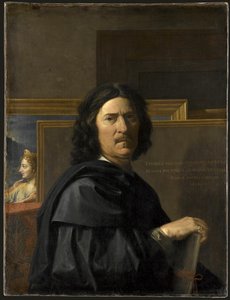
Nicolas Poussin
1594 - 1665 , France
Quick Facts
- Artistic Movement Or Style: French Baroque, French Classicism
- Artists Or Movements Influenced By This Artist:
- Jacques-Louis David
- Paul Cézanne
- Artists Who Influenced This Artist:
- Titian
- Raphael
- Full Name: Nicolas Poussin
- Nationality: French
- Notable Artworks:
- The Death of Germanicus
- The Seven Sacraments
- A Roman Road
- Orion Blinded Searching for the Sun
- The Seasons
- Place Of Birth: Le Havre, France
- Date Of Birth: 1594
- Date Of Death: 1665
Related Articles

Mastering the Classics: The 25 Greatest Paintings by Nicolas Poussin
Journey through the grandeur of French Baroque with our curated list of the top 25 Nicolas Poussin masterpieces. Explore the stories behind these timeless classical paintings and find museum-quality art reproductions for your decor. Discover all masterpieces on AllPaintingsStore.com.


