Money-Back Guarantee · 100 days Free Worldwide Delivery
449,587artworks 30,613artists 4,660museums 32languages
Currency
    Language
      Atelier · Est. 2015 · Paris, France
      AllPaintingsStore
      allpaintingsstore.com
      Catalogue entry

      St. Cecilia

      1628. Oil On Canvas, 118.0 x 88.0 cm. Museo del Prado.

      Fig. 1. Nicolas Poussin, St. Cecilia, 1628. Shown as the reproduction you are specifying: , .

      § 1Catalogue data

      § 2Abstract

      Collectible Description

      Explore Nicolas Poussin’s ‘St. Cecilia,’ a Baroque masterpiece depicting Mary & Jesus amidst angelic music & Roman architecture. Oil on canvas, 1628. #Poussin #BaroqueArt

      Artist Biography

      Explore Nicolas Poussin's masterful Baroque paintings—renowned for serene landscapes and mythological narratives inspired by classical antiquity. Discover iconic artworks at AllPaintingsStore.

      § 3Commentary

      A Harmonious Vision of Faith and Art: Nicolas Poussin’s *St. Cecilia* (1628)

      Nicolas Poussin's *St. Cecilia*, painted in 1628, is a captivating example of Baroque classicism – a style that blends the dramatic energy of the Baroque with the clarity and order of classical antiquity. Measuring 118 x 88 cm, this oil on canvas resides in the Prado Museum, Madrid, and offers a serene yet profoundly symbolic depiction of the saint known as the patroness of music.

      Subject & Narrative

      The painting portrays Saint Cecilia, not in a scene of martyrdom (though she faced one), but in a moment of devout contemplation. She is shown seated on a draped bench, absorbed in reading sheet music – an activity befitting her association with musical harmony. The infant Jesus sits beside her, playfully engaged with a small organ. Three cherubic angels surround them: one hovers above in adoration, another kneels presenting a scroll (likely containing further musical notation), and the third gently lifts a curtain to reveal this intimate scene. This isn’t merely a portrait; it's a visualization of divine inspiration and pious devotion within a domestic setting.

      Style & Technique

      Poussin’s style is immediately recognizable for its emphasis on linear clarity, balanced composition, and restrained emotionalism. Unlike the more flamboyant Baroque artists, Poussin prioritizes *order* and *intellectual rigor*. The painting demonstrates meticulous oil painting technique with visible brushstrokes that contribute to a rich texture, particularly in the drapery, wings, and musical score. While employing dramatic chiaroscuro – the strong contrast between light and shadow – to define form, he avoids excessive theatricality. The perspective is subtly flattened, characteristic of early Baroque tendencies, creating depth through layering rather than strict linear precision. The predominant use of curvilinear lines contributes to a sense of flowing movement and grace.

      Historical Context & Influences

      Born in France but spending most of his career in Rome, Poussin occupied a unique position within the artistic landscape of the 17th century. He rejected the prevailing *Rubensian* Baroque style – characterized by dynamism and sensuality – in favor of a more classical approach inspired by artists like Raphael and antique sculpture. His commitment to order and reason would profoundly influence later generations, including Jacques-Louis David and Paul Cézanne. Poussin’s early training was somewhat uncertain, but he quickly absorbed the influences around him before establishing his distinctive style in Rome. He worked alongside landscape painters such as Paul Bril, who pioneered Italianate landscapes.

      Symbolism & Meaning

      The symbolism within *St. Cecilia* is rich and layered. Music, naturally, represents divine harmony and the celestial realm. Saint Cecilia’s association with music stems from legends describing her singing hymns to God during her wedding, resisting earthly marriage in favor of spiritual devotion. The angels symbolize divine protection and guidance, while the musical score suggests a connection between earthly artistry and heavenly inspiration. The architectural backdrop, reminiscent of Roman ruins, alludes to both the classical past and the enduring power of faith.

      Emotional Impact & Interior Design Considerations

      *St. Cecilia* evokes a sense of peaceful contemplation, spiritual grace, and refined beauty. The painting’s muted color palette – warm golds, deep reds, and soft blues – creates a calming atmosphere. Its balanced composition and classical aesthetic make it an ideal focal point for interiors seeking a touch of timeless elegance. A high-quality reproduction would be particularly well-suited to libraries, music rooms, or spaces designed for quiet reflection. The painting’s scale (118 x 88 cm) makes it versatile enough to work in both smaller and larger settings. It pairs beautifully with antique furniture, classical sculptures, and other artworks that share a similar aesthetic sensibility.
      • Style: Baroque Classicism
      • Technique: Oil on Canvas
      • Dimensions: 118 x 88 cm
      • Current Location: Prado Museum, Madrid

      Questions & Answers

      What palette and what feeling does "St. Cecilia" combine?

      In "St. Cecilia", earthy colors accompany a calm feeling.

      Who created "St. Cecilia" and what style is it in?

      Behind "St. Cecilia" stand Nicolas Poussin and the Baroque movement.

      What are the medium and dimensions of "St. Cecilia" by Nicolas Poussin?

      The original "St. Cecilia" by Nicolas Poussin is an oil on canvas work measuring 118 x 88 cm. Technique and size describe the original object.
      § 4The artist

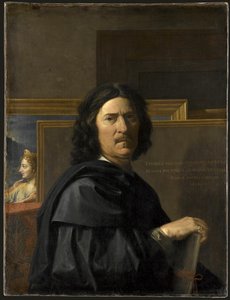
      Nicolas Poussin

      Nicolas Poussin

      1594 - 1665, France

      Quick facts about Nicolas Poussin

      • Artistic Movement Or Style: Baroque, Classicism
      • Artists Or Movements Influenced By This Artist:
        • Jacques-Louis David
        • Paul Cézanne
      • Artists Who Influenced This Artist:
        • Raphael
        • Titian
      • Date Of Birth: 1594
      • Date Of Death: 1665
      • Full Name: Nicolas Poussin
      • Nationality: French
      • Notable Artworks:
        • The Death of Germanicus
        • Seven Sacraments Series
        • A Roman Road
        • Orion Blinded
        • The Seasons
      • Place Of Birth: Le Havre, France

      Artist Biography

      A Life Steeped in Classical Reverie

      Nicolas Poussin, a name synonymous with the grandeur of French Baroque painting, was nonetheless a soul deeply rooted in Italian soil for much of his artistic life. Born in Le Havre, Normandy, in June 1594, his early years remain somewhat veiled in mystery, yet they undoubtedly laid the foundation for a career that would become pivotal in shaping the classical tradition within French art. Though he briefly studied in Paris during the early 1610s, absorbing influences from lesser-known artists of the time, it was his journey to Rome in 1624 that truly ignited his artistic destiny. This wasn’t merely a geographical relocation; it was an immersion into the heart of antiquity, a pilgrimage to the very source of inspiration that would define his aesthetic vision. Poussin's initial forays into painting were marked by a sensuous quality reminiscent of Venetian masters like Titian, yet even in these early works, a nascent sense of order and intellectual rigor began to emerge—a foreshadowing of the style he would so masterfully refine.

      The Roman Years: Forging a Classical Ideal

      Rome proved to be more than just a studio for Poussin; it became his intellectual crucible. He found himself amidst a vibrant circle of scholars, archaeologists, and fellow artists, notably Cassiano dal Pozzo, whose profound understanding of classical antiquity profoundly influenced the artist’s approach. Dal Pozzo's dedication to meticulously documenting ancient remains instilled in Poussin a deep respect for historical accuracy and a desire to imbue his paintings with a sense of timelessness. This period saw Poussin move away from the flamboyant exuberance of some of his contemporaries, instead embracing a style characterized by clarity, balance, and a deliberate emphasis on linear composition. He meticulously studied Raphael’s works, absorbing their harmonious arrangements and graceful forms, while simultaneously drawing inspiration from ancient sculptures and literary sources like Ovid's *Metamorphoses*. His paintings began to populate with figures drawn from classical history and mythology, rendered not as mere decorative elements but as embodiments of moral virtues and philosophical ideals.

      Themes of History, Myth, and the Sacred

      Poussin’s artistic output was remarkably diverse, yet consistently unified by his commitment to these core principles. He frequently depicted scenes from ancient history—the tragic fate of Germanicus, for example—imbued with a sense of stoic dignity and moral weight. His mythological paintings weren't simply retellings of familiar tales; they were explorations of human nature, often laden with allegorical meaning. The *Arcadia* series, particularly the iconic *Et in Arcadia ego*, became emblematic of his philosophical depth, prompting contemplation on mortality and the enduring power of memory. Beyond history and myth, Poussin also turned to religious subjects, most notably in *The Seven Sacraments*—a monumental undertaking that showcased both his theological understanding and compositional prowess. Even within these sacred scenes, however, he maintained a classical restraint, avoiding excessive emotionalism in favor of a serene and dignified presentation. Later in his career, expansive landscapes became increasingly prominent, blending realism with idealized forms to create vistas that evoked a sense of harmony and tranquility.

      A Lasting Legacy: Shaping French Art

      Despite spending the majority of his career abroad, Nicolas Poussin’s influence on French art was immense. He briefly returned to Paris in 1640 at the behest of Cardinal Richelieu, appointed as First Painter to the King, but found himself stifled by the demands and intrigues of court life. He soon returned to Rome, where he continued to paint until his death in 1665. His dedication to classical principles helped establish a standard for artistic training and practice within France, influencing generations of artists who followed. He became a leading figure in the Académie Royale de Peinture et de Sculpture, solidifying his position as a cornerstone of French Classicism. Artists like Jacques-Louis David and Paul Cézanne openly acknowledged their debt to Poussin’s rigorous approach and intellectual depth. His legacy extends far beyond mere stylistic imitation; it represents a commitment to order, clarity, and the enduring power of classical ideals—a testament to an artist who sought not simply to depict the world but to elevate it through the lens of reason and beauty.

      • Notable Works: *The Death of Germanicus*, *The Seven Sacraments Series*, *A Roman Road*, *Orion Blinded Searching for the Sun*, *The Seasons*.
      • Key Characteristics: Classical Composition, Linearity, Historical and Mythological Themes, Serene Landscapes.

      § 5Comparanda

      § 6Questions

      Quick Facts

      • notable elements: Virgin Mary, infant Jesus, angels, musical score, architectural setting
      • title: St. Cecilia
      • artist: Nicolas Poussin
      • subject: Religious piety, Saint Cecilia playing a keyboard instrument
      • medium: Oil on canvas

      Art Quiz

      There is only one correct answer for each question.

      Question 1:
      In Nicolas Poussin's 'St. Cecilia,' what is Saint Cecilia depicted doing?
      Question 2:
      To which art historical period does Nicolas Poussin's 'St. Cecilia' belong?
      Question 3:
      What is a prominent characteristic of the lighting in 'St. Cecilia' that exemplifies Baroque style?
      Question 4:
      Where is Nicolas Poussin’s ‘St. Cecilia’ currently housed?
      Question 5:
      What compositional element contributes to the sense of depth in 'St. Cecilia', despite a somewhat flattened perspective?

      § 7Cite this entry

      AllPaintingsStore.com, “Nicolas Poussin, St. Cecilia (1628)”, https://allpaintingsstore.com/en/art/nicolas-poussin-st-cecilia-D2T4X7-en/ArtistReproduction/ (accessed 2 October 2026).

      § 8The reproduction

      Hand Made Oil Reproduction

      Hand-painted oil on canvas in your size and frame, made to order by our artists. ( Switch to Print Switch to Digital Image)

      It is specified on the order sheet in the margin; the present state of that sheet reads as follows.

      St. Cecilia

      Reproduction Medium

      Reproduction Size

      -

      Elite Senior Artist

      More detail, finesse, and extra production time

      -

      Reproduction Frame

      -

      -

      For artworks or reproductions larger than 105 cm (approximately 41 inches) on any side, the frame will be shipped as a kit, disassembled. This method ensures safe delivery and prevents damage during transport.

      Professional assembly required - this is not a DIY product.
      The kit must be assembled and the canvas stretched by an experienced professional framer, using wood glue (not supplied), a canvas stretching plier and clamps to hold the bars square while the glue dries. Incorrect assembly or uneven canvas tension can permanently damage the artwork and is not covered by our warranty.

      • All solid wood bars are included, precisely cut to size.

      • Assembled with the screws provided, plus wood glue for the corner joints, which is not supplied and must be sourced by your framer.

      • Professional tools are required and not included: a canvas stretching plier (tensioner) and clamps to hold the bars square while the glue dries.

      Important:
      The corner joints require wood glue, the bars must be held with clamps until the glue is fully dry, and tightening the canvas on the assembled frame requires a canvas stretching plier. None of these are included in the kit. Please arrange an experienced professional framer before ordering this size.

      Nameplate

      -

      -

      Protective Varnish

      Glossy Varnish (enhances colors, protects against light/moisture)

      -

      Customize My Artwork

      Examples of what can be changed: Replace face with customer photo; Add pet (e.g., replace cat with dog); Include hidden message in background; Change background landscape or elements.

      -

      Urgent

      Worldwide Delivery () in 3/4 weeks instead of standard 5 weeks. (31 October). No compromise on quality.

      -

      Express Shipping

      Worldwide Delivery () in 5 weeks. (7 November).

      Included

      Total Price

      $ 333

      Included with every order

      • Free Worldwide Express Shipping
      • High-Quality Linen Canvas
      • Full Shipping Insurance
      • Customs Tax Refund Guarantee
      • True Color Matching Guarantee
      • 100-Day Return Policy (Defects Only)
      • 100% Money-Back Guarantee
      • Bulk Discount Offer
      Order sheet