


 Preview
 Send
Send Share
Share
 Details
 Guide
Guide

 Download
 Similars
 X-Ray
X-Ray Diaporama
 Q&A
Q&A Stats
StatsVirgin and Child

- 58.0 x 49.0 cm


 Read More
Giclée / Art Print
Museum-quality giclée or canvas print with fast production and flexible finish options. ( Buy Hand Made Painting Switch to Digital Image)




P118B $10

P118H $10

P118W $10

P438Z $10

P508JH $12

P508YH $12

P805H $10

P805Z $10

P919BZ $10

P919G $10

P919XJ $10

P959ZH $10

P968JZ $12

W106C $8

W218G $10

W218JH $8

W218Y $10

W307PJ $10

W316G $10

W316PJ $8

W316Y $10

W398PJ $8

W4111J $10

W500HY $15

W500JH $15

W692G $12

W849H $8

W940BG $15

W953PJ $8




Pick from our preset sizes that match the artwork's original proportions.

Type the width and the height you need, to fit your frame or your wall. A print can only be cut, never made bigger than the picture, so a size with a different shape loses a part of the image. We send you a digital mockup to approve before we print anything. The picture shown on this page does not show the real cut — only the mockup does.
Worldwide Delivery () in 2 weeks instead of standard 4/5 weeks. (10 November)

Free Worldwide Express Shipping

High-Quality Linen Canvas

Full Shipping Insurance

Customs Tax Refund Guarantee

True Color Matching Guarantee

100-Day Return Policy (Defects Only)

100% Money-Back Guarantee

Bulk Discount Offer
 Glass option is only available in size under 110 CM

Virgin and Child
Giclée / Art Print
Reproduction Size
-


Total Price
$ 65
Artistic Context
Painted in 1627, 'Virgin and Child' is a testament to Poussin's early career, showcasing his ability to blend classical elements with contemporary techniques. The painting measures 58 x 49 cm and is executed in oil on canvas, a medium that allowed for rich coloration and depth.Composition and Symbolism
The central figures of the Virgin Mary and the infant Jesus are depicted with serene expressions, embodying the tranquility and grace associated with religious iconography. The Virgin's veil and the child's gentle gaze evoke a sense of reverence and innocence. The background landscape, complete with trees, adds a naturalistic element to the composition, symbolizing the harmony between divine and earthly realms.Light in Painting
The use of light in 'Virgin and Child' is noteworthy, as it highlights the subjects while creating a sense of depth. This technique, reminiscent of chiaroscuro, was a hallmark of Baroque art, emphasizing contrasts between light and dark to create dramatic effects.Artistic Influences
Poussin's work was influenced by his contemporaries, including Gian Lorenzo Bernini, who was known for his sculptures that combined beauty with emotional intensity. Similarly, Poussin aimed to evoke emotions through his paintings, as seen in the tender interaction between the Virgin and Child.Relevance Today
The enduring appeal of 'Virgin and Child' lies in its timeless themes of motherhood and devotion. The painting continues to inspire artists and art enthusiasts alike, offering a glimpse into the artistic sensibilities of the 17th century.Conclusion
Nicolas Poussin's 'Virgin and Child' is a masterpiece that encapsulates the essence of Classicism with its harmonious composition, symbolic elements, and masterful use of light. This painting serves as a testament to Poussin's skill in capturing the beauty and significance of religious subjects.- View 'Virgin and Child' by Nicolas Poussin on AllPaintingsStore
- Learn more about the role of light in painting on Wikipedia
- Explore other works by Nicolas Poussin, such as 'Pieta', on AllPaintingsStore
Questions & Answers
What is "Virgin and Child" made with?
"Virgin and Child" is executed in oil.
What kind of piece is "Virgin and Child"?
In the catalog, "Virgin and Child" by Nicolas Poussin is filed as wall art. The category helps find similar works.
Where and for what purpose is "Virgin and Child" recommended?
"Virgin and Child" by Nicolas Poussin is recommended for statement, ideally in a living room. Use and space together guide where a reproduction fits.
Related Artworks


Artist Biography
Early Life, Family and Training
To understand the rigid discipline of Nicolas Poussin, one must look to his origins in Les Andelys, Normandy. Born in June 1594, his early development was not a product of sudden inspiration but of structured, methodical training. He began his technical education in Rouen, a start that provided the foundational mechanics necessary for his later, more complex compositions. This early period established a pattern of rigorous preparation that would define his entire career.
By 1612, Nicolas Poussin had moved to Paris, where he remained until 1623. This decade in the French capital was a period of significant growth, moving him beyond the initial instruction of his youth. His education was not limited to the visual; he received instruction in Latin, a fact that provided the linguistic tools required to engage directly with the classical texts he would later translate into imagery. This literacy in ancient language and structure ensured his work was built on a foundation of logic rather than mere visual sensation.
The Roman Years and Artistic Development
Poussin arrived in Rome in 1624, having traveled via Venice. At this stage, he was an unformed painter, lacking the definitive direction that would later define his career. He did not stay in France to find his voice; instead, he spent most of his working life in Rome, a city that provided the necessary intellectual and physical landscape for his evolution. This was not a period of mere residence, but a fundamental shift in his artistic trajectory. He moved away from the sensuous, Venetian-influenced style of his youth toward a more disciplined, structured approach. This transition was driven by a deep engagement with the classical ruins and the scholarly circles of the Eternal City.
His development in Rome was marked by a rejection of the flamboyant, theatrical Baroque tastes prevalent in his time. Instead of prioritizing immediate sensory impact or dramatic gesture, he sought a sense of order and logic. He studied antique remains and the works of Raphael to build a visual language rooted in clarity and balance. This period saw him move from the experimental, almost unformed works of his arrival to a highly controlled method of composition. He eventually established a style that favored line over color, focusing on the intellectual weight of his subjects rather than superficial spectacle. He remained in Rome until his death in 1665, having transformed from an unformed immigrant into a central figure of the classical tradition.
Patrons, Workshop and Commissions
Poussin’s career was defined by a selective, intellectual circle of patrons rather than the broad, theatrical demands of the Counter-Reformation. In Rome, his primary connection was Cassiano dal Pozzo, a scholar and archaeologist whose influence anchored Poussin within a specific, high-minded social stratum. This relationship secured Poussin his only papal commission in 1628. Such work required a departure from the flamboyant, emotive style popular in the city at the time, favoring instead the structured clarity that his patrons demanded. His ability to satisfy these discerning collectors established his reputation as a painter of substance.
His professional standing eventually reached the highest levels of the French state. During his brief return to Paris, he was appointed First Painter to the King under Louis XIII and Cardinal Richelieu. This position carried significant weight, yet the administrative and courtly pressures proved incompatible with his working methods. He held the title of First Painter of the King, but the demands of the court led him to abandon the position and return to Rome. His preference for the company of scholars over the intrigues of the palace highlights the disciplined, almost reclusive nature of his professional life.
- The Martyrdom of Saint Erasmus (1628)
Technique and Style
Poussin’s approach to composition was a disciplined exercise in geometry and logic. He rejected the chaotic, emotional spontaneity of the Baroque in favor of clarity and order. To achieve this, he functioned more like an architect than a mere painter. He utilized a specialized box lit through openings in its walls to plan his canvases, allowing him to study light and shadow before a single brushstroke was applied to the final surface. This methodical preparation ensured that every figure and landscape element occupied a precise, rational space.
His process involved a physical, almost theatrical staging of his subjects. He used small stages with wax figures and arranged draperies to work out complex arrangements. This tactile method allowed him to master the interplay of light and form. He employed chiaroscuro to sculpt his figures, using light and shadow to provide depth and emotional weight without relying on the superficial drama of his contemporaries. His preference for line over color defined his aesthetic; he prioritized the structural integrity of a scene, ensuring that the underlying logic of the composition remained the primary focus for the viewer.
Key Works and Themes
Poussin’s output was defined by a rigorous commitment to structure, often using historical and mythological narratives to explore human morality. He frequently depicted scenes from ancient history, treating the canvas as a stage for stoic dignity. This intellectual approach is evident in his religious works, such as the Martyrdom of Saint Erasmus, which he painted for the Church of Saint Peter. Even in his earlier, more sensuous period, works like The Nurture of Bacchus show a transition from Venetian-inspired color toward the disciplined linearity that would define his mature style.
His thematic range extended into deep philosophical territory, most notably in Et in Arcadia Ego. This work uses a landscape setting to prompt contemplation on mortality. In the late 1630s, he turned his attention to the sacred through the Seven Sacraments series. These paintings demonstrate his ability to maintain classical restraint even when handling heavy theological subjects. He did not rely on emotional excess; instead, he used clear, logical arrangements to convey spiritual meaning.
- The Martyrdom of Saint Erasmus
- The Nurture of Bacchus
- Et in Arcadia Ego
- The Seven Sacraments
Legacy and Influence
Poussin’s impact on French art was structural rather than merely stylistic. By establishing a standard for order and clarity, he became a cornerstone of French Classicism. His presence in the Académie Royale de Peinture et de Sculpture solidified a rigorous approach to composition that defined the era. He did not merely paint; he provided a framework for how history and myth should be organized on a canvas. This discipline ensured his influence persisted long after his death in Rome.
The reach of his method extended into the next century, shaping the direction of major movements. Artists such as Jacques-Louis David and Paul Cézanne acknowledged their debt to his intellectual depth and his preference for line over color. While David applied these principles to Neoclassicism, Cézanne found a different resonance in Poussin's structured landscapes. His ability to impose logic onto a scene remains a primary reference point for anyone studying the evolution of Western composition.
- Et in Arcadia Ego
- The Seven Sacraments
- The Death of Germanicus
- Orion Blinded Searching for the Sun
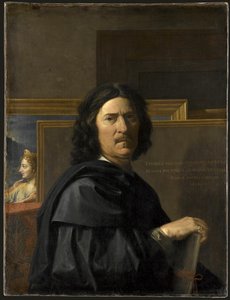
Nicolas Poussin
1594 - 1665 , France
Quick Facts
- Artistic Movement Or Style: French Baroque, French Classicism
- Artists Or Movements Influenced By This Artist:
- Jacques-Louis David
- Paul Cézanne
- Artists Who Influenced This Artist:
- Titian
- Raphael
- Full Name: Nicolas Poussin
- Nationality: French
- Notable Artworks:
- The Death of Germanicus
- The Seven Sacraments
- A Roman Road
- Orion Blinded Searching for the Sun
- The Seasons
- Place Of Birth: Le Havre, France
- Date Of Birth: 1594
- Date Of Death: 1665
Related Articles

Baroque Classicism: Reconciling Drama & Order in 17th-Century Art
Explore the captivating world of Baroque Classicism! Discover its history, key artists like Caravaggio & Rubens, and defining characteristics. Expert insights & high-quality reproductions at AllPaintingsStore.

Unveiling the Masterpieces: The Top 25 Must-See Artworks in The Louvre, Paris
Discover the 25 most iconic masterpieces from the Louvre. Explore the stories behind these legends and find museum-quality art on AllPaintingsStore.com.

Neo-Classicism's Greatest Hits: 10 Masterpieces for Your Home |
Journey through Neo-Classicism's finest! Explore 10 iconic masterpieces by David, Ingres & Canova. Discover art history, techniques & timeless beauty – perfect for inspiring your home decor. Find museum-quality reproductions at

Nicolas Poussin: Classicism, Allegory & Order in 17th-Century French Painting
Explore the life & work of Nicolas Poussin, a master of French Classicism. Discover his allegorical paintings, Roman influences, and enduring impact on art history. Expert analysis & insights.

Baroque Drama: Bringing Opulence & Emotion into Contemporary Interiors
Explore the opulent world of Baroque interior design! Discover key elements, modern applications & how to bring dramatic elegance into your home with AllPaintingsStore.com's authentic reproductions.


