Money-Back Guarantee · 100 days Free Worldwide Delivery
449,587artworks 30,613artists 4,660museums 32languages
Catalogue entry

Nasturtiums

1912. Acrylic On Canvas. Yale University Art Gallery.
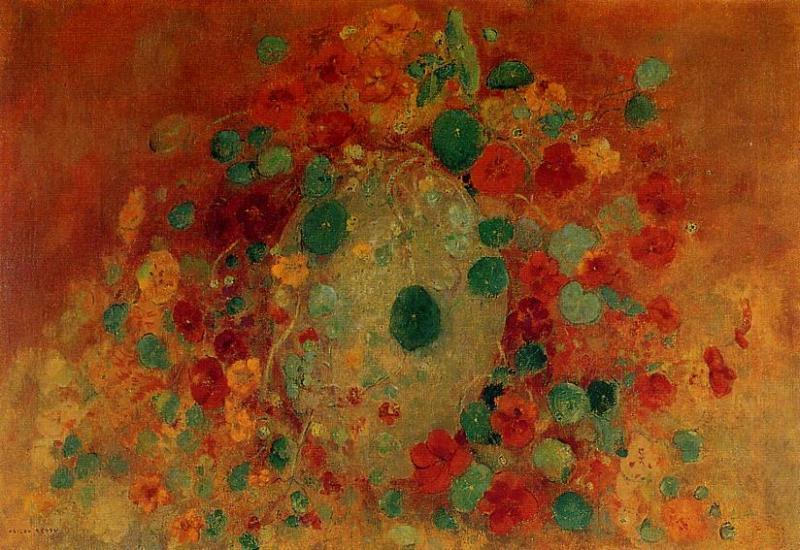
Fig. 1. Odilon Redon, Nasturtiums, 1912. Shown as the reproduction you are specifying: , .

§ 1Catalogue data

§ 2Abstract

Collectible Description

Nasturtiums by Odilon Redon (1912) is a captivating Symbolist painting featuring a woman’s face amidst flowers and a striking red hue background. Inspired by Henri Matisse and Sun Zong-Wei, explore its legacy at Yale University Art Gallery.

Artist Biography

Explore the enigmatic world of Odilon Redon (1840-1916), a French Symbolist known for his haunting ‘noirs,’ dreamlike visions, and influence on Surrealism.

§ 3Commentary

Nasturtiums by Odilon Redon: A Dreamscape of Floral Symbolism

The painting Nasturtiums by Odilon Redon is a captivating piece of art that showcases the artist’s unique style and technique. Created in 1912, this oil on canvas painting is a prime example of Symbolist art, characterized by its use of vibrant colors and dreamlike imagery. The painting features a woman's face surrounded by flowers, with a necklace made from the same flowers, creating a sense of harmony and balance. This evocative composition transcends mere representation; it delves into the subconscious mind, mirroring the artist’s fascination with exploring hidden emotions and spiritual truths—a hallmark of the Symbolist movement.
  • Artist & Context: Odilon Redon (1840-1916) emerged as a pivotal figure in French Symbolism, reacting against the materialism of Impressionism and embracing esoteric influences. His artistic vision sought to capture intangible realities—dreams, myths, and spiritual experiences—rather than objective depictions of the external world.
  • Style & Technique: Redon’s distinctive style is instantly recognizable by its muted palette dominated by earthy reds and browns, punctuated by delicate floral hues. He employed a meticulous technique utilizing thin glazes of oil paint layered upon canvas to achieve remarkable luminosity and textural depth. This painstaking process allowed him to convey an atmosphere of melancholy and contemplation.
  • Symbolism & Imagery: The central motif—a woman’s face intertwined with flowers—holds profound symbolic significance. Flowers, particularly nasturtiums, represent beauty, fragility, and rebirth – themes frequently explored by Redon. The necklace mirroring the floral arrangement symbolizes unity and interconnectedness, suggesting a harmonious relationship between humanity and nature.
  • Location & Legacy: Currently housed at Yale University Art Gallery in Hartford, United States, Nasturtiums exemplifies Redon’s enduring influence on modern art. Its ethereal beauty continues to inspire artists and collectors alike, cementing its place as a cornerstone of Symbolist aesthetics.

Similar Works & Artists: Exploring the Realm of Dreams

Redon's artistic explorations resonated with fellow Symbolists like Henri Matisse, whose painting Nasturtiums with 'La Danse' similarly utilizes bold colors and floral motifs to convey emotion and movement. Matisse’s approach shares Redon’s commitment to capturing subjective experience—a desire to express inner feelings rather than external appearances. Furthermore, Sun Zong-Wei’s paintings demonstrate a comparable preoccupation with fantastical landscapes and symbolic imagery, reflecting the broader spirit of Symbolist art's quest for spiritual illumination.

Discover More About Odilon Redon & His Inspirations

To delve deeper into Redon’s artistic journey and his profound engagement with mythology and folklore, visit https://AllPaintingsStore.com. Explore articles detailing his fascination with Japanese prints—a significant influence on his visual vocabulary—and discover reproductions of his celebrated masterpieces like Nasturtiums and Pandora. You can find detailed information about Yale University Art Gallery and its impressive collection of modern and contemporary art at https://YaleArtGallery.org/.

Experience the Beauty of Symbolist Art

Nasturtiums by Odilon Redon stands as a testament to the power of imagination and artistic vision—a timeless masterpiece that invites viewers into a realm beyond the visible, fostering contemplation and appreciation for the sublime.

Questions & Answers

Which artist is "Nasturtiums" attributed to?

"Nasturtiums" is attributed to Odilon Redon.

How do medium and movement combine in "Nasturtiums"?

In "Nasturtiums", the acrylic on canvas technique meets the Symbolist Art movement.

Is "Nasturtiums" by Odilon Redon a well-known artwork?

"Nasturtiums" by Odilon Redon has a recognized popularity level. This classification reflects how widely the work is recognized.

§ 4The artist

Odilon Redon

Odilon Redon

1840 - 1916, France

Quick facts about Odilon Redon

  • Artistic Movement Or Style: Symbolism
  • Artists Or Movements Influenced By This Artist:
    • Surrealism
    • Marcel Duchamp
    • Max Ernst
  • Artists Who Influenced This Artist:
    • Jean-Léon Gérôme
    • Rodolphe Bresdin
  • Date Of Birth: 1840
  • Date Of Death: 1916
  • Full Name: Odilon Redon
  • Nationality: French
  • Notable Artworks:
    • Centaurs
    • Onnes
    • Portrait of Ari Redon
  • Place Of Birth: Bordeaux, France

Artist Biography

A World Beyond the Visible: The Enigmatic Art of Odilon Redon

Odilon Redon, born Bertrand-Jean Redon in 1840 in Bordeaux, France, was an artist perpetually drawn to translate the unseen realms of imagination and dream into tangible form. His artistic journey began not with grand ambition but with quiet observation; at just ten years old he won a drawing prize—a foreshadowing of the visual sensitivity that would define his life’s work. Though initially steered towards architecture by familial expectations, Redon's true calling lay elsewhere, illuminated by instruction from Jean-Léon Gérôme and, crucially, Rodolphe Bresdin, who guided him in the intricate arts of etching and lithography. These techniques became foundational to his early explorations, allowing him to delve into a world of shadowy figures and ambiguous forms that would soon captivate those seeking an alternative to academic realism. The interruption of the Franco-Prussian War saw Redon briefly serving in the military, but it was upon his return to Paris that his artistic vision truly began to coalesce.

The Birth of Symbolism: ‘Noirs’ and Early Visions

Redon's early career was marked by a deliberate withdrawal from prevailing artistic trends. He didn’t seek to replicate the visible world, but rather to evoke its hidden currents—the anxieties, desires, and spiritual longings that lay beneath the surface of everyday life. This led to his famed series of “noirs,” monochromatic works executed in charcoal and lithography. These weren't merely studies in darkness; they were explorations of the subconscious, populated by strange creatures, disembodied eyes, and haunting figures emerging from swirling mists. The influence of writers like Edgar Allan Poe and Charles Baudelaire is palpable here—a shared fascination with the macabre, the mysterious, and the power of suggestion. These works weren't immediately embraced; Redon remained largely unknown for years. However, a pivotal moment arrived in 1884 with Joris-Karl Huysmans’ novel *À rebours* (Against Nature), where the decadent aristocrat Des Esseintes championed Redon’s drawings, instantly elevating his status within avant-garde circles. This recognition opened doors and allowed Redon to further develop his unique artistic language. He described his work as ambiguous and undefinable, stating they should “place us, as does music, in the ambiguous realm of the undetermined.”

A Palette Awakens: From Monochrome to Vibrant Expression

While the “noirs” established Redon as a significant force in Symbolism, his art underwent a remarkable transformation in the 1890s. He began to embrace color—first pastels, then oils—infusing his compositions with a newfound vibrancy and luminosity. This shift wasn’t merely technical; it reflected an evolving emotional landscape within the artist himself. The earlier works often carried a sense of melancholy and isolation, but the later paintings reveal a growing interest in mythology, Buddhism, and Japanese art – *Japonism* was a significant influence. Works like *The Death of the Buddha* (1899) demonstrate this fascination with Eastern spirituality, while pieces commissioned by Baron Robert de Domecy for his château showcase Redon’s ability to blend decorative elements with symbolic imagery. The portraits of Baroness de Domecy and her daughter Jeanne are particularly striking examples of this period, capturing not just physical likeness but also a sense of inner life and psychological depth. Redon explored his internal feelings and psyche through his art, aiming to “place the visible at the service of the invisible.”

Legacy and Influence: A Precursor to Surrealism

Odilon Redon’s impact on the art world extends far beyond his own lifetime. He was awarded the Legion of Honor in 1903, and his work gained wider recognition with exhibitions at the New York Armory Show in 1913. However, it wasn't until after his death in 1916 that his true significance became fully apparent. Redon’s exploration of dreams, the subconscious, and irrationality paved the way for Surrealism, inspiring artists like Marcel Duchamp and Max Ernst to delve into similar territories. His emphasis on subjective experience and emotional expression also resonated with Expressionist painters. He wasn't simply depicting what he saw; he was visualizing what he felt, a principle that continues to inspire artists today. Redon’s legacy is one of artistic courage, a willingness to embrace the ambiguous, and a profound belief in the power of art to reveal the hidden dimensions of human experience. His drawings defied classification, ushering in a unique type of fantastic imagery born of sickness and delirium, yet always imbued with a haunting beauty.

Key Characteristics & Themes

  • Symbolism: Redon is considered a central figure in the Symbolist movement, prioritizing emotional and spiritual expression over realistic representation.
  • Dreamlike Imagery: His works are often characterized by fantastical creatures, ambiguous landscapes, and scenes that evoke the atmosphere of dreams.
  • Exploration of the Subconscious: Redon delved into themes of anxiety, desire, and the hidden depths of the human psyche.
  • Influence of Literature & Mythology: He drew inspiration from writers like Poe and Baudelaire, as well as Eastern religions and mythology.
  • Technical Innovation: Redon’s mastery of lithography and his innovative use of color in pastels and oils were crucial to his artistic vision.

§ 5Comparanda

§ 6Questions

Quick Facts

  • Movement: Symbolist
  • Subject or theme: Floral motifs
  • Title: Nasturtiums
  • Notable elements or techniques: Bold colors, delicate brushstrokes
  • Artist: Odilon Redon

§ 7Cite this entry

AllPaintingsStore.com, “Odilon Redon, Nasturtiums (1912)”, https://allpaintingsstore.com/en/art/odilon-redon-nasturtiums-8EWMMH-en/ (accessed 3 October 2026).

§ 8The reproduction

Hand Made Oil Reproduction

Hand-painted oil on canvas in your size and frame, made to order by our artists. ( Switch to Print Switch to Digital Image)

It is specified on the order sheet in the margin; the present state of that sheet reads as follows.

Nasturtiums

Reproduction Medium

Reproduction Size

-

Elite Senior Artist

More detail, finesse, and extra production time

-

Reproduction Frame

-

-

For artworks or reproductions larger than 105 cm (approximately 41 inches) on any side, the frame will be shipped as a kit, disassembled. This method ensures safe delivery and prevents damage during transport.

Professional assembly required - this is not a DIY product.
The kit must be assembled and the canvas stretched by an experienced professional framer, using wood glue (not supplied), a canvas stretching plier and clamps to hold the bars square while the glue dries. Incorrect assembly or uneven canvas tension can permanently damage the artwork and is not covered by our warranty.

  • All solid wood bars are included, precisely cut to size.

  • Assembled with the screws provided, plus wood glue for the corner joints, which is not supplied and must be sourced by your framer.

  • Professional tools are required and not included: a canvas stretching plier (tensioner) and clamps to hold the bars square while the glue dries.

Important:
The corner joints require wood glue, the bars must be held with clamps until the glue is fully dry, and tightening the canvas on the assembled frame requires a canvas stretching plier. None of these are included in the kit. Please arrange an experienced professional framer before ordering this size.

Nameplate

-

-

Protective Varnish

Glossy Varnish (enhances colors, protects against light/moisture)

-

Customize My Artwork

Examples of what can be changed: Replace face with customer photo; Add pet (e.g., replace cat with dog); Include hidden message in background; Change background landscape or elements.

-

Urgent

Worldwide Delivery () in 3/4 weeks instead of standard 5 weeks. (31 October). No compromise on quality.

-

Express Shipping

Worldwide Delivery () in 5 weeks. (7 November).

Included

Total Price

$ 258

Included with every order

  • Free Worldwide Express Shipping
  • High-Quality Linen Canvas
  • Full Shipping Insurance
  • Customs Tax Refund Guarantee
  • True Color Matching Guarantee
  • 100-Day Return Policy (Defects Only)
  • 100% Money-Back Guarantee
  • Bulk Discount Offer
Order sheet