- Home

- Oil Painting Reproduction
- ono yōko
- Hichiko Happo

 Buy print
 Send
Send Share
Share
 Details

 Download
 Similars
 X-Ray
X-Ray Diaporama
Hichiko Happo
 Acrylic On Canvas
- WallArt
- Contemporary Performance Art
 2014
2014 200.0 x 100.0 cm
 Guggenheim Museum Bilbao
 Read More
Hand Made Oil Reproduction
Hand-painted oil on canvas in your size and frame, made to order by our artists.




P118B $10

P118H $10

P118W $10

P438Z $10

P508JH $12

P508YH $12

P805H $10

P805Z $10

P919BZ $10

P919G $10

P919XJ $10

P959ZH $10

P968JZ $12

W106C $8

W218G $10

W218JH $8

W218Y $10

W307PJ $10

W316G $10

W316PJ $8

W316Y $10

W398PJ $8

W4111J $10

W500HY $15

W500JH $15

W692G $12

W849H $8

W940BG $15

W953PJ $8




Pick from our preset sizes that match the artwork's original proportions.

You may enter your own dimensions to fit a specific frame or space. If your selected size does not match the original image's proportions, we will either crop the artwork or extend the painting with additional hand-painted elements. A digital mockup will be sent for your approval before production begins.
Please note that the on-screen preview does not reflect the actual cropping or extension. Only the mockup will accurately show the final composition.
While custom sizes are available, we recommend selecting a dimension from the predefined list to preserve the original proportions.
After order, AllPaintingsStore.com team will email client for instructions and provide a mockup preview
Worldwide Delivery () in 3/4 weeks instead of standard 5 weeks. (16 July). No compromise on quality.

Free Worldwide Express Shipping

High-Quality Linen Canvas

Full Shipping Insurance

Customs Tax Refund Guarantee

True Color Matching Guarantee

60-Day Return Policy (Defects Only)

100% Money-Back Guarantee

Bulk Discount Offer
 Glass option is only available in size under 110 CM

Hichiko Happo
Reproduction Medium
Reproduction Size
-


Total Price
-
Artwork Description
The Genesis of a Gesture
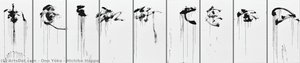
Yoko Ono’s Hichiko Happo isn't merely a painting; it’s an invocation, a captured moment of pure action translated onto canvas. Created in 2014 as part of her ambitious “Action Painting” series, this work emerged from a retrospective at the Guggenheim Museum Bilbao – a space already steeped in the legacy of groundbreaking performance and conceptual art. The piece represents a deliberate reversal of fortune, a joyful counterpoint to the samurai’s stoic endurance of suffering. Ono sought not hardship, but happiness, weaving a narrative of optimism into the very fabric of her artistic process.
The genesis lies in an ancient Japanese tale – the story of Yamanaka Shikanosuke, a warrior who vowed to endure “seven misfortunes and eight sufferings” to protect his city. Ono, deeply moved by this act of selfless sacrifice, flipped the script, embracing positivity and applying it to her own life experience. This shift is powerfully embodied in the work’s title itself: Hichiko Happo – a phrase suggesting “seven happinesses and eight treasures.” The deliberate choice of Japanese calligraphy underscores this intentionality, connecting the piece to centuries-old traditions of artistic expression and spiritual contemplation.
A Symphony of Black Ink
At first glance, Hichiko Happo presents a deceptively simple composition: nine horizontal brushstrokes arranged in a linear row across a stark white background. However, this minimalism belies an intricate process and profound depth. Each stroke is not merely a line; it’s a carefully considered gesture, meticulously rendered with sumi ink – a traditional Japanese pigment known for its rich, velvety texture and ability to shift subtly with the application of water. The varying thicknesses and fluidity of each line create a dynamic interplay of form and movement, suggesting a continuous flow, almost like a visual score.
- The Gesture of Writing: Each stroke directly represents the act of writing or drawing – a fundamental human impulse to communicate and record experience.
- Sequential Progression: The arrangement of the strokes creates a clear sequence, inviting the viewer to trace the artist’s hand across the canvas, experiencing the process of creation itself.
- Subtle Texture: The slight variations in ink density and flow introduce subtle textural nuances, adding depth and dimensionality to what could have been a flat composition.
Decoding Symbolism and Emotion
Beyond its technical execution, Hichiko Happo resonates with layers of symbolic meaning. The monochromatic palette – solely shades of black against white – evokes a sense of austerity and introspection, mirroring the samurai’s initial burden of suffering. Yet, the deliberate use of positive words in the title transforms this darkness into an invitation to joy and abundance. The brushstrokes themselves can be interpreted as symbols of creativity, communication, and perhaps even the very act of artistic expression – a testament to Ono's belief in the power of imagination.
Furthermore, the work’s connection to Japanese calligraphy—a tradition deeply rooted in Zen Buddhism—adds another layer of significance. The emphasis on control, precision, and a connection to nature aligns with the core principles of this ancient art form. Hichiko Happo isn't simply a visual representation; it’s an embodiment of a philosophical concept – a celebration of resilience, optimism, and the transformative power of shifting one’s perspective.
A Legacy in Motion
Created during her “Action Painting” series, Hichiko Happo exemplifies Ono's ongoing exploration of performance art and conceptual ideas. Each iteration of this series developed unique visual qualities, reflecting the dynamic nature of her artistic process and the specific context of each presentation. Reproductions offer a tangible connection to this powerful work, allowing viewers to experience its beauty, complexity, and emotional resonance within their own spaces. It’s an invitation to contemplate not just the image itself, but also the profound story it tells – a story of transformation, resilience, and the enduring pursuit of happiness.
Related Artworks

Artist Biography
A Life Interwoven with Art and Activism
Yoko Ono, born in Tokyo in 1933, is a figure whose artistic journey transcends easy categorization. Her upbringing within an aristocratic Japanese family provided a foundation of privilege, yet her life was dramatically reshaped by the upheaval of World War II, experiences that instilled a profound sensitivity to human suffering and a commitment to peace—themes that would become central to her art. From a young age, Ono demonstrated a natural inclination towards creative expression, initially through piano studies, but soon expanding into broader artistic explorations. The family’s relocation to New York City in 1952 proved pivotal, immersing her in the burgeoning avant-garde scene and setting the stage for a career that would challenge conventional notions of art itself. Her early education at Sarah Lawrence College provided intellectual grounding, yet it was the vibrant downtown art world that truly ignited her artistic spirit.Embracing the Avant-Garde: Fluxus and Conceptual Beginnings
Ono quickly found herself drawn to the radical experimentation of the 1960s New York art scene, becoming a key member of the Fluxus movement. This international collective sought to dismantle traditional artistic boundaries, embracing chance, performance, and everyday life as legitimate sources of creative inspiration. Influenced by composers like John Cage—whose embrace of silence and indeterminacy profoundly impacted her approach—and artists such as La Monte Young, Ono began developing a unique artistic vocabulary centered on conceptualism. Her early works weren’t paintings or sculptures in the traditional sense; they were *events*, *happenings*, and instructional pieces designed to provoke thought and engage the audience directly. These performances often defied categorization, prioritizing ideas over aesthetics and blurring the line between artist and spectator. A prime example is her series of “Instruction Paintings,” which presented simple directives for viewers to complete, transforming them from passive observers into active participants in the artwork’s creation. This emphasis on participation foreshadowed a key element that would define much of her later work.Expanding Artistic Boundaries: From Performance to Peace
Ono's artistic output is remarkably diverse, spanning conceptual art, performance art, music, filmmaking, and tireless peace activism. Her “instructional pieces,” most notably compiled in *Grapefruit* (1964), are perhaps her most iconic contribution to conceptual art. These poetic prompts—ranging from the whimsical (“Imagine a raindrop”) to the profound (“Think of something you want to change”)—invite audiences to actively engage their imaginations and complete the artwork within their own minds. Installations like “Liverpool Skyladders” demonstrate her commitment to public art, creating monumental structures that interact with urban spaces and invite contemplation. The "Wish Tree" series, where visitors write wishes on tags and tie them to branches, embodies themes of hope, collective intention, and a yearning for peace—a recurring motif throughout her career. This desire for global harmony became increasingly prominent following her relationship with John Lennon, beginning in 1966. Their marriage in 1969 was met with intense media scrutiny, but it also provided a powerful platform for their shared activism. Together, they staged iconic protests against the Vietnam War, including the famous “Bed-Ins for Peace,” and formed the Plastic Ono Band, releasing critically acclaimed albums like *Wedding Album* and *Double Fantasy*, which earned them a Grammy Award in 1980.A Lasting Legacy of Innovation and Advocacy
Following the tragic death of John Lennon in 1980, Yoko Ono dedicated herself to preserving his legacy through initiatives like Strawberry Fields in Central Park and the Imagine Peace Tower in Iceland—a beacon of hope erected as a tribute to peace. She continues to create art and advocate for causes close to her heart: peace, environmental sustainability, and human rights. Her pioneering work has profoundly influenced generations of artists across various disciplines, challenging conventional norms and expanding the possibilities of artistic expression. Ono’s emphasis on conceptualism, audience participation, and social engagement remains remarkably relevant in contemporary art practice. She is recognized not only as a groundbreaking artist but also as a courageous activist who used her platform to promote positive change, leaving an indelible mark on both the art world and the global landscape. Her work reminds us that art can be more than just something to look at; it can be a catalyst for dialogue, healing, and transformation. Yoko Ono’s influence continues to resonate today, inspiring artists and activists alike to envision a more peaceful and equitable world.
ono yōko
1933 - , Japan
Quick Facts
- Artistic Movement Or Style: Conceptual art, Fluxus
- Artists Or Movements Influenced By This Artist:
- Performance art
- Avant-garde music
- Artists Who Influenced This Artist:
- John Cage
- La Monte Young
- Date Of Birth: 1933
- Full Name: Yoko Ono
- Nationality: Japanese
- Notable Artworks:
- Grapefruit
- Liverpool Skyladders
- Wish Tree
- Hichiko Happo
- Place Of Birth: Tokyo, Japan
Related Articles

Minimalist Masterpieces: 10 Artworks for Serene Home Decor | AllPaintingsStore
Find serenity with 10 minimalist masterpieces! Explore Agnes Martin, Rothko & more. Discover the stories behind iconic abstract art, neutral palettes & calming designs. Museum-quality reproductions at AllPaintingsStore.com – elevate your home decor today!

Ephemeral Lines: Exploring Emotional Resonance in Ink Sketching Traditions
Explore the profound art of ink sketching! Discover techniques to express emotion, master line work, and cultivate artistic sensitivity. Learn from historical masters & unlock your creative potential.

Alfred Freddy Krupa: A Modern Visionary of New Ink Art & Emotional Depth
Explore the captivating world of Alfred Freddy Krupa, a pioneering Croatian artist redefining New Ink Art. Discover his unique technique, powerful themes, and global impact. A must-read for art enthusiasts & collectors.
Ivory Black Masters: 10 Paintings That Define Dramatic Art |
Delve into the power of 'Ivory Black' with 10 iconic paintings by masters like Rembrandt & Caravaggio. Explore dramatic chiaroscuro, gothic moods & timeless art history. Find museum-quality reproductions and elevate your home decor at

Chromatic Absence: Exploring the Aesthetic Power of Black & White Art
Explore the captivating world of monochrome art! Discover its rich history, influential artists like Malevich & Klein, and profound emotional impact. Expert insights for collectors & design enthusiasts.