Money-Back Guarantee · 100 days Free Worldwide Delivery
449,564artworks 30,613artists 4,658museums 32languages
Catalogue entry

The absinth drinker

Acrylic On Canvas.

Fig. 1. Pablo Picasso, The absinth drinker. Shown as the reproduction you are specifying: , .

§ 1Catalogue data

§ 2Abstract

Collectible Description

Artist Biography

Co-founder of Cubism and creator of Guernica. Discover the revolutionary works of Pablo Picasso today.

§ 3Commentary

The Absinthe Drinker: A Portrait of Parisian Melancholy

Pablo Picasso’s “The Absinthe Drinker,” completed in 1901, stands as a pivotal work within the artist's burgeoning Cubist exploration and a haunting reflection of the anxieties simmering beneath the surface of Belle Époque Paris. More than just a depiction of a woman enjoying a drink—though the meticulous observation of her posture and gaze is undeniably striking—the painting embodies a profound psychological complexity that continues to fascinate art historians.

  • Subject Matter: The portrait portrays a solitary female figure seated at a table, illuminated by diffused light. Her downward gaze conveys introspection and perhaps sorrow, contrasting sharply with the upward tilt of her head as she observes the absinthe glass before her.
  • Style & Technique: Picasso’s masterful application of Cubist principles is immediately apparent. The woman's face and torso are fragmented into geometric planes—a technique pioneered by Picasso alongside Georges Braque—creating a simultaneous representation of multiple perspectives. This deliberate distortion challenges traditional notions of realism, prioritizing conceptual exploration over accurate visual depiction.
  • Color Palette: Dominated by muted earthy tones – ochre, brown, and grey – the palette contributes to the painting’s melancholic atmosphere. Picasso employs subtle color gradations to sculpt form and texture, emphasizing the materiality of the surfaces depicted. The use of complementary colors—primarily greens and reds—adds visual interest without overwhelming the overall mood.

Historical Context: “The Absinthe Drinker” emerged during a period marked by social unrest and intellectual ferment in Paris. Absinthe, a potent anise-flavored liqueur popular among artists and intellectuals of the time, symbolized decadence, disillusionment, and escape from societal pressures. Picasso’s choice to depict this drink—and its drinker—reflects the pervasive mood of uncertainty and introspection that characterized the era.

Symbolism: The absinthe glass itself serves as a potent symbol of contemplation and detachment. Its positioning beneath the woman's gaze suggests she is wrestling with internal thoughts, attempting to find solace in solitude amidst the bustling city life outside. Furthermore, Picasso’s stylistic choices—the fragmentation of form and the muted color palette—mirror the psychological state of his subject, conveying a sense of emotional vulnerability.

Emotional Impact: “The Absinthe Drinker” transcends mere visual representation; it evokes a palpable feeling of melancholy and quiet contemplation. Picasso’s ability to capture the subtleties of human emotion—the unspoken sadness lurking beneath the surface—solidifies his place as one of the most influential artists of the 20th century. It remains a compelling testament to the power of art to explore the complexities of the human psyche.

Questions & Answers

What is a reproduction of "The absinth drinker" by Pablo Picasso recommended for?

The recommended use of a print of "The absinth drinker" is accent.

How do I download the image of "The absinth drinker" by Pablo Picasso?

A download is available for "The absinth drinker": the artwork's Download page offers a high-resolution digital image download.

Who created "The absinth drinker"?

The artist behind "The absinth drinker" is Pablo Picasso. The work is catalogued under Pablo Picasso's name.
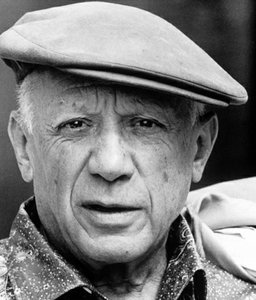
§ 4The artist

Pablo Picasso

Pablo Picasso

1881 - 1973, Spain

Quick facts about Pablo Picasso

  • Full Name: Pablo Diego José Ruiz Picasso
  • Nationality: Spanish
  • Date Of Birth: 1881
  • Date Of Death: 1973
  • Place Of Birth: Malaga, Spain
  • Notable Artworks:
    • Les Demoiselles d'Avignon
    • Guernica
    • The Old Guitarist
    • La Vie
    • Family of Saltimbanques
  • Artistic Movement Or Style: Cubism, Surrealism
  • Artists Who Influenced This Artist:
    • Velázquez
    • Goya
    • Matisse
  • Artists Or Movements Influenced By This Artist:
    • Cubism
    • Modern art

Artist Biography

The boy from Málaga

A child's first words in Málaga were “piz, piz,” a small attempt at saying pencil. This early pull toward the lead and paper was nurtured by his father, José Ruiz y Blasco, who taught him the basics of figure drawing and oil painting. The boy learned to copy the masters and draw from plaster casts under a disciplined eye. As he grew, the family moved through A Coruña and Barcelona. These years were marked by the quiet weight of loss, particularly the death of his sister, Conchita, from diphtheria when she was only seven. Such shadows would later find their way into the heavy, blue-green tones of his early work.

By thirteen, he was already taking entrance exams for advanced classes in Barcelona, finishing in a week what took others a month. His hands moved with a precision that even his father noticed, once seeing him paint over an unfinished sketch of a pigeon with such accuracy that the instructor realized the student had surpassed him. He eventually moved to Paris, a city where he would spend much of his adult life, constantly shifting his focus from one way of seeing to another.

Shifting palettes and fractured forms

The early twentieth century saw his work move through distinct phases of color and mood. There was the Blue Period, where the canvases were filled with beggars, the blind, and the lonely, rendered in somber shades of blue. This gave way to the Rose Period, a time when pinks, oranges, and reds appeared, often featuring the figures of circus performers like harlequins and acrobats. These years showed a man reacting to his own life and the world around him through the temperature of his palette.

In 1907, the way he handled space changed fundamentally with Les Demoiselles d'Avignon. Influenced by African masks and Iberian sculpture, he began to break objects into geometric shapes. Alongside Georges Braque, he developed Cubism. This involved two main stages:

  • Analytic Cubism: A method of fragmenting objects into muted, geometric pieces as if dissecting the form itself.
  • Synthetic Cubism: An approach that brought in collage elements like newspaper clippings and fabric scraps to add texture and new layers.

A life of constant change

His work never settled into a single way of being. He explored Neoclassicism with large, monumental figures and later engaged with the imagery of Surrealism, using distorted perspectives to tap into the subconscious. The violence of the Spanish Civil War left its mark on his canvas in 1937 through Guernica. This large oil painting used a stark palette of black, white, and grey to show the suffering of a bombed town, featuring a gored horse, a bull, and screaming women. It remains a heavy, monochromatic response to the chaos of war.

In his later years, he continued to experiment with ceramics, sculpture, and printmaking. He even created large-scale public works, such as the 1967 steel sculpture in Chicago, which was inspired by the head of his Afghan Hound, Kabul. He died in Mougins, France, leaving behind a massive collection of work that spans over seventy-six years of experimentation.

§ 5Comparanda

§ 6Questions

Quick Facts

  • Influences: Symbolism
  • Movement: Cubism
  • Title: The Absinthe Drinker
  • Subject or Theme: Portraiture; Parisian nightlife
  • Dimensions: 73 x 54 cm
  • Location: Hermitage Museum, Saint Petersburg

§ 7Cite this entry

AllPaintingsStore.com, “Pablo Picasso, The absinth drinker”, https://allpaintingsstore.com/en/art/pablo-picasso-the-absinth-drinker-8EWNN8-en/ArtistReproduction/ (accessed 11 October 2026).

§ 8The reproduction

Hand Made Oil Reproduction

Hand-painted oil on canvas in your size and frame, made to order by our artists. ( Switch to Print Switch to Digital Image)

It is specified on the order sheet in the margin; the present state of that sheet reads as follows.

The absinth drinker

Reproduction Medium

Reproduction Size

-

Elite Senior Artist

More detail, finesse, and extra production time

-

Reproduction Frame

-

-

For artworks or reproductions larger than 105 cm (approximately 41 inches) on any side, the frame will be shipped as a kit, disassembled. This method ensures safe delivery and prevents damage during transport.

Professional assembly required - this is not a DIY product.
The kit must be assembled and the canvas stretched by an experienced professional framer, using wood glue (not supplied), a canvas stretching plier and clamps to hold the bars square while the glue dries. Incorrect assembly or uneven canvas tension can permanently damage the artwork and is not covered by our warranty.

  • All solid wood bars are included, precisely cut to size.

  • Assembled with the screws provided, plus wood glue for the corner joints, which is not supplied and must be sourced by your framer.

  • Professional tools are required and not included: a canvas stretching plier (tensioner) and clamps to hold the bars square while the glue dries.

Important:
The corner joints require wood glue, the bars must be held with clamps until the glue is fully dry, and tightening the canvas on the assembled frame requires a canvas stretching plier. None of these are included in the kit. Please arrange an experienced professional framer before ordering this size.

Nameplate

-

-

Protective Varnish

Glossy Varnish (enhances colors, protects against light/moisture)

-

Customize My Artwork

Examples of what can be changed: Replace face with customer photo; Add pet (e.g., replace cat with dog); Include hidden message in background; Change background landscape or elements.

-

Urgent

Worldwide Delivery () in 3/4 weeks instead of standard 5 weeks. (8 November). No compromise on quality.

-

Express Shipping

Worldwide Delivery () in 5 weeks. (15 November).

Included

Total Price

$ 258

Included with every order

  • Free Worldwide Express Shipping
  • High-Quality Linen Canvas
  • Full Shipping Insurance
  • Customs Tax Refund Guarantee
  • True Color Matching Guarantee
  • 100-Day Return Policy (Defects Only)
  • 100% Money-Back Guarantee
  • Bulk Discount Offer
Order sheet