Money-Back Guarantee · 100 days Free Worldwide Delivery
449,587artworks 30,613artists 4,660museums 32languages
Currency
    Language
      Atelier · Est. 2015 · Paris, France
      AllPaintingsStore
      allpaintingsstore.com
      Catalogue entry

      Untitled (73)

      1939. Acrylic On Canvas, 100.0 x 81.0 cm.

      Fig. 1. Pablo Picasso, Untitled (73), 1939. Shown as the reproduction you are specifying: , .

      § 1Catalogue data

      § 2Abstract

      Collectible Description

      Artist Biography

      Co-founder of Cubism and creator of Guernica. Discover the revolutionary works of Pablo Picasso today.

      § 3Commentary

      A Silent Scream Captured in Monochrome: Exploring Picasso’s “Untitled (73)”

      Pablo Picasso's "Untitled (73)" stands as a haunting testament to the artist’s enduring fascination with psychological exploration and his masterful command of Surrealist aesthetics. Painted in 1939, amidst the turbulent backdrop of Europe on the brink of World War II, this monumental canvas – measuring 100 x 81 cm – transcends mere visual representation; it delves into the depths of human emotion and confronts viewers with a visceral depiction of vulnerability and despair. The painting’s stark palette—primarily grayscale punctuated by flashes of yellow—immediately establishes its dramatic mood. Picasso eschews vibrant color, opting instead for tonal variations that amplify the sense of unease and isolation. This deliberate restriction serves not to diminish the artwork's impact but rather to heighten its expressive power, mirroring the psychological intensity conveyed through the central figure’s posture and facial expression. The subject is positioned centrally on a chair, mouth agape in an unsettling gesture—a silent scream frozen in time—suggesting profound anguish and suppressed emotion.
      • Style: Surrealism – Picasso's embrace of Surrealist principles aligns with his broader artistic ambition to liberate art from the constraints of realism, prioritizing dreamlike imagery and subconscious associations.
      • Technique: Picasso employs a Cubist approach, fracturing forms into geometric planes that simultaneously depict multiple perspectives—a technique pioneered by Picasso himself and influential across subsequent generations of artists. This fragmentation contributes to the painting’s unsettling effect, disrupting conventional spatial perception and mirroring the fractured psyche of its subject.
      • Historical Context: Created during the Second Sino-Japanese War and the looming shadow of Nazi Germany, “Untitled (73)” reflects Picasso's engagement with the anxieties of his time. The artwork serves as a poignant commentary on human suffering and resilience in the face of adversity—themes that resonate powerfully even today.
      The symbolism embedded within the composition is equally compelling. The chair itself represents stability, yet it’s rendered upside down, symbolizing disorientation and loss of control. The yellow hue – sparingly used – evokes warmth and optimism but also hints at impending doom, mirroring the precariousness of human existence during wartime. Furthermore, the figure's open mouth embodies a primal expression of pain—a universal symbol of vulnerability and despair that transcends cultural boundaries. “Untitled (73)” is more than just a painting; it’s an invitation to contemplate the complexities of human emotion and the enduring power of art to confront us with uncomfortable truths.
      • Interior Design Inspiration: Consider incorporating elements of Picasso's monochrome palette into contemporary interior spaces—creating serene yet impactful focal points that evoke contemplation and emotional resonance.
      • Collector’s Perspective: This artwork exemplifies Picasso’s mastery of expressive abstraction, securing its place as a cornerstone of 20th-century art history and representing an exceptional investment for discerning collectors.

      Questions & Answers

      What does "Untitled (73)" by Pablo Picasso depict, and in what mood?

      "Untitled (73)" by Pablo Picasso depicts human figure, geometric abstraction, facial expression, chair composition, psychological depth, symbolic imagery, dramatic pose, in a dramatic mood. Subject and atmosphere together describe the work.

      What is the format of "Untitled (73)"?

      "Untitled (73)" by Pablo Picasso has a portrait format. The format describes the proportions of the composition.

      At what size is "Untitled (73)" recommended to be printed?

      A large reproduction is suggested for "Untitled (73)" by Pablo Picasso. Size can be adjusted while keeping the proportions.
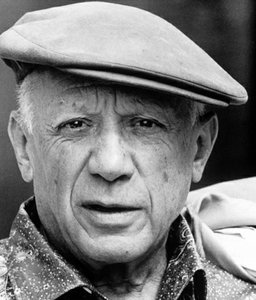
      § 4The artist

      Pablo Picasso

      Pablo Picasso

      1881 - 1973, Spain

      Quick facts about Pablo Picasso

      • Full Name: Pablo Diego José Ruiz Picasso
      • Nationality: Spanish
      • Date Of Birth: 1881
      • Date Of Death: 1973
      • Place Of Birth: Malaga, Spain
      • Notable Artworks:
        • Les Demoiselles d'Avignon
        • Guernica
        • The Old Guitarist
        • La Vie
        • Family of Saltimbanques
      • Artistic Movement Or Style: Cubism, Surrealism
      • Artists Who Influenced This Artist:
        • Velázquez
        • Goya
        • Matisse
      • Artists Or Movements Influenced By This Artist:
        • Cubism
        • Modern art

      Artist Biography

      The boy from Málaga

      A child's first words in Málaga were “piz, piz,” a small attempt at saying pencil. This early pull toward the lead and paper was nurtured by his father, José Ruiz y Blasco, who taught him the basics of figure drawing and oil painting. The boy learned to copy the masters and draw from plaster casts under a disciplined eye. As he grew, the family moved through A Coruña and Barcelona. These years were marked by the quiet weight of loss, particularly the death of his sister, Conchita, from diphtheria when she was only seven. Such shadows would later find their way into the heavy, blue-green tones of his early work.

      By thirteen, he was already taking entrance exams for advanced classes in Barcelona, finishing in a week what took others a month. His hands moved with a precision that even his father noticed, once seeing him paint over an unfinished sketch of a pigeon with such accuracy that the instructor realized the student had surpassed him. He eventually moved to Paris, a city where he would spend much of his adult life, constantly shifting his focus from one way of seeing to another.

      Shifting palettes and fractured forms

      The early twentieth century saw his work move through distinct phases of color and mood. There was the Blue Period, where the canvases were filled with beggars, the blind, and the lonely, rendered in somber shades of blue. This gave way to the Rose Period, a time when pinks, oranges, and reds appeared, often featuring the figures of circus performers like harlequins and acrobats. These years showed a man reacting to his own life and the world around him through the temperature of his palette.

      In 1907, the way he handled space changed fundamentally with Les Demoiselles d'Avignon. Influenced by African masks and Iberian sculpture, he began to break objects into geometric shapes. Alongside Georges Braque, he developed Cubism. This involved two main stages:

      • Analytic Cubism: A method of fragmenting objects into muted, geometric pieces as if dissecting the form itself.
      • Synthetic Cubism: An approach that brought in collage elements like newspaper clippings and fabric scraps to add texture and new layers.

      A life of constant change

      His work never settled into a single way of being. He explored Neoclassicism with large, monumental figures and later engaged with the imagery of Surrealism, using distorted perspectives to tap into the subconscious. The violence of the Spanish Civil War left its mark on his canvas in 1937 through Guernica. This large oil painting used a stark palette of black, white, and grey to show the suffering of a bombed town, featuring a gored horse, a bull, and screaming women. It remains a heavy, monochromatic response to the chaos of war.

      In his later years, he continued to experiment with ceramics, sculpture, and printmaking. He even created large-scale public works, such as the 1967 steel sculpture in Chicago, which was inspired by the head of his Afghan Hound, Kabul. He died in Mougins, France, leaving behind a massive collection of work that spans over seventy-six years of experimentation.

      § 5Comparanda

      § 6Questions

      Quick Facts

      • Artist: Pablo Picasso
      • Location: Private Collection
      • Notable elements or techniques: Facial expression, Surrealist style
      • Title: Untitled (73)
      • Influences: Cézanne
      • Movement: Surrealism

      § 7Cite this entry

      AllPaintingsStore.com, “Pablo Picasso, Untitled (73) (1939)”, https://allpaintingsstore.com/en/art/pablo-picasso-untitled-73-8XYP9V-en/ArtistReproduction/ (accessed 2 October 2026).

      § 8The reproduction

      Hand Made Oil Reproduction

      Hand-painted oil on canvas in your size and frame, made to order by our artists. ( Switch to Print Switch to Digital Image)

      It is specified on the order sheet in the margin; the present state of that sheet reads as follows.

      Untitled (73)

      Reproduction Medium

      Reproduction Size

      -

      Elite Senior Artist

      More detail, finesse, and extra production time

      -

      Reproduction Frame

      -

      -

      For artworks or reproductions larger than 105 cm (approximately 41 inches) on any side, the frame will be shipped as a kit, disassembled. This method ensures safe delivery and prevents damage during transport.

      Professional assembly required - this is not a DIY product.
      The kit must be assembled and the canvas stretched by an experienced professional framer, using wood glue (not supplied), a canvas stretching plier and clamps to hold the bars square while the glue dries. Incorrect assembly or uneven canvas tension can permanently damage the artwork and is not covered by our warranty.

      • All solid wood bars are included, precisely cut to size.

      • Assembled with the screws provided, plus wood glue for the corner joints, which is not supplied and must be sourced by your framer.

      • Professional tools are required and not included: a canvas stretching plier (tensioner) and clamps to hold the bars square while the glue dries.

      Important:
      The corner joints require wood glue, the bars must be held with clamps until the glue is fully dry, and tightening the canvas on the assembled frame requires a canvas stretching plier. None of these are included in the kit. Please arrange an experienced professional framer before ordering this size.

      Nameplate

      -

      -

      Protective Varnish

      Glossy Varnish (enhances colors, protects against light/moisture)

      -

      Customize My Artwork

      Examples of what can be changed: Replace face with customer photo; Add pet (e.g., replace cat with dog); Include hidden message in background; Change background landscape or elements.

      -

      Urgent

      Worldwide Delivery () in 3/4 weeks instead of standard 5 weeks. (31 October). No compromise on quality.

      -

      Express Shipping

      Worldwide Delivery () in 5 weeks. (7 November).

      Included

      Total Price

      $ 258

      Included with every order

      • Free Worldwide Express Shipping
      • High-Quality Linen Canvas
      • Full Shipping Insurance
      • Customs Tax Refund Guarantee
      • True Color Matching Guarantee
      • 100-Day Return Policy (Defects Only)
      • 100% Money-Back Guarantee
      • Bulk Discount Offer
      Order sheet