Money-Back Guarantee · 100 days Free Worldwide Delivery
449,587artworks 30,613artists 4,660museums 32languages
Currency
    Language
      Atelier · Est. 2015 · Paris, France
      AllPaintingsStore
      allpaintingsstore.com
      Catalogue entry

      St. Augustine

      Acrylic On Canvas.

      Fig. 1. Piero della Francesca, St. Augustine. Shown as the reproduction you are specifying: , .

      § 1Catalogue data

      § 2Abstract

      Collectible Description

      Piero della Francesca's monumental Polyptych of St Augustine reunites eight panels from five European museums after centuries apart, showcasing breathtaking detail and geometric precision—a cornerstone of Renaissance art.

      Artist Biography

      An Early Renaissance master known for The History of the True Cross. Discover his geometric precision and serene beauty today.

      § 3Commentary

      A Renaissance Vision Revisited: The Reunion of Piero della Francesca’s Augustinian Polyptych

      The Augustinian Polyptych, completed in 1469 by Piero della Francesca – arguably the most influential painter of his era – represents more than just a stunning visual achievement; it embodies the intellectual fervor and humanist ideals that defined the High Renaissance. For centuries, this monumental artwork existed as fragmented shards scattered across Europe’s museums, each panel bearing witness to its own journey through time. Now, after a remarkable collaborative effort spanning five continents, the polyptych has been reunited in its entirety—a feat celebrated by art historians and enthusiasts alike—offering an unprecedented opportunity to contemplate Piero della Francesca's genius at its fullest potential.
      • Subject Matter: The altarpiece depicts Saint Augustine of Hippo alongside St John the Evangelist, St Nicholas of Tolentino, St Michael the Archangel, St Apollonia and St Monica—figures revered for their piety and embodying Christian virtues. These saints were chosen to represent the four evangelists and the Virgin Mary, reflecting the theological concerns prevalent during the Renaissance.
      • Style: Piero della Francesca’s style is characterized by geometric precision and masterful perspective – innovations that revolutionized painting technique. He eschewed illusionistic effects favored by earlier artists, opting instead for a rigorously calculated representation of space and form, creating an atmosphere of serene contemplation.

      Technique: A Masterclass in Oil Painting

      Piero della Francesca employed oil paint on panel—a technique that allowed for unparalleled luminosity and tonal subtlety compared to tempera or fresco. The artist meticulously layered thin glazes upon a prepared ground, achieving remarkable depth and realism without resorting to dramatic chiaroscuro (light and shadow). This painstaking process demanded exceptional skill and patience, reflecting Piero’s unwavering commitment to artistic excellence. Detailed scientific analysis confirms the use of pigments derived from minerals—specifically azurite for the Virgin Mary's robe—demonstrating a profound understanding of material science alongside artistic vision.
      • Geometric Precision: Piero della Francesca meticulously calculated linear perspective, creating an illusion of depth that defied conventional artistic conventions. This groundbreaking approach established him as a pioneer in spatial representation and profoundly influenced subsequent generations of painters.

      Symbolism and Emotional Impact

      Beyond its technical brilliance, the Augustinian Polyptych resonates with profound symbolic meaning. The saints’ postures convey humility and devotion—expressions of Christian faith that transcended mere iconography. Furthermore, Piero della Francesca's deliberate avoidance of emotional expression—a hallmark of his artistic style—encourages viewers to engage in a contemplative dialogue with the artwork itself. Rather than eliciting sentimental responses, the polyptych invites reflection on themes of spirituality, morality, and human dignity—themes that continue to inspire artists and audiences today.

      A Legacy Enduring Through Time

      The reunion of Piero della Francesca’s Augustinian Polyptych marks a pivotal moment in art history—a testament to the enduring power of artistic innovation and intellectual curiosity. Its meticulous reconstruction provides invaluable insight into Renaissance aesthetics and illuminates the artist's unwavering pursuit of perfection. As a masterpiece of visual culture, it stands as an inspiration for artists and designers alike—a beacon of beauty and intellect that transcends temporal boundaries and speaks directly to the human spirit.

      Questions & Answers

      Why is the copyright status of "St. Augustine" what it is?

      The copyright status of "St. Augustine" - in the public domain - its copyright has expired - follows from the artist's death in 1492.

      What is "St. Augustine" about?

      The themes present in "St. Augustine" by Piero della Francesca include religious art, geometric perspective, renaissance painting, humanism, medieval influence, saint figure, polyptych composition. Together they summarize the artwork's subject matter.

      What color leads the composition of "St. Augustine" by Piero della Francesca?

      The color that stands out most in "St. Augustine" is gray (#70675c). The dominant color is useful when matching an artwork to an interior.
      § 4The artist

      Piero della Francesca

      Piero della Francesca

      1415 - 1492, Italy

      Quick facts about Piero della Francesca

      • Artistic Movement Or Style: Early Renaissance
      • Artists Or Movements Influenced By This Artist:
        • Leonardo da Vinci
        • Raphael
      • Artists Who Influenced This Artist:
        • Masaccio
        • Brunelleschi
      • Full Name: Piero di Benedetto de' Franceschi
      • Nationality: Italian
      • Notable Artworks:
        • The History of the True Cross
        • Montefeltro Altarpiece
        • Baptism of Christ
        • The Resurrection
        • The Nativity
      • Place Of Birth: San Sepolcro, Italy
      • Date Of Birth: 1415
      • Date Of Death: 1492

      Artist Biography

      The geometry of a quiet life

      In the small, sun-drenched town of Sansepolcro, Piero di Benedetto de’ Franceschi lived a life shaped by the precise lines of his surroundings. His father worked with leather and wool, a trade that required a steady hand and an eye for detail. This early environment, far from the crowded workshops of larger cities, provided a foundation of stillness. He learned to see the world through the lens of order. Around 1439, he moved toward Florence, where the air was thick with new ways of seeing. There, he worked alongside Domenico Veneziano and studied the works of Masaccio in the Brancacci Chapel. He did not simply look at these paintings; he measured them. He took the innovations of Brunelleschi and broke them down into mathematical truths.

      His hands moved between the brush and the compass. To him, a figure was as much a product of geometry as it was of anatomy. This way of working meant that light did not just fall upon a surface; it defined the volume of every limb and stone. He understood how a single vanishing point could pull a viewer into a deep, constructed space. His mind occupied the space between art and science, treating the canvas as a field for mathematical exploration.

      The weight of the fresco

      Much of his work remains fixed to the walls of churches in Tuscany. In the Basilica of San Francesco in Arezzo, he spent years working on the cycle of frescoes known as The History of the True Cross. These scenes are not hurried. Each figure possesses a heavy, quiet dignity. He used light and shadow to give weight to the characters, making them feel as solid as the architecture surrounding them. In other works, like the Baptism of Christ, he used a restrained palette to create an atmosphere of clarity. The colors are not loud, yet they possess a luminous quality that seems to come from within the figures themselves.

      His approach to composition relied on strict principles:

      • The use of linear perspective to create measurable depth.
      • A focus on balanced, symmetrical arrangements.
      • The application of geometric forms to human anatomy.
      • The use of light to define physical volume and mass.

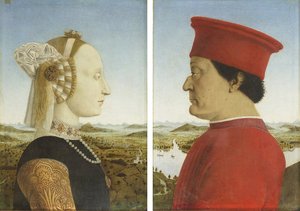
      In the Montefeltro Altarpiece, his skill with oil painting allowed for a meticulous rendering of detail in the portraits of Federico da Montefeltro and Battista Sforza. He captured the texture of skin and the weight of fabric with a scientific precision. Even in his more recent works, such as The Nativity, he placed sacred scenes within a recognizable landscape, using the hills and rivers of the Tuscan countryside to ground the divine in the earthly.

      A legacy of measurement

      Piero was also a writer, documenting his findings in De Prospectiva Pingendi. This treatise on perspective painting shows that his interest in math was not secondary to his art; it was the core of it. He wrote about how to use geometry to represent the three-dimensional world on a flat surface. His work bridged the gap between the older, more decorative Gothic traditions and the new, rational Renaissance style. He sought beauty through proportion and order.

      He died in 1492, leaving behind a body of work that influenced those who followed, including Leonardo da Vinci and Raphael. They looked to his mastery of light and his ability to organize space with mathematical certainty. His paintings remain windows into a world where the spiritual and the rational exist in a state of permanent, quiet balance.

      § 5Comparanda

      § 6Questions

      Quick Facts

      • Artist: Piero della Francesca
      • Artistic style: Renaissance
      • Dimensions: 308 × 207 cm
      • Medium: Oil on panel
      • Title: Saint Augustine Altarpiece
      • Influences: Masaccio

      § 7Cite this entry

      AllPaintingsStore.com, “Piero della Francesca, St. Augustine”, https://allpaintingsstore.com/en/art/piero-della-francesca-st-augustine-8XYRAA-en/ArtistReproduction/ (accessed 2 October 2026).

      § 8The reproduction

      Hand Made Oil Reproduction

      Hand-painted oil on canvas in your size and frame, made to order by our artists. ( Switch to Print Switch to Digital Image)

      It is specified on the order sheet in the margin; the present state of that sheet reads as follows.

      St. Augustine

      Reproduction Medium

      Reproduction Size

      -

      Elite Senior Artist

      More detail, finesse, and extra production time

      -

      Reproduction Frame

      -

      -

      For artworks or reproductions larger than 105 cm (approximately 41 inches) on any side, the frame will be shipped as a kit, disassembled. This method ensures safe delivery and prevents damage during transport.

      Professional assembly required - this is not a DIY product.
      The kit must be assembled and the canvas stretched by an experienced professional framer, using wood glue (not supplied), a canvas stretching plier and clamps to hold the bars square while the glue dries. Incorrect assembly or uneven canvas tension can permanently damage the artwork and is not covered by our warranty.

      • All solid wood bars are included, precisely cut to size.

      • Assembled with the screws provided, plus wood glue for the corner joints, which is not supplied and must be sourced by your framer.

      • Professional tools are required and not included: a canvas stretching plier (tensioner) and clamps to hold the bars square while the glue dries.

      Important:
      The corner joints require wood glue, the bars must be held with clamps until the glue is fully dry, and tightening the canvas on the assembled frame requires a canvas stretching plier. None of these are included in the kit. Please arrange an experienced professional framer before ordering this size.

      Nameplate

      -

      -

      Protective Varnish

      Glossy Varnish (enhances colors, protects against light/moisture)

      -

      Customize My Artwork

      Examples of what can be changed: Replace face with customer photo; Add pet (e.g., replace cat with dog); Include hidden message in background; Change background landscape or elements.

      -

      Urgent

      Worldwide Delivery () in 3/4 weeks instead of standard 5 weeks. (31 October). No compromise on quality.

      -

      Express Shipping

      Worldwide Delivery () in 5 weeks. (7 November).

      Included

      Total Price

      $ 258

      Included with every order

      • Free Worldwide Express Shipping
      • High-Quality Linen Canvas
      • Full Shipping Insurance
      • Customs Tax Refund Guarantee
      • True Color Matching Guarantee
      • 100-Day Return Policy (Defects Only)
      • 100% Money-Back Guarantee
      • Bulk Discount Offer
      Order sheet