Money-Back Guarantee · 100 days Free Worldwide Delivery
449,564artworks 30,613artists 4,660museums 32languages
Catalogue entry

Composition, V

Acrylic On Canvas.

Fig. 1. Piet Mondrian, Composition, V. Shown as the reproduction you are specifying: , .

§ 1Catalogue data

§ 2Abstract

Collectible Description

Experience Piet Mondrian's 'Composition V,' a groundbreaking abstract masterpiece! This iconic painting showcases bold geometric forms and primary colors, embodying Neoplasticism’s revolutionary vision.

Artist Biography

Piet Mondrian pioneered Neoplasticism with works like Broadway Boogie Woogie. Discover the beauty of his geometric abstractions today.

§ 3Commentary

A Symphony in Primary Colors: Deconstructing Piet Mondrian’s “Composition No. V”

Piet Mondrian's "Composition No. V," painted in 1914, isn’t merely a painting; it’s an architectural blueprint for pure abstraction, a distillation of the artist’s lifelong quest to reveal the underlying structure of reality through geometric forms and elemental colors. This seminal work, housed within the MoMA's collection, offers a profound glimpse into the genesis of Neoplasticism – Mondrian’s revolutionary approach to art that sought to transcend representational imagery and capture the essence of universal harmony.

The canvas itself is dominated by a carefully orchestrated grid of black lines bisecting fields of vibrant color: assertive reds, cool blues, and sunny yellows. These aren't arbitrary choices; they are meticulously selected hues representing fundamental forces – red for energy and passion, blue for tranquility and spirituality, and yellow for intellect and illumination. The composition isn’t chaotic, despite its seemingly simple arrangement. Instead, it possesses a dynamic equilibrium, a visual tension that draws the eye across the surface while simultaneously suggesting an underlying order.

The Roots of Abstraction: Influences and Evolution

Mondrian's journey to this iconic composition was paved with experimentation. Initially trained as a landscape painter in the Dutch Impressionist tradition – evidenced by works like “The Red Mill” – he gradually moved away from depicting the external world, recognizing its inherent limitations in conveying spiritual truth. His early explorations of Pointillism and Fauvism provided valuable lessons in color theory and expressive brushwork, but ultimately proved insufficient to his artistic goals. He sought a more rigorous, intellectual approach, one that would strip away all superfluous detail and reveal the essential elements of art.

Crucially, Mondrian’s thinking was deeply influenced by Theosophy, a spiritual philosophy emphasizing the interconnectedness of all things. This belief informed his desire to create an art form that reflected this underlying unity – a visual language capable of communicating universal values beyond the limitations of individual experience. The influence of Japanese art, particularly its emphasis on asymmetry and negative space, also played a significant role in shaping his evolving style.

Deconstructing Form: The Language of Neoplasticism

“Composition No. V” is a textbook example of Neoplasticism – Mondrian’s systematic reduction of form to its most basic elements. He abandoned traditional perspective and representation, opting instead for a strictly orthogonal grid composed of horizontal and vertical lines. These lines aren't merely decorative; they define the spatial relationships within the painting, creating a sense of depth and structure. The colors themselves are applied in flat planes, devoid of shading or modeling, further emphasizing their purity and essential nature.

The black lines act as both dividers and connectors, delineating distinct areas while simultaneously linking them together to form a cohesive whole. This deliberate simplification wasn’t an exercise in minimalism; it was a conscious effort to reveal the underlying structure of reality – a world composed of fundamental geometric forms and elemental colors.

A Legacy of Harmony: Emotional Impact and Enduring Relevance

“Composition No. V” is more than just a visually striking artwork; it’s an invitation to contemplate the nature of beauty, order, and spirituality. The painting's stark simplicity and harmonious balance evoke a sense of calm and serenity, while its bold colors and assertive lines convey a feeling of energy and dynamism. It’s a testament to Mondrian’s belief that art could be a powerful tool for achieving spiritual enlightenment.

Today, “Composition No. V” continues to resonate with audiences around the world, serving as an enduring symbol of modernism and abstract art. Its influence can be seen in countless works of art, design, and architecture – a testament to Mondrian’s pioneering vision and his profound impact on the course of artistic history. Reproductions of this iconic piece offer a beautiful way to bring a touch of Mondrian's harmonious aesthetic into any space.

Questions & Answers

Where can I find a guide to "Composition, V"?

The guide to "Composition, V" is the artwork's Guide page - a printable factsheet showing the artwork with its caption, credit line and identity table (artist, dates, medium, original size, collection).

What is the luminance of "Composition, V" by Piet Mondrian?

"Composition, V" by Piet Mondrian has a gentle luminance luminance. Luminance describes how much light the colors appear to reflect.

What underlying hue runs through "Composition, V" by Piet Mondrian?

The dominant hue of "Composition, V" by Piet Mondrian is golden yellow range. The hue is the underlying tone of the palette.
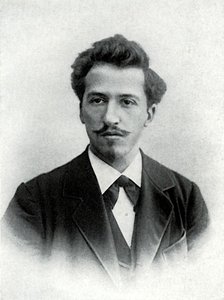
§ 4The artist

Piet Mondrian

Piet Mondrian

1872 - 1944, Netherlands

Artist Biography

The Architecture of Order

To look at a Mondrian today is to see the blueprint of modern visual culture. We encounter his logic every time we interact with a clean graphic layout or a minimalist building facade. He stripped away the unnecessary until only the essential remained. This was not an act of destruction, but one of extreme distillation. By reducing his vocabulary to straight lines, right angles, and a strict palette of red, blue, and yellow, he removed the distraction of reality to reveal a structural truth.

His early work in the Netherlands followed much more traditional paths. He began with landscapes that captured the windmills and rivers of the Dutch countryside, heavily influenced by the Hague School and Impressionism. Pieces like The Red Mill show an artist focused on naturalistic detail and the soft light of his homeland. However, even in these early years, a drive toward simplification was present. He moved through Pointillism and Fauvism, testing how much color and form could be compressed before the subject disappeared entirely.

The Parisian Shift and Neoplasticism

The move to Paris in 1912 changed everything. Encountering Cubism forced him to deconstruct objects into geometric components. He stopped trying to depict what he saw and began exploring how he saw it. This period was deeply tied to his interest in Theosophy, a mystical philosophy that sought universal principles beneath surface appearances. He believed art could express these hidden truths through pure abstraction.

By 1917, this search resulted in Neoplasticism, or "pure plastic art." Alongside Theo van Doesburg, he co-founded the De Stijl movement to promote a rigid aesthetic of horizontal and vertical lines. The rules were absolute:

  • The use of primary colors: red, blue, and yellow.
  • The use of primary values: black, white, and gray.
  • A focus on right angles and straight lines.

This reduction was a deliberate attempt to manifest spiritual order through visual balance. Works like Composition with Red, Blue and Yellow demonstrate this commitment to geometric purity.

New York and the Final Rhythm

The arrival of World War II forced Mondrian to flee Europe for New York City in 1940. The transition from the organic landscapes of his youth to the rigid grid of Manhattan provided a new, unexpected energy. His late works, such as Broadway Boogie Woogie, show a shift in rhythm. While he maintained his core principles, the lines began to dance with a new, syncopated movement inspired by the city's pulse and jazz music.

His death in 1944 ended a career that had fundamentally altered the trajectory of 20th-century art. He left behind a legacy that moved far beyond the canvas, influencing everything from architecture to fashion, including the famous 1965 collection by Yves Saint Laurent. His work remains a standard for anyone seeking clarity and structural integrity in a chaotic visual age.

§ 5Comparanda

§ 6Questions

Quick Facts

  • Subject or theme: Compositional
  • Artist: Piet Mondrian
  • Movement: Neoplasticism
  • Year: 1914
  • Influences:
    • Cubism
    • Fauvism
  • Title: Composition V

Art Quiz

There is only one correct answer for each question.

Question 1:
What is the primary style of Piet Mondrian’s ‘Composition, V’?
Question 2:
The painting ‘Composition, V’ prominently features which color palette?
Question 3:
In what year was ‘Composition, V’ created?
Question 4:
Piet Mondrian's artistic philosophy, as expressed in relation to this work, emphasizes:
Question 5:
What movement is Piet Mondrian most closely associated with?

§ 7Cite this entry

AllPaintingsStore.com, “Piet Mondrian, Composition, V”, https://allpaintingsstore.com/en/art/piet-mondrian-composition-v-8LT54B-en/ (accessed 6 October 2026).

§ 8The reproduction

Hand Made Oil Reproduction

Hand-painted oil on canvas in your size and frame, made to order by our artists. ( Switch to Print Switch to Digital Image)

It is specified on the order sheet in the margin; the present state of that sheet reads as follows.

Composition, V

Reproduction Medium

Reproduction Size

-

Elite Senior Artist

More detail, finesse, and extra production time

-

Reproduction Frame

-

-

For artworks or reproductions larger than 105 cm (approximately 41 inches) on any side, the frame will be shipped as a kit, disassembled. This method ensures safe delivery and prevents damage during transport.

Professional assembly required - this is not a DIY product.
The kit must be assembled and the canvas stretched by an experienced professional framer, using wood glue (not supplied), a canvas stretching plier and clamps to hold the bars square while the glue dries. Incorrect assembly or uneven canvas tension can permanently damage the artwork and is not covered by our warranty.

  • All solid wood bars are included, precisely cut to size.

  • Assembled with the screws provided, plus wood glue for the corner joints, which is not supplied and must be sourced by your framer.

  • Professional tools are required and not included: a canvas stretching plier (tensioner) and clamps to hold the bars square while the glue dries.

Important:
The corner joints require wood glue, the bars must be held with clamps until the glue is fully dry, and tightening the canvas on the assembled frame requires a canvas stretching plier. None of these are included in the kit. Please arrange an experienced professional framer before ordering this size.

Nameplate

-

-

Protective Varnish

Glossy Varnish (enhances colors, protects against light/moisture)

-

Customize My Artwork

Examples of what can be changed: Replace face with customer photo; Add pet (e.g., replace cat with dog); Include hidden message in background; Change background landscape or elements.

-

Urgent

Worldwide Delivery () in 3/4 weeks instead of standard 5 weeks. (3 November). No compromise on quality.

-

Express Shipping

Worldwide Delivery () in 5 weeks. (10 November).

Included

Total Price

$ 258

Included with every order

  • Free Worldwide Express Shipping
  • High-Quality Linen Canvas
  • Full Shipping Insurance
  • Customs Tax Refund Guarantee
  • True Color Matching Guarantee
  • 100-Day Return Policy (Defects Only)
  • 100% Money-Back Guarantee
  • Bulk Discount Offer
Order sheet