

Acrylic On Canvas.

§ 1Catalogue data

§ 2Abstract
Collectible Description
 Read More
Artist Biography
Piet Mondrian pioneered Neoplasticism with works like Broadway Boogie Woogie. Discover the beauty of his geometric abstractions today.
§ 3Commentary
A Prelude to Geometric Mastery: Exploring ‘Woods near Oele’
Piet Mondrian's early artistic explorations were rooted in the traditions of Dutch landscape painting, influenced by luminism and Impressionism. Yet, even amidst these formative influences, a subtle yearning for simplification persisted—a desire to distill nature’s essence into its purest form. *Woods near Oele*, painted in 1908, stands as a pivotal piece during this transitional phase, marking Mondrian's nascent departure from representational art and foreshadowing his groundbreaking embrace of abstraction.
The Influence of Landscape Painting & Impressionism
Like many Dutch artists of the time—Jan Toorop and Jan Sluijters—Mondrian initially studied nature diligently, mastering technique while simultaneously searching for something beyond mere visual depiction. The Hague School’s meticulous observation of light and color served as a crucial foundation for his developing aesthetic sensibilities. However, Mondrian wasn't merely mirroring the world; he sought to capture its underlying harmony and rhythm – a quest that would ultimately propel him toward radically new artistic horizons.
Stylistic Innovations & Emerging Geometric Vision
Early experiments with Pointillism and Fauvism exposed Mondrian to diverse approaches to color and form, each offering valuable insights into expressive possibilities. Yet, none fully satisfied his burgeoning artistic vision. He recognized the limitations of Impressionist techniques in conveying deeper emotional truths—a realization that fueled his determination to forge a path distinct from established conventions.
The Significance of ‘Woods near Oele’
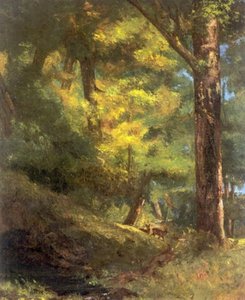
This canvas embodies Mondrian's initial foray into abstraction, characterized by bold vertical and diagonal lines – a stylistic precursor to his iconic De Stijl style. The painting captures the serene beauty of the Oele forest, rendered with careful attention to texture and tonal gradation. Notably, it reflects influences from luminism and Impressionism, demonstrating Mondrian’s ongoing engagement with traditional artistic methods while simultaneously hinting at his impending embrace of geometric abstraction.
A Window into Mondrian's Developing Aesthetic
The composition is balanced and harmonious, reflecting Mondrian’s belief in universal order. The muted color palette contributes to the painting’s tranquil atmosphere—a deliberate choice that underscores its role as a stepping stone toward his revolutionary style. *Woods near Oele* isn’t merely a landscape; it's an emblem of Mondrian’s artistic journey – a testament to his unwavering pursuit of simplification and geometric precision.
Questions & Answers
How does the style of "Forest" relate to its creator's era?
"Forest" belongs to the Post-Impressionism movement, and its creator worked in the Modern era.
Does "Forest" have an augmented reality preview?
"Forest" by Piet Mondrian can be previewed on your own wall with the artwork's AR Preview page, using augmented reality on a compatible device.
Can I see "Forest" by Piet Mondrian under different lights?
The X-Ray page of "Forest" by Piet Mondrian is an interactive viewer that lets you slide through eleven optical layers of the artwork's image, including an X-ray style view.



 Switch to Print


 For artworks or reproductions larger than 105 cm (approximately 41 inches) on any side, the frame will be shipped as a kit, disassembled. This method ensures safe delivery and prevents damage during transport.


