


 Preview
 Send
Send Share
Share
 Details
 Guide
Guide

 Download
 Similars
 X-Ray
X-Ray Diaporama
 Q&A
Q&A Stats
StatsOval Composition


 Read More
Get a print-ready file that goes far beyond the web preview. Every digital image we sell comes from a high-resolution master in our stock database — usually 5,000 to 15,000 pixels wide — so you can print large, crop tightly, or reproduce fine detail with confidence.
No file leaves our studio untouched. A digital expert checks the colors against the original painting and corrects them if needed, then improves clarity and detail with professional retouching tools — always staying faithful to the artist's brushwork and style. The result is an image that looks like the painting, not like a filtered scan.
You approve before you're done: our expert sends the image by e-mail within 72 hours for your review. Not satisfied? Ask for improvements or corrections, or request a refund if the quality falls short.
This is the quality relied on by publishers, design studios, galleries and print shops.
Digital Image
Download a high-resolution file for personal display, printing, and creative projects. ( Switch to Print Buy Hand Made Painting)
Included in Every Digital Image Order
Expert Digital Delivery, Guaranteed
When you choose AllPaintingsStore.com, you're not just getting an image - you're receiving a professionally enhanced digital artwork, crafted with precision and backed by a satisfaction guarantee. Here's everything that comes with your order, automatically:

Fast Email Delivery
Your high-resolution digital image file will be emailed to you within 72 hours of ordering - ready for immediate use.

AI-Enhanced Digital File
Your artwork is professionally optimized using advanced AI tools and manual editing, ensuring maximum detail, clarity, and color accuracy.

Free Lifetime Re-Delivery
Accidentally deleted or lost your file? No worries - we'll resend it to you anytime, free of charge.

No Import Fees - Ever
Enjoy your artwork instantly with zero customs, duties, or delivery fees - digital downloads are always tax-free.

Color Accuracy Guarantee
We ensure your digital image reflects the original colors as closely as possible using professional tools and color management.

100-Day Satisfaction Guarantee
If you're not satisfied with your digital image, we'll revise it or refund 100% within 100 days - no questions asked.

100% Money-Back Guarantee
Not satisfied? Get a full refund within 100 days of receiving your digital file - no questions asked.

Bulk Order Discounts
Buy 3 images, save 10% - Buy 5, save 15% - Buy 10+, save 20%. Great for creative projects, galleries, and agencies.
A Window into Mondrian’s Evolution: ‘Oval Composition’
This striking monochrome drawing offers a fascinating glimpse into the artistic development of Piet Mondrian, predating his iconic geometric abstractions. Created sometime before 1911, *Oval Composition* reveals a pivotal moment in the artist's journey – a transition from representational landscapes to the radical simplification that would define his later work and the De Stijl movement. The artwork isn’t merely a study; it’s an energetic exploration of form and space, brimming with the seeds of Mondrian’s future aesthetic.Deconstructing the Landscape
The subject matter appears to be an abstracted landscape – perhaps mountains or a coastline – but any direct representation is deliberately obscured. Instead, Mondrian employs a dynamic interplay of jagged, angular lines and geometric shapes within an oval frame. This isn’t about *depicting* nature; it's about distilling its essence into fundamental forms. The composition lacks a traditional focal point, encouraging the eye to wander across the densely packed arrangement, experiencing the artwork as a unified field of energy.Technique and Materials
Mondrian’s masterful technique is immediately apparent. Executed in graphite or charcoal on paper, the work showcases meticulous control of line weight and shading. Hatching and cross-hatching are employed to build form and create a sense of depth, despite the overall flattening of perspective. The varying densities of these lines imply light and shadow, adding nuance to the monochrome palette. This isn’t simply sketching; it's a carefully considered study in tonal values and textural effects.Style & Influences
*Oval Composition* sits at the crossroads of several early 20th-century art movements. The fragmented forms and distorted perspective hint at Cubist influences, while the expressive use of line and emphasis on emotional impact align with Expressionism. However, Mondrian quickly moved beyond these styles, using them as stepping stones toward his unique brand of abstraction. This piece demonstrates his early experimentation with reducing reality to its most basic components – a process that would ultimately lead to Neoplasticism.Symbolism and Interpretation
The symbolism within *Oval Composition* is subtle yet potent. The angularity of the lines can be interpreted as representing chaos, disruption, or the inherent instability of the natural world. Conversely, the enclosing oval frame might symbolize containment, a desire to impose order on this perceived chaos, or even represent a self-contained universe. It’s a work that invites contemplation and multiple interpretations.Historical Context & Significance
During this period (1872-1911), Mondrian was transitioning from traditional Dutch Impressionism to more avant-garde approaches. He was actively seeking new ways to represent reality, moving away from purely visual representation towards a more spiritual and philosophical approach to art. *Oval Composition* is a crucial example of this transitional phase, demonstrating his willingness to experiment and challenge conventional artistic norms.Emotional Impact & Aesthetic Appeal
Despite its monochrome palette, *Oval Composition* possesses an undeniable energy. The dynamic lines and fragmented forms create a sense of movement and tension, while the meticulous technique conveys a feeling of intense focus and control. This artwork is not about serene beauty; it’s about intellectual exploration and emotional resonance. It's a piece that rewards close viewing and offers a compelling visual experience for art lovers and collectors alike.- For Art Lovers: A rare opportunity to witness the genesis of one of modern art’s most influential styles.
- For Collectors: An important work in Mondrian's oeuvre, representing a crucial stage in his artistic development.
- For Interior Designers: A sophisticated and thought-provoking piece that adds depth and intellectual weight to any space. Its monochrome palette makes it incredibly versatile, complementing a wide range of interior styles.
Questions & Answers
Where can I buy a digital image of "Oval Composition" by Piet Mondrian?
To get a digital file of "Oval Composition" by Piet Mondrian, order a high-resolution digital image download on its Digital Image page.
What feeling do the colors of "Oval Composition" by Piet Mondrian create?
The neutrals palette of "Oval Composition" by Piet Mondrian goes together with its reflective emotional tone. Color is one of the ways a work conveys feeling.
Is "Oval Composition" free of copyright?
"Oval Composition" by Piet Mondrian is in the public domain - its copyright has expired. This status governs how the image of the work may be reproduced.
Related Artworks


Artist Biography
The Architecture of Order
To look at a Mondrian today is to see the blueprint of modern visual culture. We encounter his logic every time we interact with a clean graphic layout or a minimalist building facade. He stripped away the unnecessary until only the essential remained. This was not an act of destruction, but one of extreme distillation. By reducing his vocabulary to straight lines, right angles, and a strict palette of red, blue, and yellow, he removed the distraction of reality to reveal a structural truth.
His early work in the Netherlands followed much more traditional paths. He began with landscapes that captured the windmills and rivers of the Dutch countryside, heavily influenced by the Hague School and Impressionism. Pieces like The Red Mill show an artist focused on naturalistic detail and the soft light of his homeland. However, even in these early years, a drive toward simplification was present. He moved through Pointillism and Fauvism, testing how much color and form could be compressed before the subject disappeared entirely.
The Parisian Shift and Neoplasticism
The move to Paris in 1912 changed everything. Encountering Cubism forced him to deconstruct objects into geometric components. He stopped trying to depict what he saw and began exploring how he saw it. This period was deeply tied to his interest in Theosophy, a mystical philosophy that sought universal principles beneath surface appearances. He believed art could express these hidden truths through pure abstraction.
By 1917, this search resulted in Neoplasticism, or "pure plastic art." Alongside Theo van Doesburg, he co-founded the De Stijl movement to promote a rigid aesthetic of horizontal and vertical lines. The rules were absolute:
- The use of primary colors: red, blue, and yellow.
- The use of primary values: black, white, and gray.
- A focus on right angles and straight lines.
This reduction was a deliberate attempt to manifest spiritual order through visual balance. Works like Composition with Red, Blue and Yellow demonstrate this commitment to geometric purity.
New York and the Final Rhythm
The arrival of World War II forced Mondrian to flee Europe for New York City in 1940. The transition from the organic landscapes of his youth to the rigid grid of Manhattan provided a new, unexpected energy. His late works, such as Broadway Boogie Woogie, show a shift in rhythm. While he maintained his core principles, the lines began to dance with a new, syncopated movement inspired by the city's pulse and jazz music.
His death in 1944 ended a career that had fundamentally altered the trajectory of 20th-century art. He left behind a legacy that moved far beyond the canvas, influencing everything from architecture to fashion, including the famous 1965 collection by Yves Saint Laurent. His work remains a standard for anyone seeking clarity and structural integrity in a chaotic visual age.
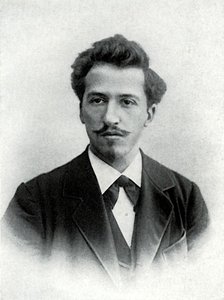
Piet Mondrian
1872 - 1944 , Netherlands