


 Preview
 Send
Send Share
Share
 Details
 Guide
Guide

 Download
 Similars
 X-Ray
X-Ray Diaporama
 Q&A
Q&A Stats
StatsSun

 Read More
Giclée / Art Print
Museum-quality giclée or canvas print with fast production and flexible finish options. ( Buy Hand Made Painting Switch to Digital Image)




P118B $10

P118H $10

P118W $10

P438Z $10

P508JH $12

P508YH $12

P805H $10

P805Z $10

P919BZ $10

P919G $10

P919XJ $10

P959ZH $10

P968JZ $12

W106C $8

W218G $10

W218JH $8

W218Y $10

W307PJ $10

W316G $10

W316PJ $8

W316Y $10

W398PJ $8

W4111J $10

W500HY $15

W500JH $15

W692G $12

W849H $8

W940BG $15

W953PJ $8




Pick from our preset sizes that match the artwork's original proportions.

Type the width and the height you need, to fit your frame or your wall. A print can only be cut, never made bigger than the picture, so a size with a different shape loses a part of the image. We send you a digital mockup to approve before we print anything. The picture shown on this page does not show the real cut — only the mockup does.
Worldwide Delivery () in 2 weeks instead of standard 4/5 weeks. (30 October)

Free Worldwide Express Shipping

High-Quality Linen Canvas

Full Shipping Insurance

Customs Tax Refund Guarantee

True Color Matching Guarantee

100-Day Return Policy (Defects Only)

100% Money-Back Guarantee

Bulk Discount Offer
 Glass option is only available in size under 110 CM

Sun
Giclée / Art Print
Reproduction Size
-


Total Price
$ 65
The Architectonics of Emotion: Piet Mondrian’s Exploration of Universal Beauty
Piet Mondrian (1872–1944), born Pieter Cornelis Mondriaan in Amersfoort, Netherlands, wasn't simply a painter; he was an architect of feeling. His artistic journey began with landscapes steeped in Dutch Impressionism – canvases like *The Red Mill*, capturing the serene beauty of his homeland with meticulous observation and vibrant hues—a deliberate homage to the Hague School’s legacy. Yet, even amidst these familiar forms, Mondrian harbored a restless spirit, driven by an insistent desire for simplification and abstraction. This early experimentation with Pointillism and Fauvism wasn't merely stylistic exploration; it represented a crucial step in his quest to distill nature’s essence into its purest visual elements.- Early Influences: Mondrian’s formative years were profoundly shaped by the artistic currents of his time, notably Impressionism and Post-Impressionism. These movements instilled in him a sensitivity to color and light—qualities he would later champion as foundational to achieving universal aesthetic harmony.
- The Pursuit of Geometric Clarity: As Mondrian matured, he increasingly rejected representational painting in favor of geometric abstraction. This decisive shift stemmed from his conviction that true beauty resided not in mimicking reality but in expressing underlying spiritual principles through pure forms—a radical departure from prevailing artistic conventions.
Neoplasticism: A Manifesto for Universal Harmony
Mondrian’s breakthrough came with the development of Neoplasticism, a term he coined alongside Theo van Doesburg in 1914. This wasn't merely an aesthetic preference; it was a philosophical declaration—a belief that art should transcend subjective experience and communicate objective truths about the cosmos. He envisioned a visual language stripped down to its essentials: horizontal and vertical lines intersecting at right angles, combined with primary colors (red, blue, yellow) and their corresponding achromatic values (black, white). This austere palette wasn’t born of nihilism but rather from an earnest attempt to capture the fundamental building blocks of existence—a reflection of his deeply held spiritual convictions.- Formal Reduction: Mondrian meticulously reduced his artistic vocabulary to these three geometric elements, rejecting any decorative or expressive additions that might distract from their inherent purity.
- Symbolic Significance: The horizontal and vertical lines represented stability and dynamism respectively—symbols of the opposing forces governing the universe according to Mondrian’s cosmological worldview.
The Influence of Eastern Philosophy
Mondrian's artistic vision extended beyond Western abstraction; he drew inspiration from Eastern philosophies, particularly Zen Buddhism. He saw parallels between the meditative practice of emptying the mind and his own process of simplifying form—a deliberate effort to achieve a state of spiritual contemplation through visual art. This influence is evident in the balanced compositions of his later works, where lines intersect with unwavering precision, creating an atmosphere of serene stillness.- Zen Buddhism: Mondrian admired Zen’s emphasis on mindfulness and acceptance—principles that resonated deeply with his desire to transcend ego and embrace the interconnectedness of all things.
- Compositional Balance: The harmonious arrangement of lines and colors in his paintings reflected Zen's pursuit of equilibrium—a visual manifestation of spiritual serenity.
A Legacy of Pure Aesthetics
Piet Mondrian’s uncompromising commitment to geometric abstraction cemented his place as one of the most influential artists of the 20th century. His work continues to inspire designers, architects, and artists alike—a testament to the enduring power of pure aesthetics—a belief that art could elevate human consciousness and reveal the underlying order of the universe. He died in Paris in 1944, leaving behind a body of paintings that remain remarkably consistent with his initial artistic principles—a timeless expression of universal beauty achieved through radical simplification.Questions & Answers
What space matches the colors of "Sun" by Piet Mondrian?
The dark colors of "Sun" by Piet Mondrian match its recommended space: a living room.
Is "Sun" by Piet Mondrian in the public domain, and why?
"Sun" by Piet Mondrian is in the public domain - its copyright has expired. Copyright terms are measured from the artist's death, and Piet Mondrian died in 1944.
How harmonious are the colors of "Sun" by Piet Mondrian?
The color harmony of "Sun" is recorded as unified palette.
Related Artworks


Artist Biography
The Architecture of Order
To look at a Mondrian today is to see the blueprint of modern visual culture. We encounter his logic every time we interact with a clean graphic layout or a minimalist building facade. He stripped away the unnecessary until only the essential remained. This was not an act of destruction, but one of extreme distillation. By reducing his vocabulary to straight lines, right angles, and a strict palette of red, blue, and yellow, he removed the distraction of reality to reveal a structural truth.
His early work in the Netherlands followed much more traditional paths. He began with landscapes that captured the windmills and rivers of the Dutch countryside, heavily influenced by the Hague School and Impressionism. Pieces like The Red Mill show an artist focused on naturalistic detail and the soft light of his homeland. However, even in these early years, a drive toward simplification was present. He moved through Pointillism and Fauvism, testing how much color and form could be compressed before the subject disappeared entirely.
The Parisian Shift and Neoplasticism
The move to Paris in 1912 changed everything. Encountering Cubism forced him to deconstruct objects into geometric components. He stopped trying to depict what he saw and began exploring how he saw it. This period was deeply tied to his interest in Theosophy, a mystical philosophy that sought universal principles beneath surface appearances. He believed art could express these hidden truths through pure abstraction.
By 1917, this search resulted in Neoplasticism, or "pure plastic art." Alongside Theo van Doesburg, he co-founded the De Stijl movement to promote a rigid aesthetic of horizontal and vertical lines. The rules were absolute:
- The use of primary colors: red, blue, and yellow.
- The use of primary values: black, white, and gray.
- A focus on right angles and straight lines.
This reduction was a deliberate attempt to manifest spiritual order through visual balance. Works like Composition with Red, Blue and Yellow demonstrate this commitment to geometric purity.
New York and the Final Rhythm
The arrival of World War II forced Mondrian to flee Europe for New York City in 1940. The transition from the organic landscapes of his youth to the rigid grid of Manhattan provided a new, unexpected energy. His late works, such as Broadway Boogie Woogie, show a shift in rhythm. While he maintained his core principles, the lines began to dance with a new, syncopated movement inspired by the city's pulse and jazz music.
His death in 1944 ended a career that had fundamentally altered the trajectory of 20th-century art. He left behind a legacy that moved far beyond the canvas, influencing everything from architecture to fashion, including the famous 1965 collection by Yves Saint Laurent. His work remains a standard for anyone seeking clarity and structural integrity in a chaotic visual age.
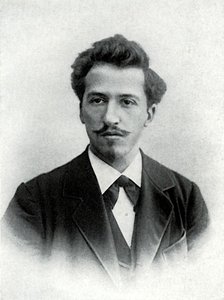
Piet Mondrian
1872 - 1944 , Netherlands
Related Articles

Neoplasticism Explained: A Professional Guide to Geometric Abstraction and Primary Color for Modern Interior Design
Master the use of Neoplasticism in hospitality design. Learn how Piet Mondrian’s geometric forms and primary colors create order and modern sophistication. Expert guidance on sourcing high-quality, large-scale abstract reproductions for professional hotel and corporate interiors.


