The Precision of the Unseen
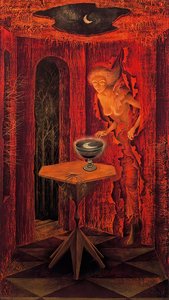
In the quiet corners of her studio, Remedios Varo worked with a meticulousness that mirrored the technical drawings of her father, a hydraulic engineer. This early exposure to the mechanics of the world left a mark on her hand, a preference for the fine line and the precise detail. She did not merely paint; she constructed. Her canvases are populated by intricate apparatuses, gears, and hybrid creatures that seem to operate under their own internal logic. There is a certain stillness in her work, the kind found in a laboratory or a sanctuary, where every movement is deliberate and every object has a purpose.
Her upbringing in Anglès, Spain, provided a foundation of duality. From her father, she learned the discipline of observation and the structure of technical drafting. From her mother, she inherited a sense of the spiritual. This tension between the measurable and the mysterious became the engine of her creativity. She moved through the world with a curious eye, absorbing the landscapes of her frequent relocations and the formal training she received at the Real Academia de Bellas Artes de San Fernando in Madrid. It was here that her technical skill met the burgeoning interest in the subconscious, though her path would always remain her own.
A Life in Motion
The movement of her life was dictated by the shifts of history. The Spanish Civil War and the subsequent occupation of France forced her into a series of displacements, eventually leading her to Mexico City. This relocation was not merely a change of scenery; it was a shift in the very substance of her work. In Mexico, she found a community of thinkers and artists, including Leonora Carrington, who shared her interest in the esoteric. She never became a Mexican citizen, maintaining her Spanish identity even as her vision expanded to include the philosophies and indigenous ideas found in her new home.
Her work moved away from the simple portraits of her early years toward a language of symbols. She became interested in alchemy, not as a pursuit of gold, but as a metaphor for the refinement of the self. Her paintings often feature solitary women engaged in mysterious, scientific, or spiritual tasks. These figures are not passive. They are inventors and seekers, often surrounded by machines that seem to bridge the gap between the physical and the metaphysical. In works like Creation of birds, the act of making becomes a cosmic event, a blending of the biological and the magical.
The Architecture of Dreams
Varo’s style is often described as para-surrealism, a term that captures her departure from the standard Surrealist focus on the subconscious. While others sought to release the chaotic impulses of the mind, she sought to organize them. Her paintings are highly structured, using the precision of an illustrator to depict the impossible. She used oil on masonite to achieve a level of detail that demands a close, unhurried gaze. One can see the fine threads of fate being woven or the subtle movement of celestial energy through her brushwork.
Her legacy is found in the way she merged the scientific with the mystical. She looked at the universe through the lens of an engineer and the heart of a seeker. Her paintings remain a study in how the human spirit attempts to map the unknown. Through her intricate depictions of transformation and connection, she created a visual language for the parts of existence that cannot be measured by a ruler or a clock, yet feel entirely real to those who observe them closely.


 Read More


 Switch to Print


 For artworks or reproductions larger than 105 cm (approximately 41 inches) on any side, the frame will be shipped as a kit, disassembled. This method ensures safe delivery and prevents damage during transport.