Money-Back Guarantee · 100 days Free Worldwide Delivery
449,564artworks 30,613artists 4,660museums 32languages
Catalogue entry

The rape 1

Acrylic On Canvas.

Fig. 1. René Magritte, The rape 1. Shown as the reproduction you are specifying: , .

§ 1Catalogue data

§ 2Abstract

Collectible Description

Artist Biography

René Magritte (1898-1967): Explore the surreal world of this Belgian master! Discover iconic paintings like 'The Lovers,' challenging reality & perception.

§ 3Commentary

The Rape: An Exploration of Surrealist Paradox

René Magritte’s “The Rape” (1928) stands as a cornerstone of Surrealist art, a deceptively simple image brimming with unsettling questions about perception and desire. Painted during Magritte's formative years—a period profoundly shaped by the tragic loss of his mother—the artwork embodies themes of concealment, vulnerability, and the elusive nature of truth. Its stark blue background serves as an oppressive canvas for the central figure: a woman’s head rendered in meticulous detail against this muted hue. The woman’s breasts are prominently displayed, yet obscured by a white cloth – a deliberate act of obfuscation that immediately disrupts any straightforward interpretation.
  • Style & Technique: Magritte's approach aligns perfectly with the Surrealist movement’s rejection of rational thought and embrace of dreamlike imagery. He employs precise realism—a technique seemingly antithetical to Surrealism—to depict a scene laden with symbolic significance. The smooth, polished surface of the painting contributes to its unsettling stillness, mirroring the frozen moment captured within the subconscious mind.
  • Historical Context: Created in Paris during Magritte’s artistic breakthrough, “The Rape” reflects the broader intellectual climate of the era. Surrealism emerged from Dada nihilism and sought to liberate art from the constraints of logic and reason, exploring psychological landscapes and challenging conventional notions of reality. It was influenced by psychoanalytic theories pioneered by Sigmund Freud, particularly his concept of the unconscious desire for forbidden pleasures.
  • Symbolism & Interpretation: The white cloth concealing the breasts is arguably the painting’s most potent symbol. It represents both protection and concealment—a barrier erected to shield the woman from scrutiny while simultaneously denying her audience access to her inner thoughts and feelings. This ambiguity speaks to the Surrealist preoccupation with repressed desires and the impossibility of fully grasping one's own motivations. The upward gaze of the woman’s eyes directs attention towards the sky, suggesting a yearning for transcendence or perhaps an acknowledgement of forces beyond human control.
  • Emotional Impact: “The Rape” evokes a palpable sense of unease and disorientation. Magritte skillfully manipulates visual cues to destabilize our expectations, prompting us to confront uncomfortable truths about sexuality and vulnerability. The painting’s quiet grandeur amplifies its unsettling effect, inviting contemplation on the hidden anxieties that lurk beneath the surface of everyday life.

Connections to Other Works & Legacy

Like “The Lovers,” Magritte's oeuvre consistently investigates the tension between appearance and reality—a preoccupation evident throughout his career. The series of four variations on "The Lovers" further explores this concept, demonstrating Magritte’s commitment to dissecting familiar images and exposing their underlying contradictions. “The Rape” solidified Magritte’s reputation as a visionary artist who challenged artistic conventions and captivated audiences with his masterful use of symbolism and technique. Its enduring influence can be seen in contemporary art that similarly interrogates the boundaries between consciousness and unconsciousness, cementing its place as an iconic masterpiece of Surrealist art.

Questions & Answers

Where can I buy a print of "The rape 1" by René Magritte?

"The rape 1" is available as a fine art print on cotton canvas or archival canvas paper. Orders are placed on its Fine Art Print page, in the size of your choice.

At what size is "The rape 1" suggested for a living room?

For a living room, the recommended print size of "The rape 1" by René Magritte is large.

Which print setup is suggested for "The rape 1" by René Magritte?

For "The rape 1", the recommended print setup is a large size and a portrait orientation.
§ 4The artist

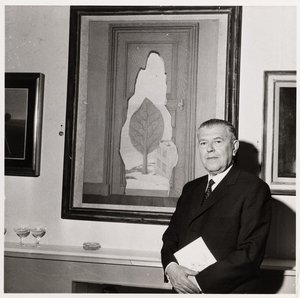
René Magritte

René Magritte

1898 - 1967, Belgium

Quick facts about René Magritte

  • Artistic Movement Or Style: Surrealism
  • Artists Or Movements Influenced By This Artist:
    • Pop art
    • Minimalist art
    • Conceptual art
  • Artists Who Influenced This Artist:
    • Giorgio de Chirico
    • Claude Monet
    • Vincent van Gogh
    • Paul Cézanne
  • Full Name: René François Ghislain Magritte
  • Nationality: Belgian
  • Notable Artworks:
    • The Treachery of Images
    • The Lovers
    • Time Transfixed
    • The Human Condition
    • Golconda
  • Place Of Birth: Lesennes, Belgium
  • Date Of Birth: 1898
  • Date Of Death: 1967

Artist Biography

Early Life and the Seeds of Surrealism

René Magritte, born René François Ghislain Magritte on November 21, 1898, in Lessines, Belgium, emerged into a world that would profoundly shape his enigmatic artistic vision. His early years were marked by an unsettling event – the suicide of his mother when he was just thirteen. The image of her body being recovered from the River Sambre, with her dress obscuring her face, became a haunting motif that would subtly permeate his later work, manifesting in veiled figures and a persistent exploration of hidden realities. This early trauma instilled within him a fascination with mystery, loss, and the unsettling power of what remains unseen. While details of his childhood remain somewhat elusive, it’s clear this formative experience laid the groundwork for his lifelong questioning of perception and representation. He began drawing lessons at age ten, revealing an innate inclination towards visual expression, but initially explored Impressionism before embarking on a path that would lead him to become one of the most significant figures in Surrealist art.

Artistic Development and Influences

Magritte’s artistic journey was not immediate or straightforward. He studied at the Académie Royale des Beaux-Arts in Brussels, yet found its traditional methods stifling. His early work experimented with Futurism and Cubism, absorbing elements of these avant-garde movements but ultimately rejecting their purely formal concerns. It wasn't until encountering Giorgio de Chirico’s painting *The Song of Love* in 1922 that Magritte discovered a resonance that would irrevocably alter his artistic course. De Chirico’s dreamlike landscapes and unsettling juxtapositions unlocked within Magritte a new way of seeing – a world where the familiar could be rendered strange, and the ordinary imbued with profound mystery. This encounter sparked his commitment to Surrealism, though he often maintained a unique distance from its more overtly psychological or automatic approaches. He preferred a meticulous, almost clinical precision in his painting, using realistic techniques to depict illogical scenarios.

The Heart of Surrealism: Challenging Reality

By 1926, Magritte had fully embraced the tenets of Surrealism, producing *Le Jockey Perdu (The Lost Jockey)*, widely considered his first truly surrealist work. However, his brand of Surrealism was distinct. He wasn’t interested in exploring the subconscious through free association or dream imagery in the manner of some of his contemporaries. Instead, Magritte sought to challenge viewers' perceptions of reality by presenting ordinary objects in unexpected contexts, forcing them to question their assumptions about the world around them. Iconic works like *The Treachery of Images (This is not a pipe)* (1929) brilliantly deconstructs the relationship between image and object, reminding us that a representation is never the thing itself. *Les Amants (The Lovers)* (1927-1928), with its shrouded figures, echoes the trauma of his mother’s death while simultaneously exploring themes of concealment and intimacy. *Time Transfixed* (1938) presents a locomotive bursting through a brick wall, disrupting our sense of space and time. And *The Human Condition* (1933), a canvas within a canvas, blurs the boundaries between representation and reality, prompting us to consider how we perceive and interpret the world.

Later Life, Recognition, and Enduring Legacy

Despite initial struggles for recognition, Magritte’s work gradually gained prominence, particularly in the United States with exhibitions in 1936 and later retrospective shows at the Museum of Modern Art (1965) and the Metropolitan Museum of Art (1992). He remained politically engaged throughout his life, advocating for artistic autonomy. He continued to refine his signature style, exploring themes of repetition, illusion, and the power of language in paintings that are both intellectually stimulating and visually arresting. Magritte died on August 15, 1967, leaving behind a body of work that continues to captivate and challenge audiences worldwide. His influence extends far beyond the realm of painting, impacting pop art, minimalist art, conceptual art, and even advertising and film. Today, his paintings are held in major museum collections around the globe, including the Musées royaux des beaux-arts de Belgique in Brussels, which houses the Magritte Museum – dedicated entirely to his work and boasting the world’s largest collection of his creations.

  • Museum Collections: Musées royaux des beaux-arts de Belgique, Brussels; Magritte Museum.

Magritte's enduring legacy lies in his ability to make us see the familiar anew, to question our assumptions about reality, and to appreciate the power of art to provoke thought and inspire wonder. He wasn’t simply painting images; he was crafting visual paradoxes that continue to resonate with viewers decades after their creation, solidifying his position as a true master of Surrealism and a pivotal figure in 20th-century art.

§ 5Comparanda

§ 6Questions

Quick Facts

  • Title: The Rape
  • Medium: Oil on canvas
  • Movement: Surrealism
  • Subject or theme: Psychological exploration
  • Dimensions: 60 x 45 cm
  • Artistic style: Dreamlike

Art Quiz

There is only one correct answer for each question.

Question 1:
What is the primary artistic style employed by René Magritte in ‘The Rape’?
Question 2:
The painting depicts a woman's head with prominent breasts. What is the symbolic significance of this depiction according to Surrealist theory?
Question 3:
What color dominates the background of ‘The Rape’, contributing to its overall atmosphere?
Question 4:
According to Wikipedia, what is depicted in 'The Lovers'?
Question 5:
What is the main theme explored by Magritte in ‘The Rape’?

§ 7Cite this entry

AllPaintingsStore.com, “René Magritte, The rape 1”, https://allpaintingsstore.com/en/art/rene-magritte-the-rape-1-8EWRAT-en/ArtistReproduction/ (accessed 6 October 2026).

§ 8The reproduction

Hand Made Oil Reproduction

Hand-painted oil on canvas in your size and frame, made to order by our artists. ( Switch to Print Switch to Digital Image)

It is specified on the order sheet in the margin; the present state of that sheet reads as follows.

The rape 1

Reproduction Medium

Reproduction Size

-

Elite Senior Artist

More detail, finesse, and extra production time

-

Reproduction Frame

-

-

For artworks or reproductions larger than 105 cm (approximately 41 inches) on any side, the frame will be shipped as a kit, disassembled. This method ensures safe delivery and prevents damage during transport.

Professional assembly required - this is not a DIY product.
The kit must be assembled and the canvas stretched by an experienced professional framer, using wood glue (not supplied), a canvas stretching plier and clamps to hold the bars square while the glue dries. Incorrect assembly or uneven canvas tension can permanently damage the artwork and is not covered by our warranty.

  • All solid wood bars are included, precisely cut to size.

  • Assembled with the screws provided, plus wood glue for the corner joints, which is not supplied and must be sourced by your framer.

  • Professional tools are required and not included: a canvas stretching plier (tensioner) and clamps to hold the bars square while the glue dries.

Important:
The corner joints require wood glue, the bars must be held with clamps until the glue is fully dry, and tightening the canvas on the assembled frame requires a canvas stretching plier. None of these are included in the kit. Please arrange an experienced professional framer before ordering this size.

Nameplate

-

-

Protective Varnish

Glossy Varnish (enhances colors, protects against light/moisture)

-

Customize My Artwork

Examples of what can be changed: Replace face with customer photo; Add pet (e.g., replace cat with dog); Include hidden message in background; Change background landscape or elements.

-

Urgent

Worldwide Delivery () in 3/4 weeks instead of standard 5 weeks. (3 November). No compromise on quality.

-

Express Shipping

Worldwide Delivery () in 5 weeks. (10 November).

Included

Total Price

$ 258

Included with every order

  • Free Worldwide Express Shipping
  • High-Quality Linen Canvas
  • Full Shipping Insurance
  • Customs Tax Refund Guarantee
  • True Color Matching Guarantee
  • 100-Day Return Policy (Defects Only)
  • 100% Money-Back Guarantee
  • Bulk Discount Offer
Order sheet