Money-Back Guarantee · 100 days Free Worldwide Delivery
449,587artworks 30,613artists 4,660museums 32languages
Currency
    Language
      Atelier · Est. 2015 · Paris, France
      AllPaintingsStore
      allpaintingsstore.com
      Catalogue entry

      St. Augustine in the Cell

      Oil On Canvas.

      Fig. 1. Sandro Botticelli, St. Augustine in the Cell. Shown as the reproduction you are specifying: , .

      § 1Catalogue data

      § 2Abstract

      Collectible Description

      Experience the profound stillness of Sandro Botticelli's St. Augustine in His Cell, an intimate Early Renaissance masterpiece capturing spiritual devotion through elegant lines and inviting you to explore this timeless work.

      Artist Biography

      Discover Sandro Botticelli (1445-1510), Renaissance master of 'Birth of Venus' & 'Primavera'. Explore his elegant style, mythological themes, and lasting influence on art history!

      § 3Commentary

      Artist

      Sandro Botticelli was an Italian Renaissance painter, born Alessandro di Mariano Filipepi in Florence around 1445. He is known for his detailed and thoughtful depictions of religious scenes, as well as mythological subjects. His style is characterized by a graceful elegance and attention to detail that make his works instantly recognizable.

      Title

      The title of this painting is "St. Augustine in His Cell". It was completed around 1490-1494, during the height of Botticelli's career.

      Media

      This painting is an oil on canvas, a popular medium during the Renaissance period due to its ability to create rich and vibrant colors.

      Style

      St. Augustine in His Cell is a prime example of Botticelli's unique style, which combines elements of both Gothic and Classical art. The painting features delicate lines and intricate details, as well as a sense of movement and energy that is characteristic of the Renaissance period.

      Historical Context

      This painting was created during a time of great change in Italy, both politically and culturally. The Renaissance was in full swing, and artists like Botticelli were pushing the boundaries of what was possible in terms of artistic expression. At the same time, religious tensions were running high, and many artists turned to religious subjects as a way of exploring these issues.

      Availability

      If you are interested in adding this beautiful painting to your collection, St. Augustine in His Cell by Sandro Botticelli is available as a hand-made oil painting reproduction from AllPaintingsStore. Our team of skilled artists will create a stunning replica of this masterpiece, using only the finest materials and techniques to ensure that it is an accurate and faithful representation of the original.

      Conclusion

      St. Augustine in His Cell is a beautiful and thought-provoking painting that showcases Botticelli's unique style and talent. Whether you are a collector, a student of art history, or simply an admirer of beauty, this painting is sure to inspire and delight. So why not add it to your collection today?

      Questions & Answers

      What feeling do the colors of "St. Augustine in the Cell" by Sandro Botticelli create?

      The earthy palette of "St. Augustine in the Cell" by Sandro Botticelli goes together with its reflective emotional tone. Color is one of the ways a work conveys feeling.

      How do I discover artworks close to "St. Augustine in the Cell" by Sandro Botticelli?

      Works similar to "St. Augustine in the Cell" are listed on the artwork's Similars page.

      How does the subject of "St. Augustine in the Cell" relate to Sandro Botticelli's usual themes?

      Among Sandro Botticelli's recorded themes - classical ideals, christian contemplation, medici patronage, renaissance grace, botticelli’s signature style - "St. Augustine in the Cell" brings its own focus on saint augustine, cell interior, religious figure, renaissance painting, meditative scene, classical influence, detailed composition.
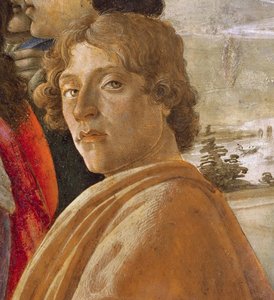
      § 4The artist

      Sandro Botticelli

      Sandro Botticelli

      1445 - 1510, Italy

      Quick facts about Sandro Botticelli

      • Artistic Movement Or Style: Early Renaissance
      • Artists Or Movements Influenced By This Artist: ['Pre-Raphaelite Brotherhood']
      • Artists Who Influenced This Artist:
        • Fra Filippo Lippi
        • Fra Angelico
        • Paolo Uccello
      • Full Name: Alessandro di Mariano Filipepi
      • Notable Artworks:
        • The Birth of Venus
        • Primavera
        • Adoration of the Magi
        • Mystic Nativity
      • Place Of Birth: Florence, Italy
      • Date Of Birth: 1445
      • Date Of Death: 1510

      Artist Biography

      Early Life and Florentine Beginnings

      Sandro Botticelli, born Alessandro di Mariano di Vanni Filipepi around 1445 in Florence, Italy, emerged during a period of extraordinary cultural ferment—the Early Renaissance. His life was deeply rooted in the city’s artistic and social fabric; he never strayed far from his neighborhood of Ognissanti, a testament to both familial ties and the vibrant creative ecosystem that nurtured him. His father, Mariano Filipepi, initially a goldsmith and later a tanner, provided an early exposure to craftsmanship and meticulous detail—qualities that would profoundly influence Botticelli’s artistic approach. Though initial reports suggested training as a goldsmith, he soon found his calling under the tutelage of Fra Filippo Lippi, a leading painter of the time. This apprenticeship proved pivotal, immersing him in the techniques and aesthetics of the Florentine school while also connecting him to influential patrons like the Medici family.

      A Style Defined by Grace and Myth

      Botticelli’s artistic style is instantly recognizable for its lyrical beauty, characterized by elegant linearity, flowing contours, and a delicate use of color. He masterfully bridged the gap between the late Gothic traditions and the burgeoning Renaissance aesthetic, absorbing influences from masters like Fra Angelico and Paolo Uccello yet forging a uniquely personal vision. His figures possess an ethereal quality, often depicted with elongated proportions and graceful poses that convey both serenity and a subtle melancholy. A defining feature of his work is the frequent incorporation of classical mythology—a reflection of the humanist interests sweeping through Renaissance Florence. He didn’t merely illustrate these ancient tales; he imbued them with new layers of meaning, exploring themes of love, beauty, and spiritual longing.

      Botticelli's technique was innovative for its time. He often employed a silverpoint drawing method underpainting his canvases, contributing to the luminosity and delicate detail seen in his finished works. His use of tempera paint allowed for precise rendering and vibrant colors, while his later experiments with oil paints broadened his expressive possibilities.

      Iconic Masterpieces and Artistic Development

      Botticelli’s legacy rests upon a handful of iconic paintings that continue to captivate audiences centuries later. The Birth of Venus, completed around 1486, stands as perhaps his most celebrated work—an allegorical depiction of the goddess emerging from a seashell, embodying Renaissance ideals of beauty and harmony. Its graceful composition, delicate color palette, and evocative symbolism have made it an enduring symbol of the era. Equally renowned is Primavera, created around 1482, a complex and enigmatic painting celebrating spring and love, populated with symbolic figures drawn from classical mythology. These works showcase Botticelli’s mastery of composition, his ability to create atmospheric depth, and his profound understanding of human emotion.

      His artistic journey unfolded in distinct phases. The early 1470s saw him focusing on religious subjects, honing his technical skills and establishing a reputation for skillful execution. The 1480s marked the peak of his creative powers, with the creation of his most famous mythological paintings. However, the late 1490s witnessed a shift in his style, influenced by the fervent preaching of Girolamo Savonarola—a Dominican friar who condemned what he saw as the decadence and moral corruption of Florence. This period resulted in more austere and emotionally charged works, reflecting a growing spiritual intensity.

      Legacy and Rediscovery

      Following his death in 1510, Botticelli’s reputation gradually faded into obscurity. For nearly three centuries, his work was largely forgotten, overshadowed by the achievements of High Renaissance masters like Leonardo da Vinci and Michelangelo. However, a remarkable rediscovery occurred in the late 19th century with the rise of the Pre-Raphaelite Brotherhood—a group of English artists who rejected academic conventions and sought inspiration in the art of the early Italian Renaissance. They were captivated by Botticelli’s linear grace, vibrant colors, and poetic sensibility, recognizing him as a kindred spirit.

      This renewed appreciation sparked a widespread reassessment of his work, establishing him as one of the most important artists of the Early Renaissance. Today, Botticelli is celebrated for his unique artistic vision, his masterful technique, and his enduring ability to evoke beauty, emotion, and spiritual contemplation. His influence can be seen in subsequent generations of artists who have sought to capture the same sense of grace and elegance in their own work. He remains a symbol of Florentine artistic achievement and a testament to the power of Renaissance humanism.

      Major Works

      • The Birth of Venus (c. 1486): An iconic depiction embodying Renaissance ideals of beauty.
      • Primavera (c. 1482): A complex allegorical painting celebrating spring and love.
      • Adoration of the Magi (1475-1476): Demonstrates early mastery of composition and perspective.
      • Mystic Nativity (1501): Reflects a shift towards spiritual themes in his later career.

      § 5Comparanda

      § 6Questions

      Quick Facts

      • Influences: Gothic Art
      • Title: St. Augustine in His Cell
      • Artistic style: Graceful elegance; Classical influences
      • Movement: Early Renaissance
      • Subject or theme: Religious contemplation

      Art Quiz

      There is only one correct answer for each question.

      Question 1:
      What artistic movement is Sandro Botticelli’s ‘St. Augustine in His Cell’ primarily associated with?
      Question 2:
      The painting depicts St. Augustine in what setting?
      Question 3:
      What medium was used to create ‘St. Augustine in His Cell’?
      Question 4:
      Botticelli's style is characterized by:
      Question 5:
      During what historical period was ‘St. Augustine in His Cell’ created?

      § 7Cite this entry

      AllPaintingsStore.com, “Sandro Botticelli, St. Augustine in the Cell”, https://allpaintingsstore.com/en/art/sandro-botticelli-st-augustine-in-the-cell-5ZKBGF-en/ArtistReproduction/ (accessed 2 October 2026).

      § 8The reproduction

      Hand Made Oil Reproduction

      Hand-painted oil on canvas in your size and frame, made to order by our artists. ( Switch to Print Switch to Digital Image)

      It is specified on the order sheet in the margin; the present state of that sheet reads as follows.

      St. Augustine in the Cell

      Reproduction Medium

      Reproduction Size

      -

      Elite Senior Artist

      More detail, finesse, and extra production time

      -

      Reproduction Frame

      -

      -

      For artworks or reproductions larger than 105 cm (approximately 41 inches) on any side, the frame will be shipped as a kit, disassembled. This method ensures safe delivery and prevents damage during transport.

      Professional assembly required - this is not a DIY product.
      The kit must be assembled and the canvas stretched by an experienced professional framer, using wood glue (not supplied), a canvas stretching plier and clamps to hold the bars square while the glue dries. Incorrect assembly or uneven canvas tension can permanently damage the artwork and is not covered by our warranty.

      • All solid wood bars are included, precisely cut to size.

      • Assembled with the screws provided, plus wood glue for the corner joints, which is not supplied and must be sourced by your framer.

      • Professional tools are required and not included: a canvas stretching plier (tensioner) and clamps to hold the bars square while the glue dries.

      Important:
      The corner joints require wood glue, the bars must be held with clamps until the glue is fully dry, and tightening the canvas on the assembled frame requires a canvas stretching plier. None of these are included in the kit. Please arrange an experienced professional framer before ordering this size.

      Nameplate

      -

      -

      Protective Varnish

      Glossy Varnish (enhances colors, protects against light/moisture)

      -

      Customize My Artwork

      Examples of what can be changed: Replace face with customer photo; Add pet (e.g., replace cat with dog); Include hidden message in background; Change background landscape or elements.

      -

      Urgent

      Worldwide Delivery () in 3/4 weeks instead of standard 5 weeks. (30 October). No compromise on quality.

      -

      Express Shipping

      Worldwide Delivery () in 5 weeks. (6 November).

      Included

      Total Price

      $ 258

      Included with every order

      • Free Worldwide Express Shipping
      • High-Quality Linen Canvas
      • Full Shipping Insurance
      • Customs Tax Refund Guarantee
      • True Color Matching Guarantee
      • 100-Day Return Policy (Defects Only)
      • 100% Money-Back Guarantee
      • Bulk Discount Offer
      Order sheet