Preview
 Send
Send Share
Share
 Details
 Guide
Guide

 Download
 Similars
 X-Ray
X-Ray Diaporama
 Q&A
Q&A Stats
StatsInterior

 Read More
The artwork displayed on this page is protected by copyright law, which means we cannot legally create or sell an identical reproduction. This protection is enforced under international agreements such as the Berne Convention and by national laws, including those outlined by the U.S. Copyright Law - Title 17.
This method fully complies with copyright regulations because it does not involve copying or duplicating the protected artwork. Instead, it is a creative reinterpretation - a new painting that is influenced by the original but not identical to it.
Giclée / Art Print
Museum-quality giclée or canvas print with fast production and flexible finish options. ( Buy Hand Made Painting Switch to Digital Image)




P118B $10

P118H $10

P118W $10

P438Z $10

P508JH $12

P508YH $12

P805H $10

P805Z $10

P919BZ $10

P919G $10

P919XJ $10

P959ZH $10

P968JZ $12

W106C $8

W218G $10

W218JH $8

W218Y $10

W307PJ $10

W316G $10

W316PJ $8

W316Y $10

W398PJ $8

W4111J $10

W500HY $15

W500JH $15

W692G $12

W849H $8

W940BG $15

W953PJ $8




Pick from our preset sizes that match the artwork's original proportions.

Type the width and the height you need, to fit your frame or your wall. A print can only be cut, never made bigger than the picture, so a size with a different shape loses a part of the image. We send you a digital mockup to approve before we print anything. The picture shown on this page does not show the real cut — only the mockup does.
Worldwide Delivery () in 2 weeks instead of standard 4/5 weeks. (19 November)

Free Worldwide Express Shipping

High-Quality Linen Canvas

Full Shipping Insurance

Customs Tax Refund Guarantee

True Color Matching Guarantee

100-Day Return Policy (Defects Only)

100% Money-Back Guarantee

Bulk Discount Offer
 Glass option is only available in size under 110 CM

Interior
Giclée / Art Print
Reproduction Size
-


Total Price
$ 65
A Dynamic Vision of Modernity: Exploring Stuart Davis’s “Interior”
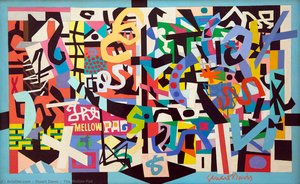
Stuart Davis's “Interior” is a captivating example of American Modernism, pulsating with energy and reflecting the artist’s unique response to the burgeoning urban landscape and the rhythms of jazz. Created sometime during his prolific career (1892-1964), this work embodies Davis’s commitment to developing a distinctly American visual language, moving beyond European influences towards a bold, independent style.
Deconstructing Space: Style & Technique
- The artwork is immediately striking for its geometric abstraction. Davis employs fragmented forms and flattened perspectives – hallmarks of both Cubism and Constructivism – but infuses them with a uniquely American sensibility.
- A vibrant palette dominates, anchored by the stark contrast between the white background, bold reds, blues, and greys, and punctuated by energetic black lines. The orange border further intensifies this visual impact.
- Davis’s technique is evident in the visible brushstrokes and layering of paint, creating a subtle texture that adds depth despite the overall flattened composition. This suggests an active process of building up form and color on the canvas, likely using oil paints as his primary medium.
- The arrangement isn't simply random; it’s carefully orchestrated into distinct zones – a tower-like structure in blue-grey, a dynamic red section with a vertical ‘sail’ or flag element, and a central area of interwoven geometric shapes. This zoning creates a sense of controlled chaos.
Echoes of Jazz & the Machine Age: Context & Symbolism
Davis was deeply influenced by jazz music, which he saw as embodying the spirit of modern America – improvisational, energetic, and uniquely its own. While “Interior” isn’t a direct representation of musical notes, the dynamic interplay of shapes and colors evokes the same sense of rhythm and syncopation found in jazz compositions.
- The architectural elements, particularly the stylized tower, could be interpreted as representing aspiration or the burgeoning skyscrapers of American cities. Davis frequently engaged with urban themes throughout his career.
- The ‘sail’ or flag-like form introduces a sense of movement and direction, perhaps symbolizing progress or the forward momentum of modern life.
- His early exposure to the Armory Show in 1913 was pivotal. While his initial works reflected the Ashcan School style, he quickly absorbed and transformed European avant-garde ideas into something distinctly American.
Emotional Resonance & Lasting Impact
“Interior” is not a tranquil scene; it’s charged with energy and tension. The fragmented forms and bold colors create a sense of dynamism, while the lack of traditional perspective can be slightly unsettling. This emotional complexity reflects the anxieties and excitements of a rapidly changing world.
- The artwork invites viewers to actively engage with its abstract language, prompting individual interpretations and fostering a personal connection.
- As a pioneering figure in American Modernism, Stuart Davis paved the way for subsequent generations of artists. His work continues to inspire those seeking to break free from convention and explore new forms of visual expression.
Questions & Answers
Are there works similar to "Interior"?
The Similars page of "Interior" by Stuart Davis presents related artworks.
How do contrast and harmony combine in "Interior"?
The color analysis of "Interior" by Stuart Davis records a statement contrast and a strong color unity harmony.
What is the dominant hue of "Interior" by Stuart Davis?
The dominant hue of "Interior" by Stuart Davis is amber to saffron. The hue is the underlying tone of the palette.
Related Artworks


Artist Biography
Stuart Davis: A Pioneer of American Modernism
Early Life and Training
Born on December 7, 1892, in Philadelphia, Stuart Davis was immersed in an artistic environment from a young age. His father, Edward Wyatt Davis, served as the art editor for the Philadelphia Press, while his mother, Helen Stuart Davis, was a sculptor. This familial background undoubtedly fostered his early interest in visual arts.
Davis received formal training at the Robert Henri School of Art in New York City from 1909 to 1912 under the guidance of Robert Henri. During this period, he formed lasting friendships with fellow painters John Sloan, Glenn Coleman, and Henry Glintenkamp.
Early Career and the Armory Show
Davis quickly gained recognition as one of the youngest exhibitors at the pivotal Armory Show in 1913. He presented five watercolor paintings that reflected the style of the Ashcan School, marking an early step in his artistic journey.
Artistic Development and Style
Throughout the 1920s, Davis developed his distinctive mature style. He began creating abstract still lifes and landscapes characterized by a proto-pop art element, incorporating contemporary subject matter like cigarette packages and spark plug advertisements into his compositions.
His work is known for its bold, brash, and colorful nature. Davis’s artistic expression was profoundly influenced by his love of jazz music, which became increasingly evident in his paintings from the 1940s and 1950s. The Ashcan School movement also played a crucial role in shaping his early aesthetic sensibilities.
Influences and Inspirations
- Robert Henri: Provided foundational training and encouraged direct observation of life.
- Ashcan School: Influenced his initial focus on urban realism and everyday subjects.
- Cubism: Inspired his exploration of abstract forms and fragmented perspectives.
- Jazz Music: Contributed to the rhythmic energy and improvisational quality of his paintings.
Notable Works
Odol (Modernism), completed in 1928, stands as a prime example of Davis’s unique style. This painting exemplifies his ability to blend abstract forms with recognizable imagery from popular culture.
Other significant works include Rocks, Gloucester (1915), The Mellow Pad, and Tropes de Teens (1956).
Legacy and Historical Significance
Stuart Davis’s contributions to American Modernism are undeniable. He paved the way for future generations of artists by challenging traditional artistic conventions and embracing contemporary themes.
As a pioneer in abstract art, he helped establish a distinctly American voice within the broader context of modern art history. His work continues to inspire and influence artists today, solidifying his place as a significant figure in 20th-century art.

Stuart Davis
1892 - 1964 , United States
Quick Facts
- Name: Stuart Davis
- Movement:
- American Modernism
- Ashcan School
- Cubism
- Birth Date: December 7, 1892
- Death Date: 1964
- Birth Place: Philadelphia, United States of America
- Nationality: American
- Date Of Birth: 1892
- Date Of Death: 1964
- Influenced By:
- Robert Henri
- Ashcan School
- Notable Works: ['Odol']
- Place Of Birth: Philadelphia, United States of America
Related Articles

Fragmented Beauty: A Professional Guide to Deconstructed Forms and Cubist Masterpieces for Architectural Design
Elevate hospitality interiors with professional-grade Cubist reproductions. Our expert guide explores deconstructed forms for designers, offering high-volume, hand-painted oil masterpieces, custom multi-panel sets, and seamless global procurement for hotels and corporate spaces.