Preview
 Send
Send Share
Share
 Details
 Guide
Guide

 Download
 Similars
 X-Ray
X-Ray Diaporama
 Q&A
Q&A Stats
StatsVisa

 Read More
The artwork displayed on this page is protected by copyright law, which means we cannot legally create or sell an identical reproduction. This protection is enforced under international agreements such as the Berne Convention and by national laws, including those outlined by the U.S. Copyright Law - Title 17.
This method fully complies with copyright regulations because it does not involve copying or duplicating the protected artwork. Instead, it is a creative reinterpretation - a new painting that is influenced by the original but not identical to it.
Giclée / Art Print
Museum-quality giclée or canvas print with fast production and flexible finish options. ( Buy Hand Made Painting Switch to Digital Image)




P118B $10

P118H $10

P118W $10

P438Z $10

P508JH $12

P508YH $12

P805H $10

P805Z $10

P919BZ $10

P919G $10

P919XJ $10

P959ZH $10

P968JZ $12

W106C $8

W218G $10

W218JH $8

W218Y $10

W307PJ $10

W316G $10

W316PJ $8

W316Y $10

W398PJ $8

W4111J $10

W500HY $15

W500JH $15

W692G $12

W849H $8

W940BG $15

W953PJ $8




Pick from our preset sizes that match the artwork's original proportions.

Type the width and the height you need, to fit your frame or your wall. A print can only be cut, never made bigger than the picture, so a size with a different shape loses a part of the image. We send you a digital mockup to approve before we print anything. The picture shown on this page does not show the real cut — only the mockup does.
Worldwide Delivery () in 2 weeks instead of standard 4/5 weeks. (3 November)

Free Worldwide Express Shipping

High-Quality Linen Canvas

Full Shipping Insurance

Customs Tax Refund Guarantee

True Color Matching Guarantee

100-Day Return Policy (Defects Only)

100% Money-Back Guarantee

Bulk Discount Offer
 Glass option is only available in size under 110 CM

Visa
Giclée / Art Print
Reproduction Size
-


Total Price
$ 65
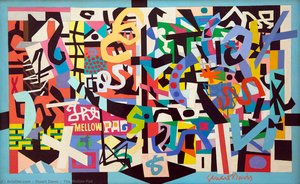
A Dynamic Synthesis: Exploring Stuart Davis’ “Visa”
Stuart Davis's "Visa" is a captivating example of American Modernism at its most vibrant and energetic. This collage-style painting isn’t merely an aesthetic statement; it’s a visual articulation of the dynamism of early 20th-century America, infused with the rhythms of jazz and the burgeoning spirit of Pop Art decades before its formal emergence. The artwork immediately commands attention through its bold typography – the phrase “CHAMPION ELSE” emblazoned across a complex field of geometric abstraction. This isn’t a tranquil scene; it's a burst of controlled chaos, reflecting the accelerating pace and multifaceted nature of modern life.Style & Technique: Cubism Meets Jazz Age Energy
Davis masterfully blends influences in “Visa.” While the fragmented forms and overlapping planes clearly nod to Cubism, particularly the Synthetic Cubist approach, the work transcends simple imitation. The bright, contrasting colors and graphic treatment anticipate the boldness of Pop Art, demonstrating Davis’s forward-thinking vision. His technique appears to be a sophisticated combination of hand-painted elements layered with potentially printed components – creating texture and depth. This mixed-media approach allows for a unique visual density and a slightly rough surface quality that adds to its tactile appeal. The flattened perspective further emphasizes the artwork's graphic nature, prioritizing impact over illusionistic space. It’s a testament to Davis’s skill in translating musicality—specifically, the improvisational spirit of jazz—into visual form.Historical Context & Symbolic Resonance
Created during a period of significant artistic upheaval and experimentation, “Visa” reflects Davis's early engagement with avant-garde movements. His inclusion in the groundbreaking Armory Show of 1913, alongside European Modernists, was pivotal in shaping his artistic trajectory. The title itself, while seemingly simple, hints at a deeper meaning. "Visa" can be interpreted as a metaphorical stamp of approval – a validation of striving and competition, aligning with the phrase “CHAMPION ELSE.” The repeated ‘C’ shapes within the composition could symbolize cycles, continuous effort, or even musical chords, reinforcing the jazz-inspired undercurrents. Davis wasn't simply depicting objects; he was exploring concepts—the energy of urban life, the pursuit of success, and the very essence of American identity in a rapidly changing world.Emotional Impact & Interior Design Considerations
“Visa” evokes a sense of exhilaration and restless energy. It’s a piece that demands attention and sparks conversation. Its bold color palette and dynamic composition make it a striking focal point for any space. In an interior design context, “Visa” would be particularly effective in modern or contemporary settings, adding a vibrant accent to minimalist décor. The artwork's graphic quality also lends itself well to larger spaces where its impact won’t be diminished. A high-quality reproduction of "Visa" offers an opportunity to bring a piece of American Modernist history into your home or office, injecting it with the spirit of innovation and artistic freedom that defines Stuart Davis’s legacy.Questions & Answers
How does the style of "Visa" relate to its creator's era?
"Visa" belongs to the Pop Art movement, and its creator worked in the Modern era.
Who created "Visa" and what style is it in?
Stuart Davis created "Visa" within the Pop Art movement.
How many people view "Visa"?
A Stats page exists for "Visa". It charts the monthly visits of the artwork and of the artist's other works, with country and language breakdowns.
Related Artworks


Artist Biography
Stuart Davis: A Pioneer of American Modernism
Early Life and Training
Born on December 7, 1892, in Philadelphia, Stuart Davis was immersed in an artistic environment from a young age. His father, Edward Wyatt Davis, served as the art editor for the Philadelphia Press, while his mother, Helen Stuart Davis, was a sculptor. This familial background undoubtedly fostered his early interest in visual arts.
Davis received formal training at the Robert Henri School of Art in New York City from 1909 to 1912 under the guidance of Robert Henri. During this period, he formed lasting friendships with fellow painters John Sloan, Glenn Coleman, and Henry Glintenkamp.
Early Career and the Armory Show
Davis quickly gained recognition as one of the youngest exhibitors at the pivotal Armory Show in 1913. He presented five watercolor paintings that reflected the style of the Ashcan School, marking an early step in his artistic journey.
Artistic Development and Style
Throughout the 1920s, Davis developed his distinctive mature style. He began creating abstract still lifes and landscapes characterized by a proto-pop art element, incorporating contemporary subject matter like cigarette packages and spark plug advertisements into his compositions.
His work is known for its bold, brash, and colorful nature. Davis’s artistic expression was profoundly influenced by his love of jazz music, which became increasingly evident in his paintings from the 1940s and 1950s. The Ashcan School movement also played a crucial role in shaping his early aesthetic sensibilities.
Influences and Inspirations
- Robert Henri: Provided foundational training and encouraged direct observation of life.
- Ashcan School: Influenced his initial focus on urban realism and everyday subjects.
- Cubism: Inspired his exploration of abstract forms and fragmented perspectives.
- Jazz Music: Contributed to the rhythmic energy and improvisational quality of his paintings.
Notable Works
Odol (Modernism), completed in 1928, stands as a prime example of Davis’s unique style. This painting exemplifies his ability to blend abstract forms with recognizable imagery from popular culture.
Other significant works include Rocks, Gloucester (1915), The Mellow Pad, and Tropes de Teens (1956).
Legacy and Historical Significance
Stuart Davis’s contributions to American Modernism are undeniable. He paved the way for future generations of artists by challenging traditional artistic conventions and embracing contemporary themes.
As a pioneer in abstract art, he helped establish a distinctly American voice within the broader context of modern art history. His work continues to inspire and influence artists today, solidifying his place as a significant figure in 20th-century art.

Stuart Davis
1892 - 1964 , United States of America
Quick Facts
- Name: Stuart Davis
- Movement:
- American Modernism
- Ashcan School
- Cubism
- Birth Date: December 7, 1892
- Death Date: 1964
- Birth Place: Philadelphia, United States of America
- Nationality: American
- Date Of Birth: 1892
- Date Of Death: 1964
- Influenced By:
- Robert Henri
- Ashcan School
- Notable Works: ['Odol']
- Place Of Birth: Philadelphia, United States of America
Related Articles

Icon Clash: The Bold Rebirth of the Cross in Modern Pop and Street Art Trends
Explore the high-octane collision of sacred symbols and street rebellion. Our expert trend forecast reveals how Pop and Street Art are reimagining the cross to kill beige minimalism and fuel bold, urban interiors. Elevate your space with unapologetic, high-impact art.

Bold & Iconic: Eye-Catching Pop Art Featuring Young Girls – A Visual Journey Through Contemporary Street Style
Discover the electric energy of Pop Art featuring young girls. Explore a visual journey through bold, iconic street art styles, from neo-pop aesthetics to high-impact dopamine decor designed to transform your space with vibrant, contemporary culture.

Digital Collage Unleashed: How to Remix Reality into High-Impact Pop Art
Master the art of digital collage. Discover how to remix pop culture icons, glitch aesthetics, and vibrant textures into high-impact Pop Art for modern urban spaces. Elevate your collection with bold, trend-setting visual strategies from the experts in contemporary graphic art.

Stuart Davis: Modernist Abstraction & the Vibrant Spirit of the Jazz Age
Explore the vibrant world of Stuart Davis, a pioneer of American Modernism. Discover his jazz-inspired paintings, signature style & investment potential. Expert insights for art collectors.

25 Iconic Roy Lichtenstein Masterpieces That Defined Pop Art
Explore 25 iconic Roy Lichtenstein Pop Art masterpieces. Discover the stories behind these legends on AllPaintingsStore.com.