Preview
 Send
Send Share
Share
 Details
 Guide
Guide

 Download
 Similars
 X-Ray
X-Ray Diaporama
 Q&A
Q&A Stats
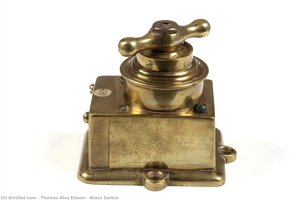
StatsBrass Switch

 Read More
Giclée / Art Print
Museum-quality giclée or canvas print with fast production and flexible finish options. ( Buy Hand Made Painting Switch to Digital Image)




































Pick from our preset sizes that match the artwork's original proportions.

Type the width and the height you need, to fit your frame or your wall. A print can only be cut, never made bigger than the picture, so a size with a different shape loses a part of the image. We send you a digital mockup to approve before we print anything. The picture shown on this page does not show the real cut — only the mockup does.
Worldwide Delivery () in 2 weeks instead of standard 4/5 weeks. (30 October)

Free Worldwide Express Shipping

High-Quality Linen Canvas

Full Shipping Insurance

Customs Tax Refund Guarantee

True Color Matching Guarantee

100-Day Return Policy (Defects Only)

100% Money-Back Guarantee

Bulk Discount Offer
 Glass option is only available in size under 110 CM

Brass Switch
Giclée / Art Print
Reproduction Size
-


Total Price
$ 65
Related Artworks


Artist Biography
Thomas Alva Edison: A Life of Innovation
Thomas Alva Edison (February 11, 1847 – October 18, 1931) was an American inventor and businessman whose inventions profoundly shaped the modern industrialized world. He is widely considered one of history’s greatest inventors.
Early Life and Education
Born in Milan, Ohio, Edison had a limited formal education due to a hearing impairment and his mother's decision to homeschool him. This early experience fostered his self-reliance and independent learning skills. He began his career as a telegraph operator, which sparked his interest in electrical technology.
Early Inventions & Menlo Park
Edison’s inventive spirit emerged early on. While working as a telegrapher, he developed devices to improve the efficiency of communication systems. In 1876, he established his first industrial research laboratory in Menlo Park, New Jersey – often called his “invention factory.” This marked a turning point, shifting invention from individual effort to organized scientific teamwork.
Major Achievements
- The Phonograph (1877): Edison’s phonograph was the first machine capable of recording and replaying sound. It revolutionized entertainment and communication.
- The Incandescent Light Bulb (1879): While not the *first* to invent a light bulb, Edison created a practical, long-lasting incandescent lamp and an entire system for electrical power generation and distribution.
- Motion Pictures: Edison played a pivotal role in developing motion picture technology, creating both the Kinetoscope (a viewing device) and the Kinetograph (a camera). His Black Maria studio was the first film studio.
- DC Generator: Edison’s ‘Long-legged Mary-Ann’ DC generator demonstrated his mastery of electrical engineering principles.
Botanical Research & Later Years
Later in life, Edison collaborated with Henry Ford and Harvey Firestone on botanical research at a laboratory in Fort Myers, Florida, seeking alternative sources for rubber production. He continued to innovate until his death, exploring areas like cement manufacturing and ore separation.
Influences & Legacy
Edison was influenced by the scientific advancements of his time and the practical needs he observed around him. He, in turn, profoundly influenced countless inventors and engineers who followed. His emphasis on systematic research and development established a model for modern industrial laboratories.
Historical Significance
Edison’s inventions transformed daily life, ushering in the age of electricity and mass communication. He held over 1,093 US patents (and many more internationally), making him one of the most prolific inventors in history. His work laid the foundation for numerous technologies we rely on today, cementing his place as a legendary figure in American innovation.

Thomas Alva Edison
1847 - 1931 , United States of America
Quick Facts
- Name: Thomas Alva Edison
- Birth Date: February 11, 1847
- Death Date: October 18, 1931
- Birth Place: Milan, United States of America
- Nationality: American
- Date Of Birth: 1847
- Date Of Death: 1931
- Notable Works:
- Phonograph
- Motion picture camera
- Electric light bulb
- Place Of Birth: Milan, United States of America