Preview
 Send
Send Share
Share
 Details
 Guide
Guide

 Download
 Similars
 X-Ray
X-Ray Diaporama
 Stats
StatsThe Pair Oared Shell


 Read More
Hand Made Oil Reproduction
Hand-painted oil on canvas in your size and frame, made to order by our artists. ( Switch to Print Switch to Digital Image)




P118B $10

P118H $10

P118W $10

P438Z $10

P508JH $12

P508YH $12

P805H $10

P805Z $10

P919BZ $10

P919G $10

P919XJ $10

P959ZH $10

P968JZ $12

W106C $8

W218G $10

W218JH $8

W218Y $10

W307PJ $10

W316G $10

W316PJ $8

W316Y $10

W398PJ $8

W4111J $10

W500HY $15

W500JH $15

W692G $12

W849H $8

W940BG $15

W953PJ $8




Pick from our preset sizes that match the artwork's original proportions.

Type the width and the height you need, to fit your frame or your wall. This is hand-painted, so for a size with a different shape the artist can paint a bit more around the picture, or cut a bit — you choose. We send you a digital mockup to approve before the painting starts. The picture shown on this page does not show the real result — only the mockup does.
After order, AllPaintingsStore.com team will email client for instructions and provide a mockup preview
Worldwide Delivery () in 3/4 weeks instead of standard 5 weeks. (22 October). No compromise on quality.

Free Worldwide Express Shipping

High-Quality Linen Canvas

Full Shipping Insurance

Customs Tax Refund Guarantee

True Color Matching Guarantee

100-Day Return Policy (Defects Only)

100% Money-Back Guarantee

Bulk Discount Offer
 Glass option is only available in size under 110 CM

The Pair Oared Shell
Reproduction Medium
Reproduction Size
-


Total Price
$ 258
The Quiet Rhythm of Effort: Exploring The Pair Oared Shell
To gaze upon Thomas Eakins's The Pair Oared Shell is to be invited into a moment suspended between exertion and profound tranquility. Painted in 1872, this work transcends a mere depiction of sport; it captures the very essence of shared human endeavor set against the backdrop of natural permanence. The scene unfolds on calm water, where two figures propel a long canoe, their synchronized effort forming a visual rhythm that is both meditative and powerful. Eakins, ever the unflinching observer of life's mechanics, renders this leisurely activity with an almost scientific precision, yet imbues it with a deep sense of soulful connection.
Mastery in Realism: Technique and Composition
Eakins’s command over oil on canvas is immediately apparent. The richness and depth achieved through his technique allow the viewer to feel the cool dampness rising from the water's surface. Notice, if you will, the masterful play of light; it catches the wood of the boat and glints off the placid surface, suggesting a subtle energy just beneath the calm veneer. Compositionally, the inclusion of the bridge spanning across the background is crucial. It acts not only as an architectural anchor, lending depth and perspective to the scene, but also subtly suggests connection—the link between two points, much like the bond between the rowers themselves.
Symbolism of Partnership and Passage
The symbolism within The Pair Oared Shell is wonderfully layered. The act of rowing itself speaks volumes about partnership; it requires mutual trust, synchronized timing, and shared physical commitment. The two figures are bound by the oars, their individual efforts merging into a single, graceful momentum. Furthermore, water has always been a potent symbol in art—representing the passage of time, emotional currents, and life's journey. Paired with the enduring structure of the bridge, the painting suggests that even moments of quiet leisure are part of a larger, continuous passage through life.
A Timeless Aesthetic for Modern Spaces
For those seeking art that speaks to both history and contemporary feeling, this piece offers unparalleled depth. Whether displayed in a formal study or a sunlit drawing-room, The Pair Oared Shell brings an intellectual gravitas alongside its serene beauty. Reproductions of this work allow collectors and designers to incorporate Eakins's celebrated realism into their décor. It is art that rewards close looking; one might spend hours tracing the musculature of the rowers or contemplating the subtle reflections on the water, finding a personal resonance within its quiet narrative.
Questions & Answers
How do medium and movement combine in "The Pair Oared Shell"?
"The Pair Oared Shell" is made in oil on canvas, in the Contemporary Realism style.
When was "The Pair Oared Shell" created, and to which movement does it belong?
"The Pair Oared Shell" by Thomas Eakins is dated 1872 and belongs to Contemporary Realism.
What is the recommended print size for "The Pair Oared Shell" by Thomas Eakins?
"The Pair Oared Shell" is recommended at a medium print size. Other sizes are available with the same proportions.
Related Artworks




Artist Biography
A Life Devoted to Reality
Thomas Cowperthwait Eakins, born in Philadelphia on July 25, 1844, stands as a monumental figure in American art—a painter of unflinching realism who dedicated his life to capturing the essence of human experience. He wasn’t merely interested in *representing* the world; he sought to dissect it, understand its anatomy, both physical and psychological, and then reconstruct it on canvas with an honesty that often bordered on provocation. Eakins's path was not one of immediate acclaim, but rather a slow burn of dedication, controversy, and ultimately, enduring recognition as perhaps the most profound realist in 19th and early 20th-century American art. His Philadelphia wasn’t a city of grand landscapes or romantic ideals; it was a world of doctors, rowers, hunters, and everyday individuals—and these were his subjects, rendered with an almost scientific precision.Early Influences and Artistic Formation
Eakins's upbringing fostered both intellectual curiosity and artistic inclination. His father, Benjamin Eakins, a writing master and calligrapher, instilled in him a love of discipline and meticulous observation. This foundation was further strengthened by his education at Central High School and the Pennsylvania Academy of the Fine Arts, where he excelled in drawing and anatomy—a fascination that would permeate his entire oeuvre. However, it was his time in Europe, particularly under the tutelage of Jean-Léon Gérôme in Paris, that truly shaped his artistic approach. Gérôme’s emphasis on precise draftsmanship and historical accuracy resonated with Eakins's own inclinations, but he quickly moved beyond mere imitation. A sojourn in Spain further refined his understanding of light, shadow, and the power of direct observation. He wasn’t content to simply copy Old Masters; he wanted to understand *how* they achieved their effects, and then apply that knowledge to his own unique vision. This period was crucial in solidifying his commitment to painting directly from life, a practice that would define his career.The Pursuit of Truth: Themes and Techniques
Eakins’s work is characterized by an unwavering commitment to realism—a refusal to idealize or romanticize his subjects. His portraits, numbering several hundred, are not flattering representations designed to appease the sitter; they are penetrating studies of character, revealing both strength and vulnerability. He painted individuals engaged in their professions – surgeons at work in *The Gross Clinic*, rowers straining against the current in *Max Schmitt in a Single Scull*—capturing not just their physical appearance but also the intensity of their focus and the demands of their craft. This dedication to truth extended to his technique. Eakins was fascinated by motion, and he employed innovative methods to capture it accurately. He studied anatomy meticulously, often dissecting cadavers to understand the underlying structure of the human body. He even experimented with photography, using it as a tool for analyzing movement and achieving greater accuracy in his paintings. His use of chiaroscuro—the dramatic contrast between light and dark—further enhanced the sense of realism and psychological depth in his work.Controversy and Legacy
Despite his artistic brilliance, Eakins’s career was marked by controversy. His insistence on painting directly from life, often including nude models, clashed with the conservative sensibilities of Victorian Philadelphia. His teaching methods at the Pennsylvania Academy were equally unconventional; he emphasized the importance of studying the human form from life and encouraged his students to challenge traditional artistic conventions. This led to friction with his colleagues and ultimately resulted in his forced resignation in 1886. Personal scandals further damaged his reputation during his lifetime, leaving him largely ostracized by the art establishment. However, Eakins remained undeterred, continuing to paint and teach privately until his health began to fail. After his death in 1916, his work gradually gained recognition, and he is now celebrated as a pivotal figure in American art history. His unflinching realism, his dedication to anatomical accuracy, and his profound understanding of the human condition continue to inspire artists and captivate audiences today. He left behind not just paintings, but a legacy of artistic integrity and a relentless pursuit of truth—a testament to the power of observation and the enduring beauty of the human form.Key Works and Enduring Influence
Several works stand as hallmarks of Eakins’s genius. *Max Schmitt in a Single Scull* (1871), with its masterful depiction of movement and light, is arguably his most iconic painting. *The Gross Clinic* (1875)*, though controversial at the time for its unflinching portrayal of surgery, remains a powerful testament to the dedication and skill of medical professionals. *William Rush and His Model* (1908) showcases his later style, blending portraiture with allegorical elements. Beyond these specific paintings, Eakins’s influence can be seen in the work of countless artists who followed him—those who sought to capture the world around them with honesty, precision, and a deep understanding of the human spirit. His commitment to realism paved the way for later movements such as Ashcan School and continues to resonate with contemporary artists today. He remains a vital force in American art, a reminder that true artistry lies not in imitation or embellishment, but in the courageous pursuit of truth.
Thomas Eakins
1844 - 1916 , United States of America
Quick Facts
- Full Name: Thomas Eakins
- Nationality: American
- Date Of Birth: 1844
- Date Of Death: 1916
- Place Of Birth: Philadelphia, United States of America
- Notable Artworks:
- Max Schmitt in a Single Scull
- The Gross Clinic
- The Swimming Hole
- The Agnew Clinic
- Artistic Movement Or Style: Realism
- Artists Who Influenced This Artist: ['Jean-Léon Gérôme']
- Artists Or Movements Influenced By This Artist: ['American Realism']
Related Articles

Thomas Sandby: Pioneering Watercolourist & Topographer of Georgian England
Explore the life & art of Thomas Sandby (1721-1798), a pioneering English watercolourist and architect. Discover his innovations, role in founding the Royal Academy, and lasting legacy at AllPaintingsStore.

Thomas Whitcombe: Navigating Light & Landscape – A Reassessment of Technique & Influence
Discover the captivating world of Thomas Whitcombe, a leading British marine painter. Explore his life, techniques, and enduring legacy with our expert analysis & guide for collectors.

Thomas Barker of Bath: Landscape Painting & Societal Reflection in Early 19th-Century England
Explore the life & work of Thomas Barker of Bath, a key figure in 19th-century English Romanticism. Discover his Parisian success, iconic paintings like 'The Bride of Death', and lasting artistic legacy. Learn more at AllPaintingsStore.

Thomas Pollock Anshutz: Capturing American Life with Realism & Reform
Explore the life & work of Thomas Pollock Anshutz, a key figure in American Realism. Discover his powerful paintings, influence on art education, and commitment to portraying everyday life with honesty and social awareness.
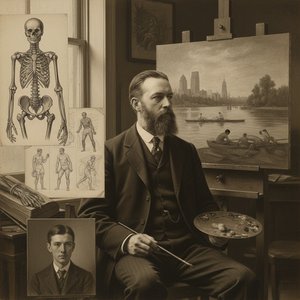
Thomas Eakins: Realism, Anatomy & the American Spirit – A Comprehensive Exploration of Life and Legacy
Explore the life & legacy of Thomas Eakins, a pivotal American Realist painter. Discover his groundbreaking techniques, anatomical precision, and iconic works like 'The Gross Clinic.' A comprehensive guide for art enthusiasts.